
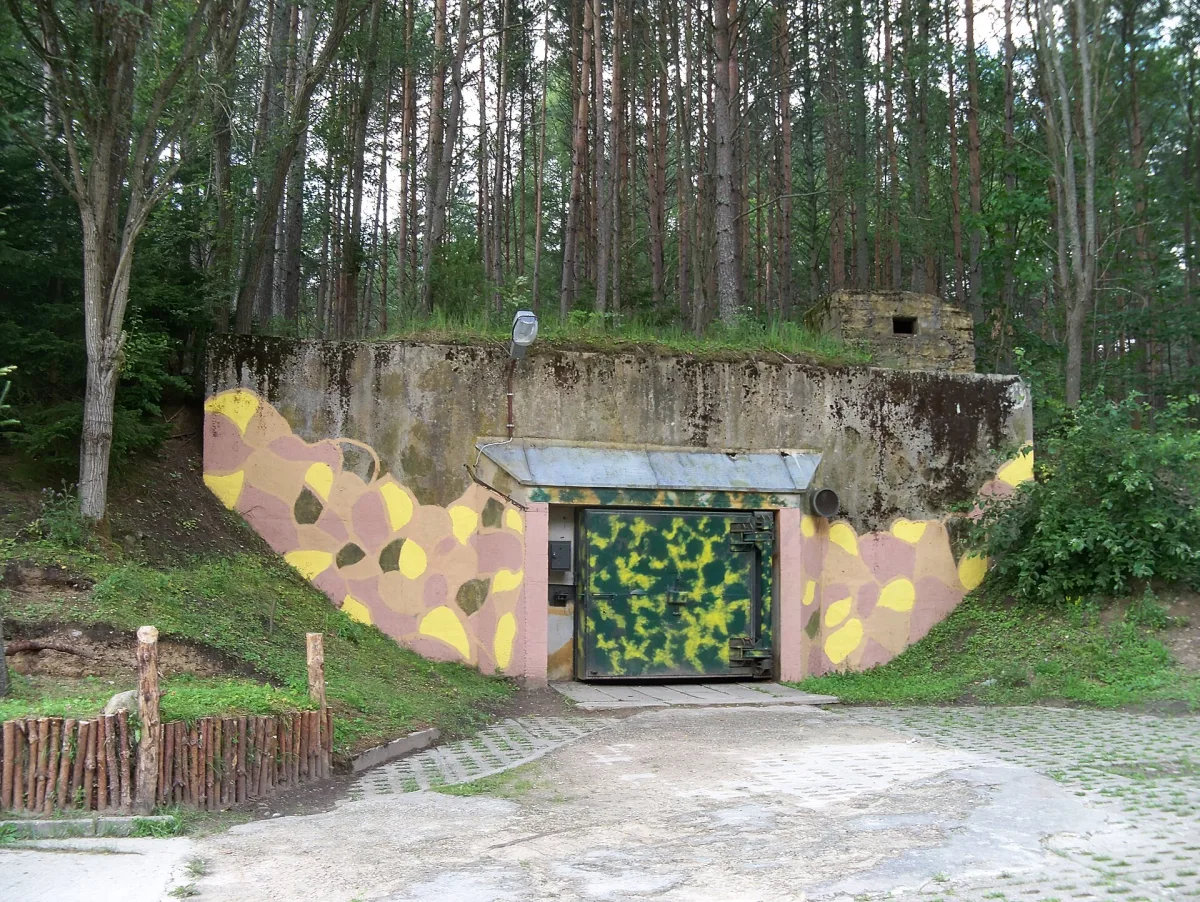
In the forests near Podborsko, in Tychowo municipality, Białogard County, stood a complex that was not on the maps. According to the Cold War Museum Podborsko 3001, a branch of the Museum of Polish Arms in Kołobrzeg, it was Object 3001, one of three Soviet nuclear weapons depots built in Poland. Below: where it came from, what it looked like and what became of it after the Soviet troops left.
The 1967 agreement and three depots
According to the museum, among the Warsaw Pact states only the Soviet Army could keep nuclear warheads in its permanent arsenal. In February 1967 in Moscow the authorities of the USSR and the Polish People's Republic signed an agreement on creating three base-depots of this kind of weapon on Polish territory. Podborsko near Białogard, Brzeźnica-Kolonia and Templewo in the Lubusz Land were chosen.
Wikipedia gives the depots numbers: 3001 in Podborsko, 3002 in Brzeźnica-Kolonia and 3003 in Templewo. According to the entry on Templewo, construction was carried out as part of an undertaking codenamed Vistula (not the same operation as the 1947 resettlement action), and according to the museum as part of an undertaking called Plan 3000. The location of the second depot is given differently: the museum places Brzeźnica-Kolonia near Borne Sulinowo, and Wikipedia near Jastrowie.
According to the museum, construction lasted more than two years. The finished facilities were handed over to the Soviet side and excluded from the country's territory, like the airfield in Bagicz. Until the early 1990s they were kept strictly secret and were guarded by elite airborne units.
Object 3001: the bunkers and the garrison
According to the museum, the complex in Podborsko covered more than 300 hectares. For over twenty years it was the place of service of a Soviet garrison of about 150 people. The warheads were stored in two bunker-depots, prepared for 160 in total, 80 in each. The museum notes that today it is not known exactly how many warheads were actually stored there. In the event of conflict, according to the museum, they were most probably to go to the Soviet airfields in Kluczewo and Bagicz.
At the turn of the 1970s and 1980s an additional shelter of the Granit type was built on the base, intended for a wheeled missile launcher. The museum writes that the character of the facility then changed from storage to storage and combat. A similar Granit-type shelter has survived in Brzeźnica-Kolonia. According to Wikipedia it resembles a huge concrete pipe, and its purpose is not known exactly: it probably served as a temporary hiding place for a vehicle carrying a warhead from the depot to the missile launch site.
In the vicinity of Borne Sulinowo, according to Wikipedia, shelters for mobile SS-20 missile launchers have also survived. For decades the town was the seat of a Soviet garrison, which is recalled today by the Museum of Military History. The garrison operated here from 1945 to 1992, and in the forest lies a Soviet cemetery with 344 graves.
The troops' departure and the life of the site after 1992
According to the museum, the last warheads were withdrawn from Podborsko most probably in 1988, and the Soviet soldiers finally left in autumn 1992, together with the unit from Białogard. Wikipedia records this more generally: the weapons were withdrawn before the end of the withdrawal of Soviet troops from Poland in 1993.
After the Soviet troops the site was used first by the Navy and then by the Prison Service. According to Wikipedia, in 2005 it was handed over to the Prison Service, which set up there an external branch of the remand prison in Koszalin. In 2015 the site was taken over by the Museum of Polish Arms in Kołobrzeg, and in September 2016 an exhibition of the Cold War Museum was opened in shelter no. 17.
Shelter no. 17 today
According to the museum, the interior has survived in an almost untouched state: there are installations for the crew, storage rooms and a transfer hall with still working equipment for moving the carts with warheads. The museum judges that the bunker-depots of Object 3001 are the only surviving relics of a nuclear arsenal in Poland. They are visited with a guide, who tells the history of the base and of the Cold War in West Pomerania; the rules of entry are given by the museum.
In the vicinity lies Lake Dobrowieckie Wielkie in Podborsko, with an area of 14.4 ha, with an unsupervised bathing area. Directions to the museum lead through the Dobrowo Closed Unit, that is, the former Soviet barracks complex.
Be the first! Add a comment.
You need to log in to add a comment.
Log in