
Three places and three dates in March 1945
The first act of Poland's Wedding to the Sea took place on 10 and 11 February 1920 in Puck and Wielka Wieś. In March 1945, during the Pomeranian operation, a similar ceremony was repeated three times on the western coast. According to Wikipedia, these were 15 March in Dziwnówek, 17 March in Mrzeżyno and 18 March in Kołobrzeg.
In Dziwnówek, according to the chronology in the Wikipedia entry, the ceremony was organised by soldiers of the 2nd Infantry Division of the 1st Polish Army, on the initiative of the commander of the 5th Infantry Regiment, Colonel Antoni Szabelski. In Mrzeżyno, according to the same entry, a lancer, Corporal Sochaczewski, took part. The entry on Mrzeżyno itself describes the wedding of 17 March 1945 as performed by soldiers of the 1st Warsaw Cavalry Brigade of the 1st Polish Army and calls it the first post-war one, which does not agree with the earlier date in Dziwnówek. Wikipedia does not resolve this discrepancy. At Mrzeżyno, at the mouth of the Rega, there is now Port Mrzeżyno, and the entry on the town lists a monument to Poland's Wedding to the Sea among its sights.
The Kołobrzeg version is the best known. According to Wikipedia, the rite was performed on 18 March by Corporal Franciszek Niewidziajło, a soldier of the 7th Infantry Regiment, chosen, as his entry states, because of his peasant background. He spoke words he had written himself about effort that had not gone in vain, and threw a ring into the waves. The same entry notes that interviews with him do not always correspond to historical truth, so details of the ceremony taken from accounts given years later should be read with caution.
The battle for Kołobrzeg, 4-18 March 1945
The Wedding to the Sea ended the battle for the city, which Wikipedia dates to 4 and 7-18 March 1945. According to that entry, Kołobrzeg was an important evacuation point and naval base in the German defensive system. Wikipedia estimates the defenders at about 10 thousand soldiers, supported by Kriegsmarine units, coastal and naval artillery, an armoured train and tanks. According to the same entry, the city also held many civilian refugees from Pomerania, with no figure given.
The actual siege began on 7 March with an attack by units of the 1st Polish Army, while on 4 March tanks of the Soviet 45th Guards Tank Brigade had made an unsuccessful attempt to take the city on the move. According to Wikipedia, there were more than 28 thousand Polish soldiers in the fighting. The general assault on the third ring of defences began on the night of 17 to 18 March. As Wikipedia states, part of the German forces was evacuated by sea, the rest were destroyed or taken prisoner, and there were about 8000 prisoners. Polish losses, according to the same entry, were 1206 killed and missing and about 2500 wounded. Wikipedia gives these figures without breaking them down by source, so they should be treated as an estimate.
The sources assess the scale of the city's destruction differently. The Encyclopedia of West Pomerania speaks of 95 per cent destroyed, while Wikipedia cites another source according to which almost 90 per cent of buildings lay in ruins after the war.
Where the ceremony took place in Kołobrzeg
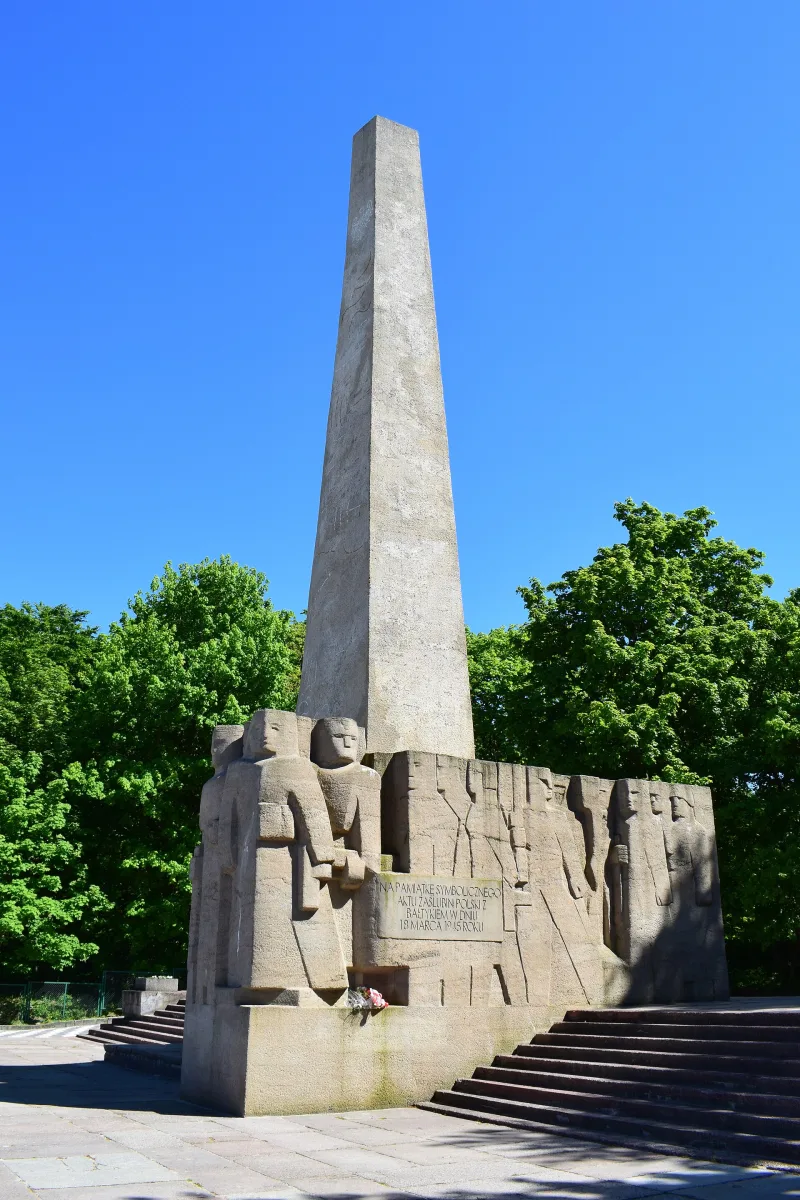
The inscription on the monument states that the historic act of the wedding took place on this spot on 18 March 1945. According to the Encyclopedia of West Pomerania this is untrue: the ceremony took place on the terrace of Ujście Fort, next to the ruins of the German lighthouse. Today's Kołobrzeg Lighthouse stands on that spot, and according to Wikipedia it carries a plaque commemorating the ceremony. The Wikipedia entry on the battle, on the other hand, says that the wedding took place after the fighting on the beach in Kołobrzeg, so the sources give two descriptions of the place: the terrace of the fort and the beach.
The monument of 1963
The Monument to Poland's Wedding to the Sea stands in the spa park by Jan Szymański Boulevard, between the entrance to the port and the pier. It was designed by Wiktor Tołkin, who according to Wikipedia is also the author of the monuments at Majdanek, in Stutthof and at Pawiak in Warsaw. The mosaics were made by Władysław Jackiewicz. The idea appeared in 1958, when a fundraising campaign was started and a competition announced. Wikipedia states that the monument was to stand on the site of the ceremony, but it was decided that this would be too close to the port, so the park was chosen, about 300 metres from it.
According to the Encyclopedia of West Pomerania, the foundation deed was laid on 17 March 1963, during celebrations of the anniversary of the capture of the city. A wedding ring belonging to Olga Lewicka, a resident of Kołobrzeg, was also placed in the foundation pit, in memory of her husband who went missing in the war. The monument was built through voluntary community work and unveiled on 3 November 1963, as both Wikipedia and the Encyclopedia report. Both state that a crowd of about 30 thousand gathered on the beach, and according to Wikipedia Franciszek Niewidziajło was among those present. The unveiling was performed, according to the Encyclopedia, by the Chairman of the Council of State, Aleksander Zawadzki.
According to the Encyclopedia, the structure is about 15-20 metres high and made of reinforced concrete. The base is covered with bas-reliefs showing Piast warriors and soldiers of 1945, above which rises a tower in the shape of a stylised flag, and the gap beneath the drooping sheet of fabric symbolises a window on the world. At the foot of the monument lie granite slabs with the names of the Polish and Soviet units that fought for Kołobrzeg and with the coats of arms of cities. One of the inscriptions on the monument bears the date October 1963, although the unveiling took place in November, as the Encyclopedia points out. According to Wikipedia, the monument was renovated in 2014, and a thorough renovation lasted from autumn 2024 to spring 2025.
Be the first! Add a comment.
You need to log in to add a comment.
Log in