
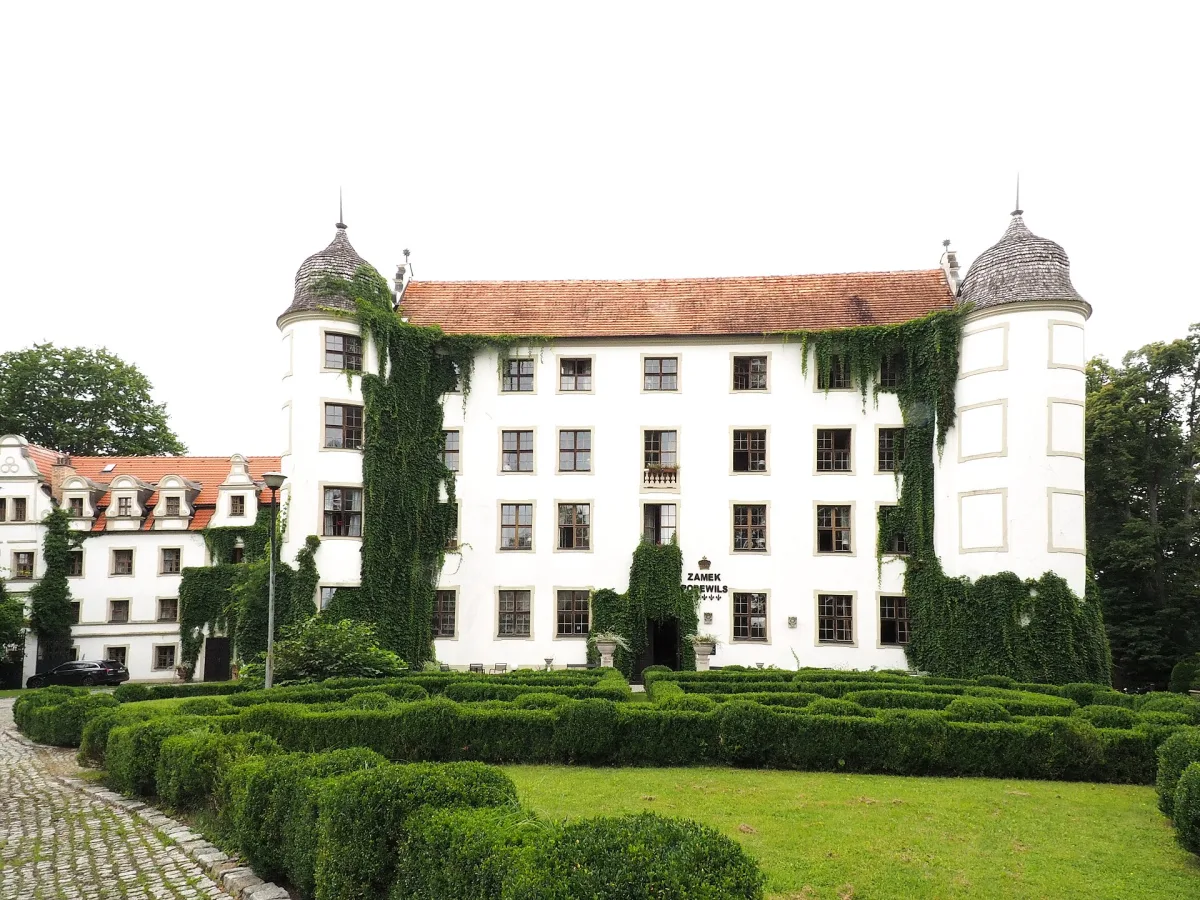
Krąg: the Podewils family on Lake Zamkowe
According to Wikipedia, the castle in Krąg stands directly on Lake Zamkowe and is one of the most interesting early modern residential complexes in Pomerania. The first mentions of the stronghold date from 1495. Adam von Podewils built it in the form of a residential tower surrounded by a moat. The tower was completely demolished, and in the 1580s a Renaissance residence was built on its site, on the initiative of Felix von Podewils. In the following centuries the building was rebuilt again in the 17th and 19th centuries, and the second change, neo-Renaissance, was the work of Karl Wilhelm von Riepenhausen.
The castle burned down in 1945. Until 1956 a forest district office and a school operated in the remains, in 1958-1960 the building was partly secured, but, abandoned, it fell into decay. In the 1970s rebuilding was begun for the needs of the forest district office, but it was stopped for financial reasons. In 1990 the castle was sold to a private owner, who carried out a renovation to the state before 1945, together with all the rebuildings. Today it houses a hotel.
Right next to it stands the Church of the Annunciation of the Blessed Virgin Mary, which according to Wikipedia was built in the 16th century, founded by Adam von Podewils, as a castle chapel. In 1696-1701 a burial chapel with carved sandstone slabs was added to it. It holds the Baroque sarcophagi of the brothers Henry and Adam von Podewils, the work of the sculptor Dawid Hasen. According to Wikipedia the sarcophagus of Henry dates from 1696, and that of Adam from 1699. The castle in Krąg itself can be viewed from the outside on the lake shore.
Tuczno: the Wedels and a Gothic fortress
The castle in Tuczno stands on a steep hill on the isthmus between Lake Zamkowe and Lake Tuczno. According to Wikipedia, in the 10th and 11th centuries there was a fishing settlement of the Pomeranians here, then a defensive stronghold that guarded the route from Człopa to Mirosławiec and Wałcz. In 1296 it was taken by Hasso von Wedel, the progenitor of the Wedel-Tuczyński family, who owned the town and castle in 1306-1739.
Construction of the masonry castle was begun in 1338 by Ludwig and Lamprecht von Wedel. The Gothic building had a trapezoid plan with sides of 28, 35, 36 and 39 m, with a courtyard surrounded on three sides by a brick wall up to 7 m high. According to Wikipedia, Emperor Charles IV named it in 1375 as one of the twelve strongest castles east of the Oder. In the 15th century the castle was besieged several times by the Teutonic Knights: on 18 August 1409 the Wedels defended it, but by 13 September they had to surrender. The Teutonic Knights held the castle until 1411, and in 1458 they burned it.
The Renaissance rebuilding came in 1542-1581, founded by Stanisław I Wedel-Tuczyński, who built a new building with corner towers. In 1608-1631 the castellan of Poznań, Krzysztof II Wedel-Tuczyński, added the south and west wings, and the castle took the shape of a palace horseshoe and lost its defensive features. After the deaths of the last Wedels in 1717 and 1739 the site passed to successive families and fell into decline. In 1945 it was partly destroyed, and in 1947 a fire destroyed it completely. It was rebuilt in 1966-1976 in the Renaissance-Baroque forms of the early 18th century.
According to Wikipedia, today it houses the Creative Work House of the Association of Polish Architects, with a conference centre, a hotel and a restaurant. The castle is surrounded by a landscape park with the ruins of blown-up bunkers of the Pomeranian Wall. On the same route as the castle in Tuczno lies the late Gothic Church of the Assumption of the Blessed Virgin Mary, and in the area the underground works of the Strzaliny nature reserve, also from the Pomeranian Wall.
Resko: the ruin of the Borck family
The Borck castle in Resko is today a ruin. According to Wikipedia, it began as a timber-and-earth structure of the knightly Borck family, and the masonry building was probably built in the second half of the 14th century. The heritage register dates the site to the turn of the 14th and 15th centuries. At the turn of the 17th and 18th centuries the stronghold was destroyed, and at that time its owners changed. A small rise with the stones of the former perimeter wall can still be seen today. The site was entered in the register in 1965. It is a ruin without interiors, so it is a place for a short walk.
The ruin is easily combined with a walk around the centre: about 200 m away stands the neoclassical town hall from 1830-1841, and next to it the late Gothic Sanctuary of Our Lady Immaculate. The Borck castle itself stands on Sportowa Street.
Płoty: two castles side by side
According to Wikipedia, the beginnings of the Old Castle in Płoty go back to the 13th century, when the castle hill was developed, and in 1465 the people of Kołobrzeg destroyed the castle here. From 1577 it belonged to the Blücher family, who rebuilt it as a Renaissance residence. In 1860 a fire consumed the castle. After the war it was rebuilt in the 1960s, and today it houses a public library and the Knights' Hall. The Old Castle stands on the Rega.
According to the entry on the town, the Ostens sold the old castle to the Blüchers in 1577, but stayed in Płoty and built a second, smaller one. Construction took place in 1606-1618. The entry on the New Castle itself gives the Eberstein family as the first owners, so the sources diverge on this matter. The castle was rebuilt in 1909-1911 as a neo-Baroque palace residence for Karl Bernard von Bismarck, to a design by Paul Korff of Laage. It housed the Pomeranian Library with about 300 volumes of manuscripts, founded by the chamberlain Friedrich Wilhelm von Osten. The furnishings were destroyed or dispersed after 1945. Today the right wing holds the meeting room of the town and municipal council and a wedding hall.
Pęzino: from the Hospitallers to the Borcks and the Puttkamers
According to Wikipedia, the castle in Pęzino was built at the turn of the 14th and 15th centuries by the Hospitallers, who from 1382 owned the village, acquired from the Borck family with the consent of Duke Warcisław V. In 1492 the castle passed to the Borcks as a hereditary fief of the Order, and around 1600 they turned it into a Renaissance residence. From 1680 it was managed by the Puttkamers. It is privately owned, but organises open days. In Pęzino a family residence grows directly out of a medieval Hospitaller stronghold.
Be the first! Add a comment.
You need to log in to add a comment.
Log in