
Rurka: the first commandery on the Rurzyca
The trail of the military orders between Chojna and Myślibórz begins in Rurka, a small village in the municipality of Chojna. According to Wikipedia, in 1244 the area was granted to the Templars together with the Banie land, and they built on an island in the Rurzyca a commandery consisting of a castle and a chapel surrounded by a moat. The National Heritage Board of Poland, whose description is quoted by zabytek.pl, gives earlier grants by Duke Barnim I in 1234 and 1235 and says that the brothers settled in Rurka in 1244. In the article on Swobnica, Wikipedia also dates the grant of the Banie land to the Templars to 1234, and in the article on Rurka to 1244, so even within Wikipedia the dates vary.
The Templar chapel in Rurka is a small, single-nave building with a straight-ended chancel, built of regularly dressed granite ashlar. Its dating also varies. Wikipedia writes of the chapel being consecrated in 1248, while according to the National Heritage Board of Poland the exact date of construction is not known, and the records allow it to be placed between 1244, when the brothers settled in Rurka, and 1248, when the Bishop of Kamień visited it. In 1261, according to Wikipedia, Bishop Hermann von Gleichen of Kamień issued in Rurka a foundation document for the commandery. After the dissolution of the Templars in 1312 the estates were taken over by the Hospitallers.
The National Heritage Board of Poland states that in 1373 the commandery was attacked and burned, and links this to a dispute between the Hospitallers and the von Wedel family. Wikipedia writes that the complex was burned by townspeople of Chojna and knights led by Wedel. The building then served as a granary, was converted into a distillery in the second half of the 19th century (around 1875, according to Wikipedia), and in the 20th century was used as a storehouse. According to the National Heritage Board of Poland, archaeological research and conservation work took place in 1995-2004, while Wikipedia mentions research in 1999. The chapel is privately owned and, according to the National Heritage Board of Poland, closed, so it is viewed from the outside.
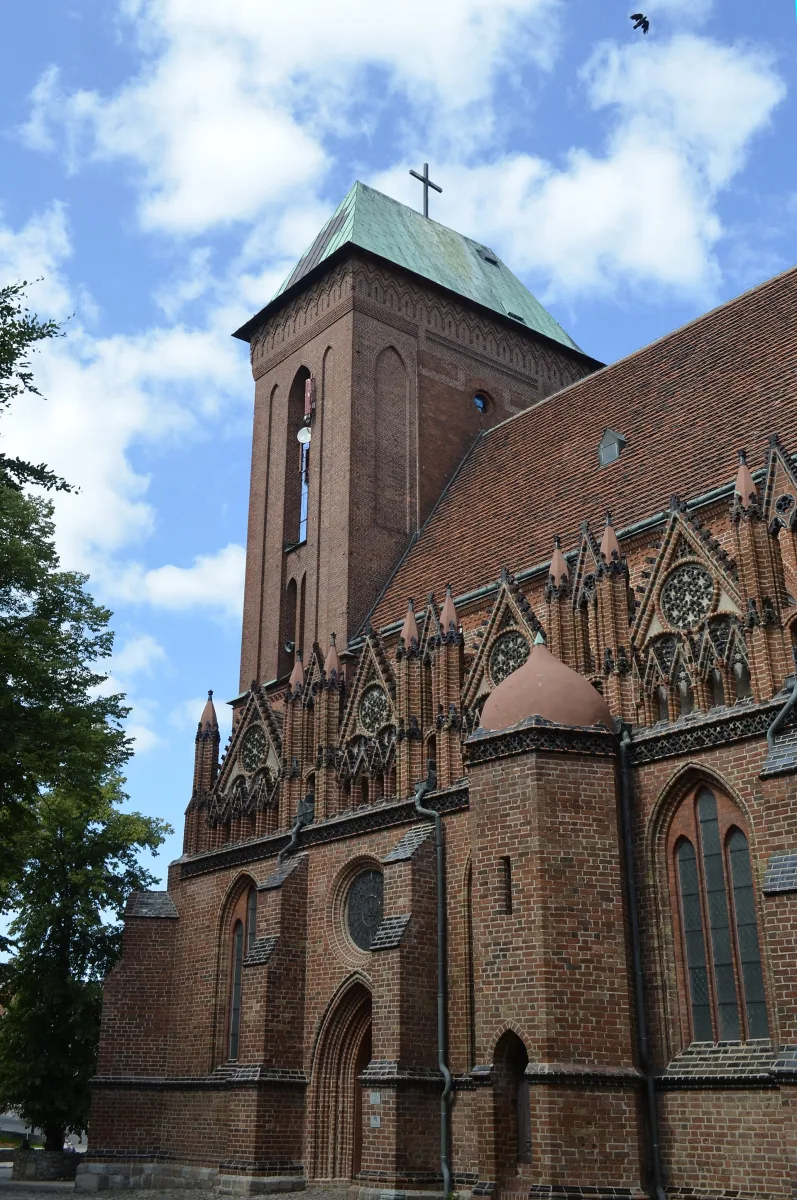
The village also has the neo-Gothic St Joseph's Church, built of brick in the 19th century. It is a much younger building than the monastic chapel, and a branch church of the Holy Trinity parish in Chojna.
Swobnica: the commandery moves to a lake
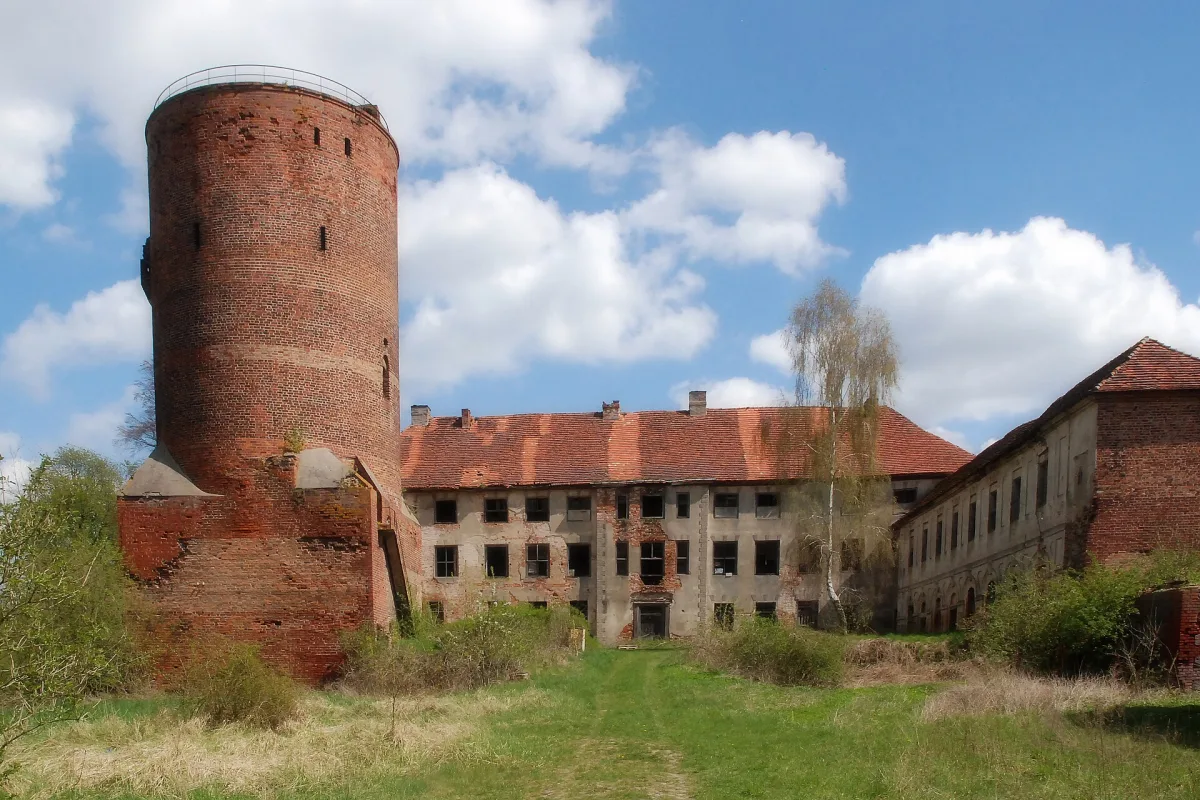
The next point on the trail lies in the municipality of Banie. According to Wikipedia these lands belonged to the Hospitallers from 1312, and in 1345 Swobnica is mentioned for the first time, becoming the seat of a commandery from 1377. The castle was built by the Hospitallers of the Bailiwick of Brandenburg in 1377-1382, with the consent of the Dukes of Szczecin, Swantibor I and Bogislaw VII. According to Wikipedia, in 1382 they moved the commandery here after townspeople of Chojna had captured and burned their castle in Rurka in 1373.
They chose a peninsula on Lake Grodziskie, surrounded by water on three sides and cut off from the land by a moat. According to Wikipedia the castle tower was 31 m high. The order was expelled from Swobnica after the Thirty Years' War, and in 1690 the castle was taken over by the Hohenzollerns of Schwedt. After 1945 it belonged to a state farm, in 2008 the north wing collapsed, and in November 2011 the owner handed the site over to the municipality of Banie. The castle is listed in the heritage register together with the park. The building itself is the castle of the Templars and Hospitallers on Lake Grodziskie.
The village also preserves an older trace of the orders: St Casimir's Church, built of granite ashlar and dated to the 13th century. According to Wikipedia it originally belonged to the Templars, and after the dissolution of the order it passed to the Hospitallers. In 1886 it was rebuilt in the neo-Gothic style, with a brick tower and a five-sided chancel added, and stained glass survives in the windows. It lies about 1.1 km from the castle.
Chwarszczany: a chapel with paintings from before 1400
The third point on the trail lies on the Myślibórz County side, in the municipality of Boleszkowice, near Kostrzyn nad Odrą. According to Wikipedia the form Chvartsane appears in 1232, when Duke Władysław Odonic of Greater Poland is said to have granted the Templars the village together with a thousand hides of land between the Oder, the Warta and the Myśla. The article notes, however, that it is uncertain whether the Kostrzyn land then belonged to Odonic or to Henry the Bearded, whom a 14th-century necrology of the Hospitallers names as the founder of the commandery. The question of the founder therefore remains disputed.
St Stanislaus Kostka's Church was originally a Templar chapel dedicated to St John the Evangelist. According to Wikipedia the first chapel was probably built in 1235-1262 and demolished around 1280, and the present one was built before 1280 in the style of reductive Gothic, raised by a Cistercian building workshop that was working on the monastery in Chorin. The hall building is 25.2 m long, 9.5 m wide and 13.6 m high, and two cylindrical towers stand at the west corners. The heritage register dates it to the second half of the 13th century. Wikipedia calls it one of the most valuable monuments of West Pomerania.
In the nave and chancel, polychrome paintings from around 1400 survive, attributed to a Hospitaller foundation: a frieze 2.75 m high showing apostles, St Christopher and holy virgins. According to Wikipedia, after 1945 the inhabitants painted them over as Teutonic, and an attempt at restoration in 1996 was abandoned for lack of funds.
One network of ties
The three places are linked not by proximity but by specific people and documents. According to Wikipedia, Bernard von Eberstein, the commander of Chwarszczany, had earlier been commander of Rurka, and in 1291 he appears with the title of preceptor of the order for Poland, Slavia and the Neumark. After the dissolution of the Templars in 1312 the margraves of Brandenburg seized their possessions, and in 1318 they confirmed the Hospitallers in possession of the order's estates. In 1433 the commander of Chwarszczany, Bruker, and the commander of Swobnica, Nickel von Thierbach, went together to the court of Duke Casimir V of Szczecin with a complaint against the Teutonic Knights. The commandery in Chwarszczany was taken over in 1540 by Margrave John of Küstrin, and the Hospitallers moved their convent to Świdwin.
The route is most conveniently covered by car, because the points are divided among several municipalities. The order is simple: the granite walls of the chapel in Rurka, viewed from the outside, the castle and church in Swobnica, and finally Chwarszczany with paintings from around 1400 that survived being painted over after 1945.
Be the first! Add a comment.
You need to log in to add a comment.
Log in