
Świdwin: the castle on the Rega and the only surviving gate
According to Wikipedia, the first mention of Świdwin dates from 1280, and the oldest town seal from 1296, when the Margraves of Brandenburg bought the whole Świdwin land from the bishops of Kamień and Margrave Waldemar granted the settlement town rights. The town lay on the route from Kołobrzeg into the interior, and in the 15th century it was on the Brandenburg side of the border with West Pomerania.
Świdwin Castle stands on the left bank of the Rega. According to Wikipedia, it was built in the 13th century to protect the trade routes from the Baltic southwards and from Szczecin to Białogard. The description of the site says that the first castle was built at the end of the 13th century at the foundation of the Margraves of Brandenburg, and that the castrum proper was begun in the early 14th century by the Wedel family. In 1384 they sold it to the Teutonic Order as the seat of a bailiwick, and in 1445 it was bought by Elector Frederick II of Brandenburg. The heritage register dates it to 1382-1455. The castle owes its name to the Knights Hospitaller: according to Wikipedia they had a commandery here from the 16th to the 19th century, and the description of the castle gives 1540 as the start of their presence and 1808 as the year the commandery was dissolved. In the 18th century, on their initiative, the castle was given a Baroque remodelling. After 1945 it was devastated and burned down, and it was rebuilt in 1962-1968. Today it houses the Świdwin Cultural Centre, the town library, a cinema and a tourist information office.
Of the town's fortifications, which according to Wikipedia were built from 1319, two elements have survived. The Stone Gate, from the 14th century, was one of three town gates and the only one to survive to this day. According to the same entry it was rebuilt in 1475, and in 2002 it was fitted with a door in the Gothic style weighing almost two tonnes. The second trace is a fourteen-metre stretch of walls by the Rega.
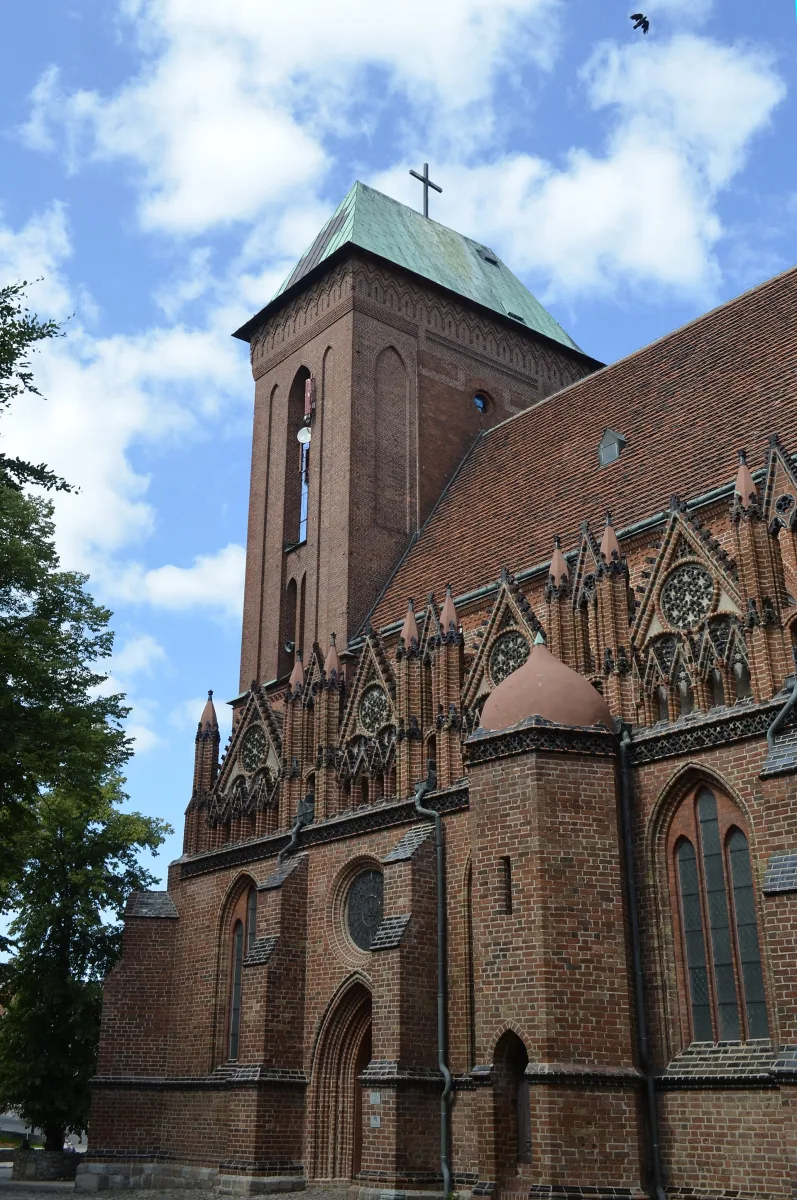
Among the town's churches the oldest is the Church of Our Lady of Perpetual Help, a Gothic basilica of dark brick. Wikipedia dates its construction to 1338, the heritage register to the turn of the 14th and 15th centuries. From 1538 the church was Protestant, and in 1689 a fire in the town burned the roofs and interior, so that only the walls remained, rebuilt within three years. After 1945, following serious damage, it was taken over by the Catholic Church and consecrated on 21 December 1947. Younger is the Neo-Gothic Church of St Michael the Archangel: consecrated on 24 December 1945, with a tower added in 1983 to a design by the Koszalin architect Jerzy Bindulski.
Białogard: the 1299 charter and a castle of which the cellars remain
The charter of Białogard is dated more precisely. According to Wikipedia, on 2 August 1299 Duke Bogislaw IV granted the already existing settlement a charter under Lübeck law. In 1307 the town received staple rights for all goods, in 1315 Duke Wartislaw IV moved the ducal residence here from Anklam, and it existed until 1321, and from 1386 Białogard belonged to the Hanseatic League.
In 1315, according to the zamki.pl website, Wartislaw IV built a brick castle on a hill above the Parsęta, on the site of an earlier stronghold. It burned down in 1526 and was rebuilt in 1535-1541, and in 1780 it was demolished. The remains of the castle today are the walls of cellars with deep niches and a walled-up entrance on the courtyard side.
The counterpart of Świdwin's Stone Gate is the High Gate, also called the Połczyn Gate, on Grottgera Street. According to Wikipedia it was built together with the town walls in the early 14th century of brick, on a stone foundation, with two storeys: the lower one has a pointed-arch passage, the upper one blind windows and a frieze. Until the end of the 19th century it served as the town jail and the caretaker's flat, later it housed a regional museum, and today it is the seat of Białogard's artists. It is the only one of the two former gates to survive.
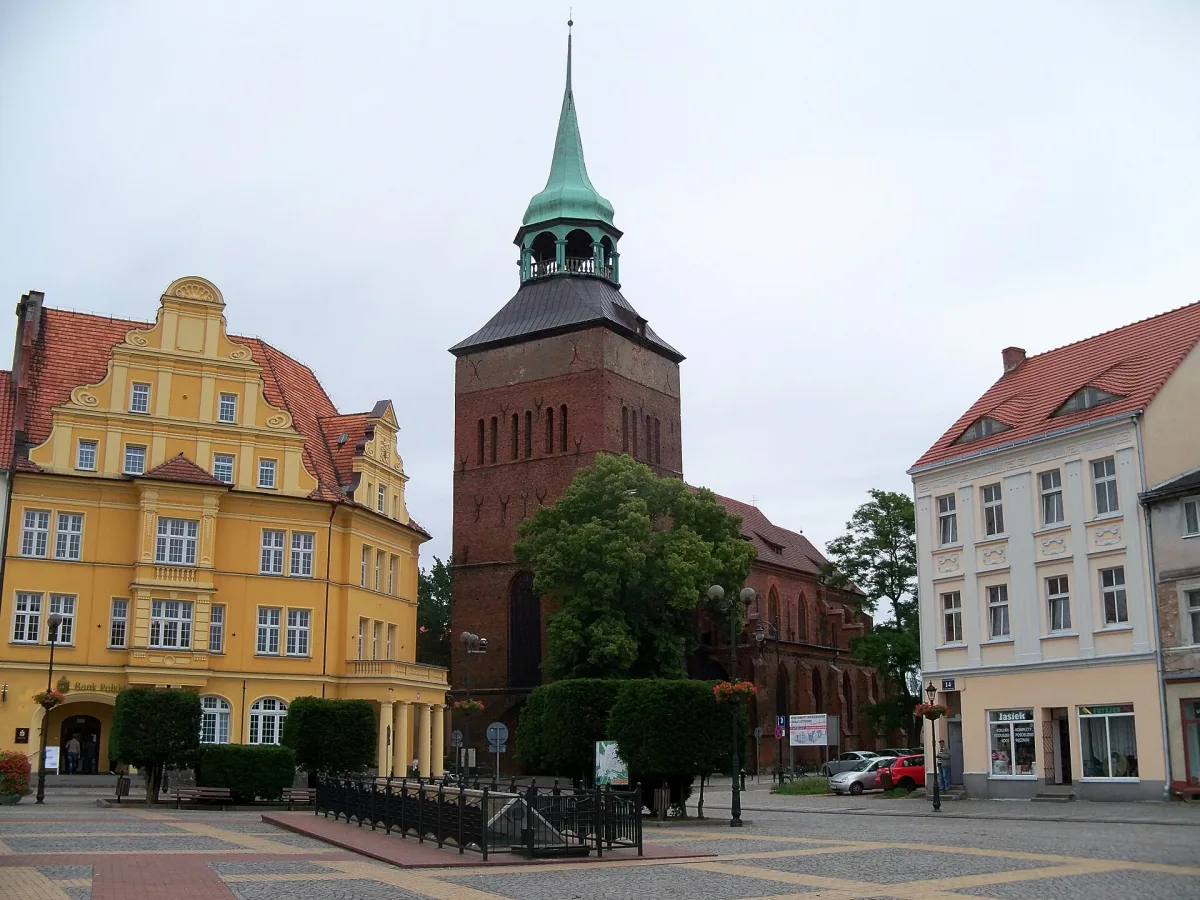
Around the market square stand buildings from different periods. The Church of the Nativity of the Blessed Virgin Mary is, according to Wikipedia, a brick three-aisled church from the early 14th century, built during the construction of the walls. The high altar dates from the early 18th century, the pulpit from 1688 and the organ from 1775. The medieval town hall standing in the middle of the square was pulled down in 1847. It was replaced by two buildings: the Old Town Hall, a Neoclassical merchant's townhouse of 1827 with a wooden clock tower of 1847, today the seat of a museum, and the brick New Town Hall, opened in 1924. The year of completion is not certain: according to the heritage records work began in 1923, while the head of the local grammar school gave the year 1926. Outside the square, on Świdwińska Street, stands the Gothic Church of St George of the 14th century, a former chapel and leper house and, until 1945, a Protestant cemetery chapel. It was consecrated as a Catholic church on 14 May 1947.
The battle of the cow of 15 July 1469
An event links the two towns that the sources call the war of the cow, the battle of the cow or the cow war. According to Wikipedia it was a quarrel between the inhabitants of Świdwin and Białogard that grew into an armed clash. Historical publications place it against the background of relations between Brandenburg, to which the Neumark then belonged, and the Duchy of Pomerania. According to a Wikipedia entry, Poland acted at that time as a mediator, and in 1468 a war broke out of which this battle was an episode.
The course is described by the entry on the war of the cow, which draws on Edward Rymar's work on the Pomeranian-Brandenburg wars and disputes. The people of Białogard, under the bailiff Karsten of Oparzno, marched armed on Świdwin, and the people of Świdwin were commanded by Krzysztof Poleński, according to Rudolf Virchow Krzysztof Polencki, son of the bailiff Jakub. The clash took place near the village of Łęgi on the Pomeranian-Neumark border. The people of Świdwin won. According to the infobox of that entry, Białogard lost 300 killed, 100 prisoners, the town banner and 300 wagons of booty; the strength of the sides is given as unknown. These are figures from a single study, with no second source.
What the dispute was about is not clear. In the infobox of the entry the cause is given as “a dispute over a cow”, with a question mark. The entry on Świdwin describes the battle as a clash of townspeople over a herd of cows, and the entry on Białogard speaks of a quarrel that went down in history as the war of the cow. The entries therefore do not even agree on whether it concerned a single animal or a herd.
The memory of the clash is kept alive by an event that has been organised since 1969, the 500th anniversary, by the two towns in turn, in June. The mayors of both towns organise skill contests referring to the Middle Ages: cutting down a wooden bear with an axe, archery and axe throwing at a target. For a year the winner holds the cow's horns, and the festival ends with a feast at which Białogard supplies the beef and Świdwin the beer. According to Wikipedia, the initiator was Leon Zdanowicz of the Świdwin County House of Culture.
Be the first! Add a comment.
You need to log in to add a comment.
Log in