
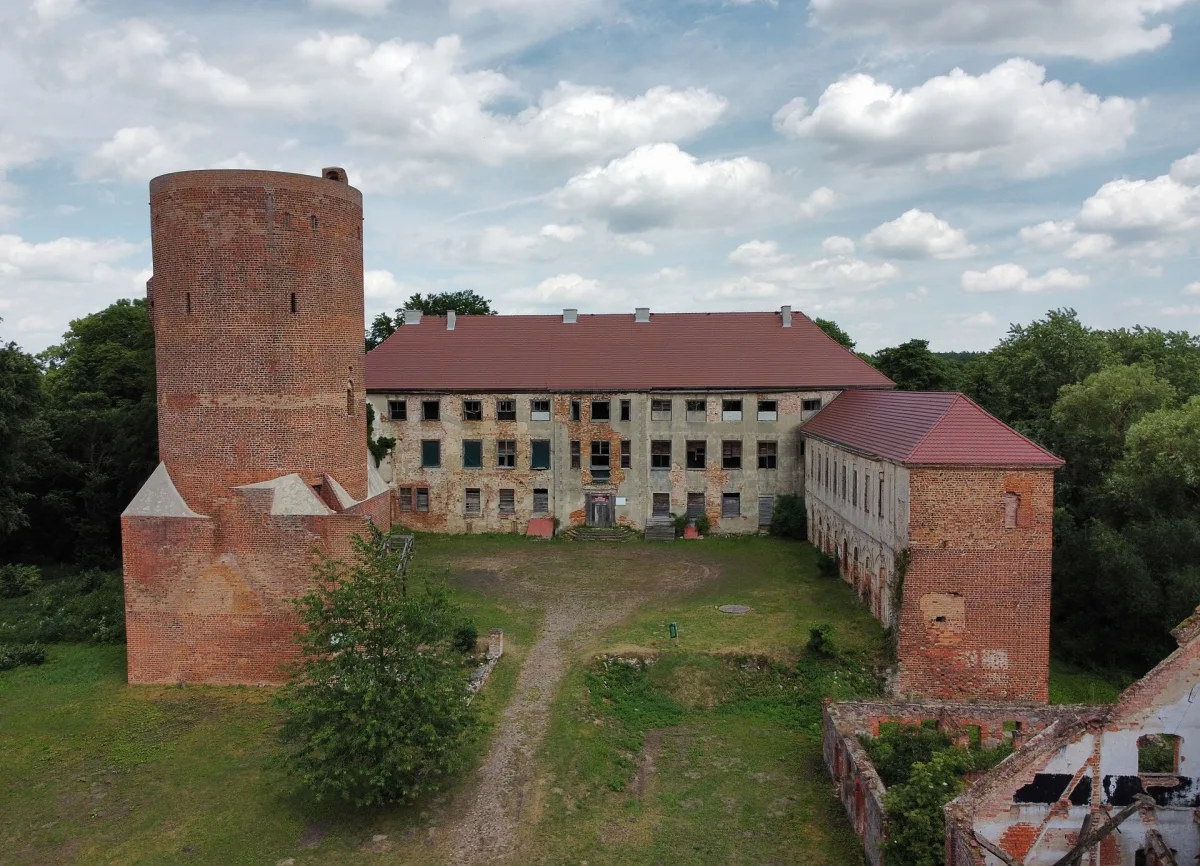
A castle on a peninsula of Lake Grodziskie
The castle in Swobnica, called Schloss Wildenbruch in German documents, was built according to Wikipedia by the Hospitallers of the Bailiwick of Brandenburg in 1377-1382. Permission to build was issued in 1377 by the dukes of Szczecin, Swantibor I and Bogislaw VII. Wikipedia speaks of a commandery, that is, the seat of a Hospitaller community, which moved here in 1382 after the castle in Rurka was burned by townspeople from Chojna in 1373. Rurka and its Templar chapel had been the Order's earlier seat. The entry on the village itself gives it slightly differently: the castle was built after 1377, and from that year Swobnica was the seat of the commandery. As the first commander at Swobnica, Wikipedia names Henryk von Güntersberg, who settled here five years after the permission was issued.
A peninsula of Lake Grodziskie was chosen for the building. It was surrounded by water on three sides, and from the west a moat cut it off from the land. Beyond the moat lay an economic outer ward, defended by a second water-filled ditch 25 m wide and by timber-and-earth fortifications. Wikipedia describes the castle as a three-wing structure on a square plan with sides of 50 m, with an inner courtyard.
Brick, the tower and the commander's house
According to Wikipedia, which here relies on the Lexicon of Castles in Poland, the brick walls on a stone foundation reached from 15 to 18 m, and at the top a crenellated gallery ran around them. On the north side stood a short residential house with a cellar, in which the upper floor was probably occupied by a chapel (mentioned in 1420), an armoury and living rooms. In a corner stood a massive tower, a bergfried, originally 31 m high. The lower part had a square plan with sides of 12.3 m and held a deep prison dungeon, while the upper part, about twenty metres high, was round and crowned with battlements and a brick pyramid or cone. The gate was placed in the west wall, close to the tower.
In the 15th century a Gothic wing was added along the whole east curtain wall, with a treasury and the commander's apartment. Wikipedia notes that at that time the tower may also have been raised so that firearms could be used from it. The south wing was built in the 15th or at the end of the 16th century. The entry on Swobnica states that the castle had windowless perimeter walls, and in the courtyard by the north wall stood a building with a chapel of two bays.
The end of the Order and a Baroque residence
The Order was removed from Swobnica after the Thirty Years' War, according to Wikipedia in 1648. In 1690 the castle was taken over by the Hohenzollern family of Schwedt, which according to this entry held it until 1945. The entry on the village, on the other hand, says that in the 18th century the castle and the village belonged to Swedish dignitaries, and later to Prussia. Wikipedia does not explain how these two descriptions can be reconciled.
In 1730 the castle was rebuilt in the Baroque style and turned into a hunting residence. The north and south buildings were then demolished, and on the site of the oldest Gothic house a palace range with an axially marked entrance was built. Work was also carried out here in the 19th century. A lithograph of 1846, which Wikipedia gives in the gallery of the entry, dates from this period.
During the Second World War, according to Wikipedia, the monument to Frederick II the Great from Szczecin was kept in the castle. In 1945 the castle was damaged. After the war, capitals from Kołbacz, Nowogard and Szadzko were also found here, along with Renaissance tomb slabs with portraits of Philip I and Barnim IX with his wife.
A state farm, ruin and takeover by the municipality
In the time of the Polish People's Republic the castle complex belonged to a state agricultural farm. The main body served as a granary, and the other rooms as flats and offices. According to Wikipedia, the castle was devastated in 1954, and the park gradually turned into a dense forest. In 1992 the castle was bought by a Dutch entrepreneur. In 2008 the north wing collapsed.
In November 2011 the owner handed the neglected castle over to the Banie municipality, thanks to the work of the Society of the Swobnica Castle, which according to Wikipedia made it possible to begin renovation. The main part of the castle was given a new roof in 2012, and in autumn 2013 the renovation of the medieval tower was completed. The Castle of the Templars (Hospitallers) has been entered in the heritage register since 31 March 1957 under number A-760, and under the same number in 1980 the park with its horse chestnut avenue was added. A cobbled avenue planted with lime trees and horse chestnuts leads to the castle.
The church and neighbouring commanderies
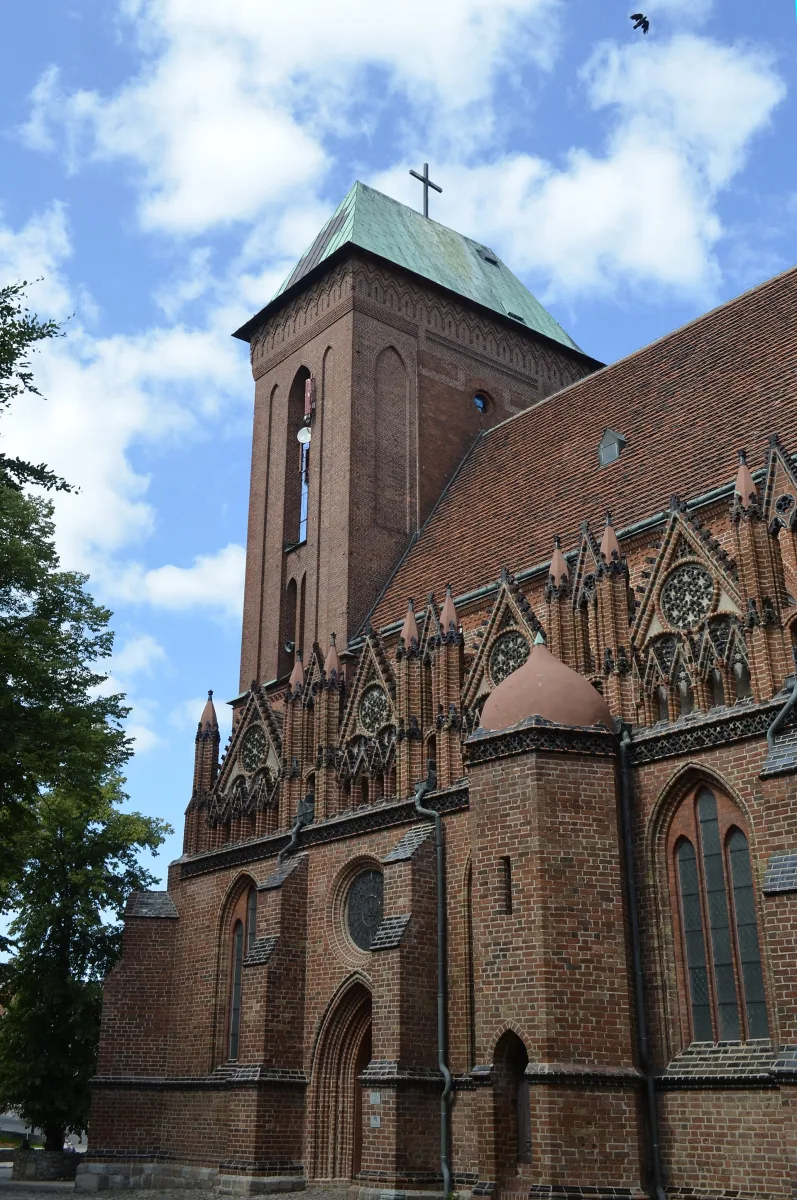
The village also has the Church of St Casimir, built of granite ashlar in the 13th century. Wikipedia states that it was rebuilt in the neo-Gothic style, but the year differs: 1886 according to the entry on the church and 1896 according to the entry on the village.
The castle in Swobnica was a model for other buildings of the Order. According to Wikipedia, the castles in Łagów and Swobnica served as the model for the castle in Pęzino, which the Hospitallers built at the turn of the 14th and 15th centuries. The castle in Pęzino remained privately owned, and the families of Borck and Puttkamer remodelled it over the following centuries. A trace of the former commanderies is also the church in Chwarszczany, originally a Templar chapel, with polychromes from about 1400 attributed to a Hospitaller foundation.
Be the first! Add a comment.
You need to log in to add a comment.
Log in