
The Battle of Cedynia is one of the most famous clashes in the history of the early Piasts, and at the same time one of the most poorly documented. According to Wikipedia, it took place on 24 June 972, and news of it has survived in two accounts: in the chronicle of Thietmar of Merseburg and in the Life of St Adalbert (Wojciech), written by Bruno of Querfurt. Everything that is known today about its course rests on these scant notes and on the findings of archaeologists.
What Thietmar recorded
The sides of the clash were the forces of Duke Mieszko I and of Margrave Hodo of the Lusatian March, who was assisted by Siegfried of Walbeck. Wikipedia describes Hodo's expedition as a private undertaking of German magnates, contrary to Mieszko's earlier agreements with Emperor Otto I. The margrave's units were said to have set out from Magdeburg and passed through the lands of the Veleti and the Obotrites, who remained neutral. The motives for the invasion are a hypothesis for historians: it may have been to halt Mieszko's growing state, or to protect a sphere of influence that Hodo counted the Veleti as part of.
According to Wikipedia, the chronicle gives the name of the place in Latin transcription as Cidini. Further details of the course are a reconstruction by historians: Mieszko was said to have divided his forces, part of the infantry feigned battle and withdrew towards the stronghold, and hidden cavalry came round behind the enemy. According to Wikipedia, the battle began on the day of St John the Baptist, that is, 24 June. Czcibor, Mieszko's brother, commanded part of the forces and tipped the balance of victory, and only Hodo and Siegfried escaped the rout, with a small group. According to Wikipedia, the exact size of the forces is unknown.
The consequences were more modest than the memory of the battle suggests. The emperor summoned both opponents before his court, and Mieszko was found guilty of breaking the peace and gave his son Bolesław as a hostage, who arrived in Quedlinburg in 973.
Where Cidini lay
The location of the battle was for centuries a matter of dispute, and Wikipedia notes that there is no certainty to this day. In the 18th century Adam Naruszewicz identified Cidini with Szczecin. Some earlier researchers looked for the place on the left bank of the Oder, pointing to Zehdenick or Zeuthen. Carl Friedrich Dingelstädt came out in favour of Cedynia, that is, the old Zehden in the Neumark (New March), and Caspar Abel considered places named Citen near Chorzyn and on Lake Myślibórz. Gelasius Dobner placed the site in Lower Lusatia.
The argument for Cedynia rests, among other things, on the river Muglitzia, that is, the eastern arm of the Oder called Mglica, which according to Wikipedia flowed at the foot of today's Cedynia. The entry on the battle adds that after the Second World War, especially from the second half of the 1950s, the view of a location at Cedynia became established, and in 1945-1989 it was dominant. Today, as Wikipedia writes, the vast majority of researchers point to Cedynia. The entry on the town itself speaks of a stronghold taken over by Mieszko around 960 and developed as a border fortress.
Cedynia and its stronghold
On a rise above the Oder valley stood a fortified Slavic settlement. The Hillfort in Cedynia is the remnant of a stronghold from the 9th to 12th centuries, surrounded by ramparts, with a fragment of a reconstructed palisade. The archaeological data from the excavations were gathered by the National Museum in Szczecin, and their results can be seen in the Regional Museum in Cedynia, which is housed not far from the hillfort on Wolności Square. The permanent exhibition shows objects from the epochs from the Stone Age to the Iron Age, and separate displays concern the battle of 972 and the crossing of the Oder in 1945.
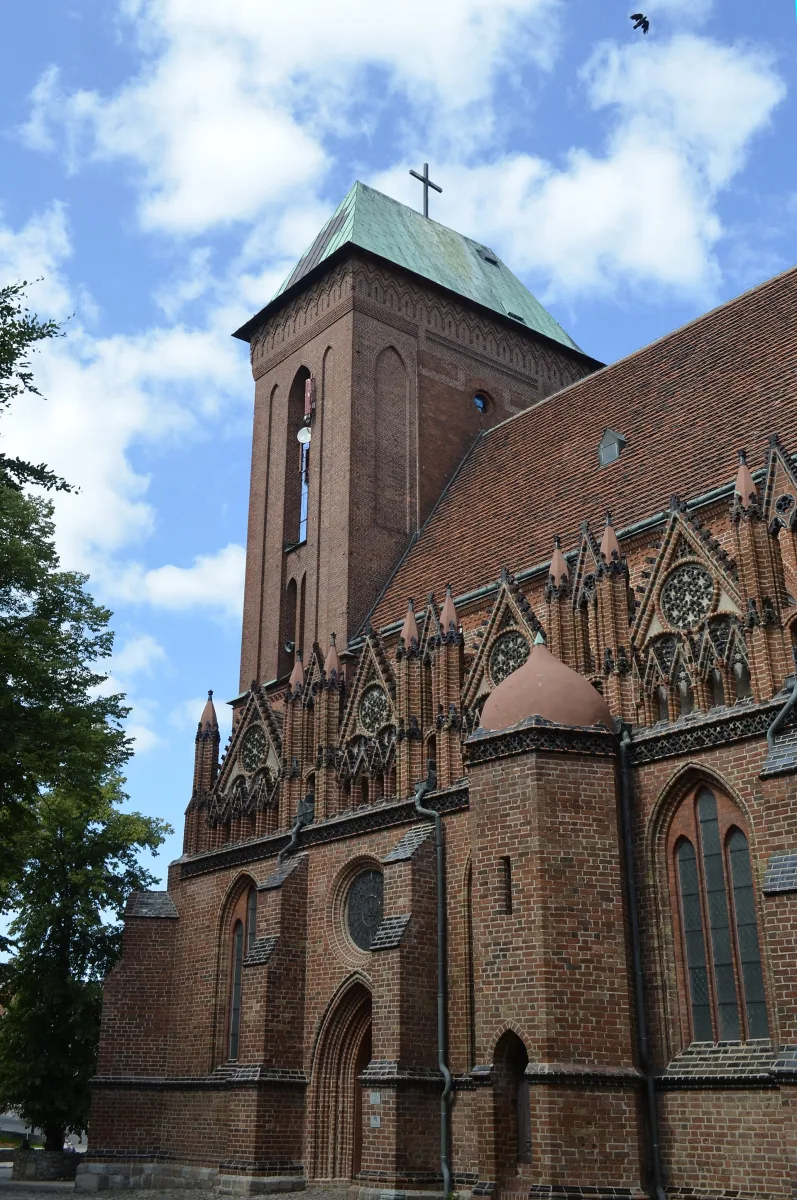
The town also has later monuments. The Wikipedia entry on Cedynia states that it received town rights in 1299, and that a convent was founded here in 1266. The Cistercian Nuns' Convent stands on a hill, and the heritage register gives 1278 as the date of its founding, so the dates in the two sources do not match. In 1945 the building burned down, and it was rebuilt in 1997-2005. Next to it stands the Church of the Nativity of the Blessed Virgin Mary, a granite building from the second half of the 13th century, remodelled in the Neo-Gothic spirit in 1898-1900. The town hall dates, according to Wikipedia, from 1840.
Czcibor Hill and the monument of 1972
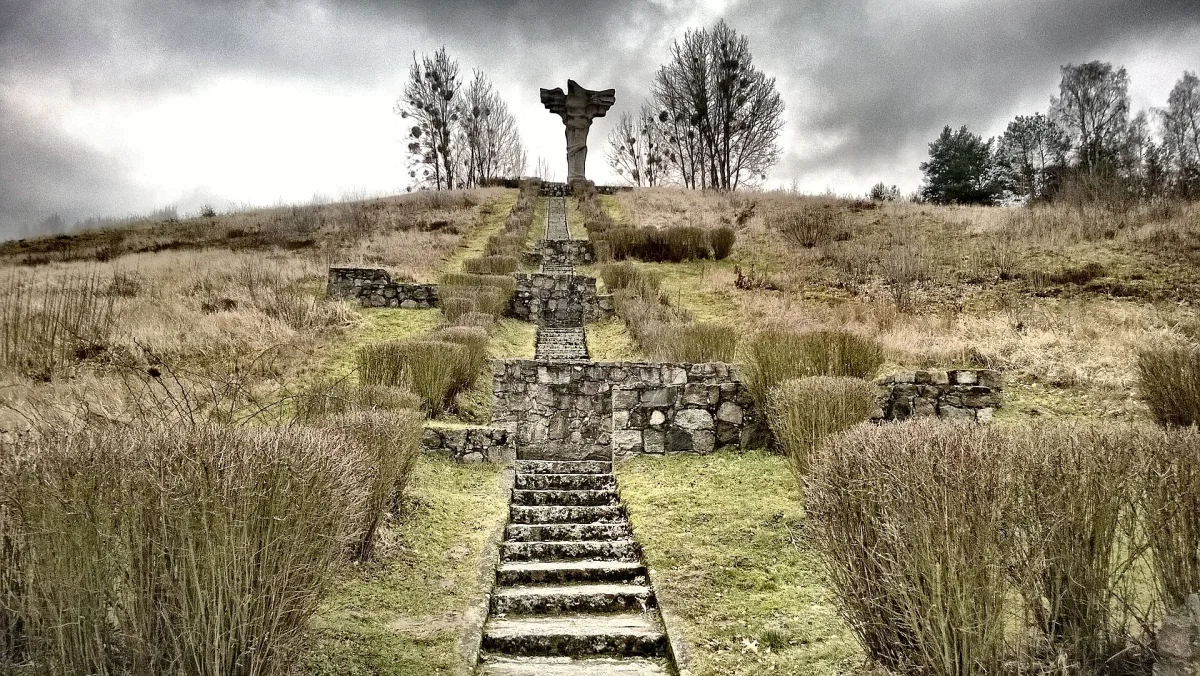
The monument to the battle does not stand in Cedynia itself. Czcibor Hill is a moraine rise in the Cedynia Carpathians (Karpaty Cedyńskie), 54.5 metres high, about 4 kilometres south-west of the town, a few hundred metres east of Osinów Dolny. 270 stone steps lead to the top. The name comes from Czcibor, and according to Wikipedia the name is also linked to a discovery made by the archaeologist Władysław Filipowiak of hearths dated to 920-970, which may have served Czcibor's warriors. The entry recalls that according to Thietmar's chronicle Czcibor attacked Hodo's forces from a hill near the stronghold of Cidini.
The monument was unveiled on 24 June 1972, on the thousandth anniversary of the battle. Wikipedia calls it the Monument to the Polish Victory on the Oder, describes it as a 15-metre stylised eagle taking flight, and names as its authors the Szczecin sculptors Czesław Wronka and Stanisław Biżek. By the steps stand plaques in four languages: Polish, Russian, English and German. At the foot of the hill there is a mosaic depicting the battle, made in 1972 by Jerzy Chmielewski and Kazimierz Błonka. From the top the Oder valley is visible.
Wikipedia also recalls that after 1945 the battle became a symbol of Poland's link with the Recovered Territories, and the celebrations of the millennium in 1972 were the culmination of this tradition. It quotes the historian Jan Maria Piskorski, according to whom the post-war myth of Cedynia, in which Mieszko and Czcibor defended Poland against the German Drang nach Osten, came loose from its source basis.
Nature around the battlefield
The area around Cedynia lies within Cedynia Landscape Park. Two nature reserves show what the slopes of the Oder valley look like. Bielinek nature reserve protects forest-steppe communities with the only site of downy oak in Poland, and Wrzosowiska Cedyńskie is a steppe reserve about 3 kilometres from the town, opened to visitors in 2016, with a path up the hill and a viewing platform.
Be the first! Add a comment.
You need to log in to add a comment.
Log in