
Over the centuries the Bishops of Kamień changed the places from which they governed their estates. Their cathedral was in Kamień Pomorski, but their lands stretched from Golczewo to the area around Koszalin and Karlino. Below are the successive seats, each with what the sources say about it, and with the points on which the sources diverge.
Karlino: a castle in the fork of the Parsęta and the Radew
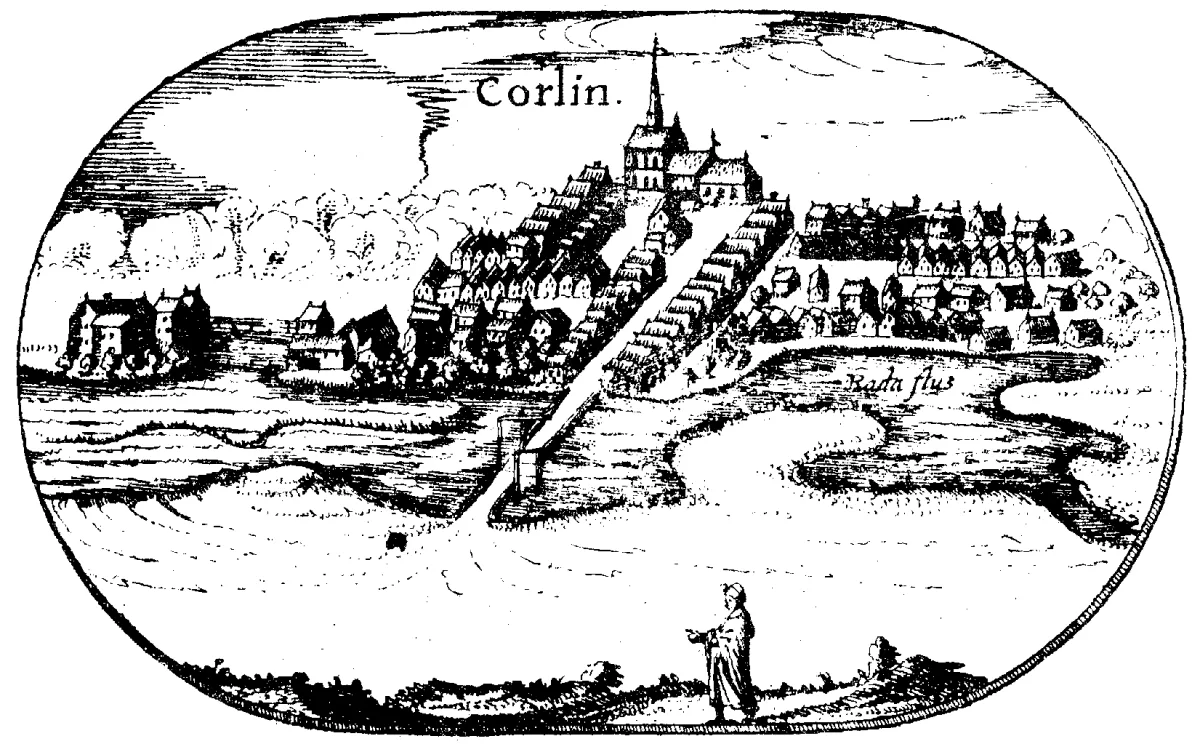
According to Wikipedia, the area around Karlino belonged to the Bishops of Kamień from about 1280, as an inheritance from Warcisław III. In 1308 Bishop Henryk von Wacholz used the phrase “castrum nostrum Corlin” in a document, meaning “our castle in Karlino”. The entry on the town adds that at that time it was a small, wooden stronghold in the fork of two rivers, the Parsęta and the Radew.
The date of the move of the episcopal seat here diverges within Wikipedia itself. The entry on the castle gives the year 1370: at that time the episcopal seat was supposedly moved from Kamień to Karlino and a decision was taken to build a defensive castle. The entry on the town gives the year 1372 and adds that Bishop Filip von Rehberg borrowed money for the construction from the town council of Słupsk. The two entries agree on what followed: in 1385 Karlino received town rights under Lübeck law, and from the 1380s most of the Bishops of Kamień lived here.
The castle did not have a quiet history. According to Wikipedia, in 1409 Karlino was burned and plundered, and in 1481 the town and castle were burned by townspeople from Kołobrzeg and Koszalin (the entry on the town speaks of the people of Koszalin, who had rebelled against the bishop). After compensation was paid the castle was rebuilt, and according to the entry its expansion continued until 1575. In 1602-1618 Bishop Francis I continued to extend it. The appearance of the castle in this period is shown by the Great Map of the Duchy of Pomerania by Eilhard Lubinus.
In 1761, during the Seven Years' War, the castle complex burned down. The ruins were demolished to ground level, the moat was filled in, and a royal brewery later stood on the cellars. The ground floor of the main wing has survived to this day: four rooms, two of which have stellar rib vaults, and in the wall between the halls an ornate passage and a double-sided Gothic fireplace can be seen. The entry on the town now calls these remains a granary. The dating of the ground floor also diverges: Wikipedia, in the entry on the castle, speaks of a Gothic ground floor from the end of the 12th century, but the same page gives the first mention of the castle in 1308 and the 14th century in its infobox, and the entry on Karlino dates the ground floor to the 14th century. The 14th century is therefore the credible date.
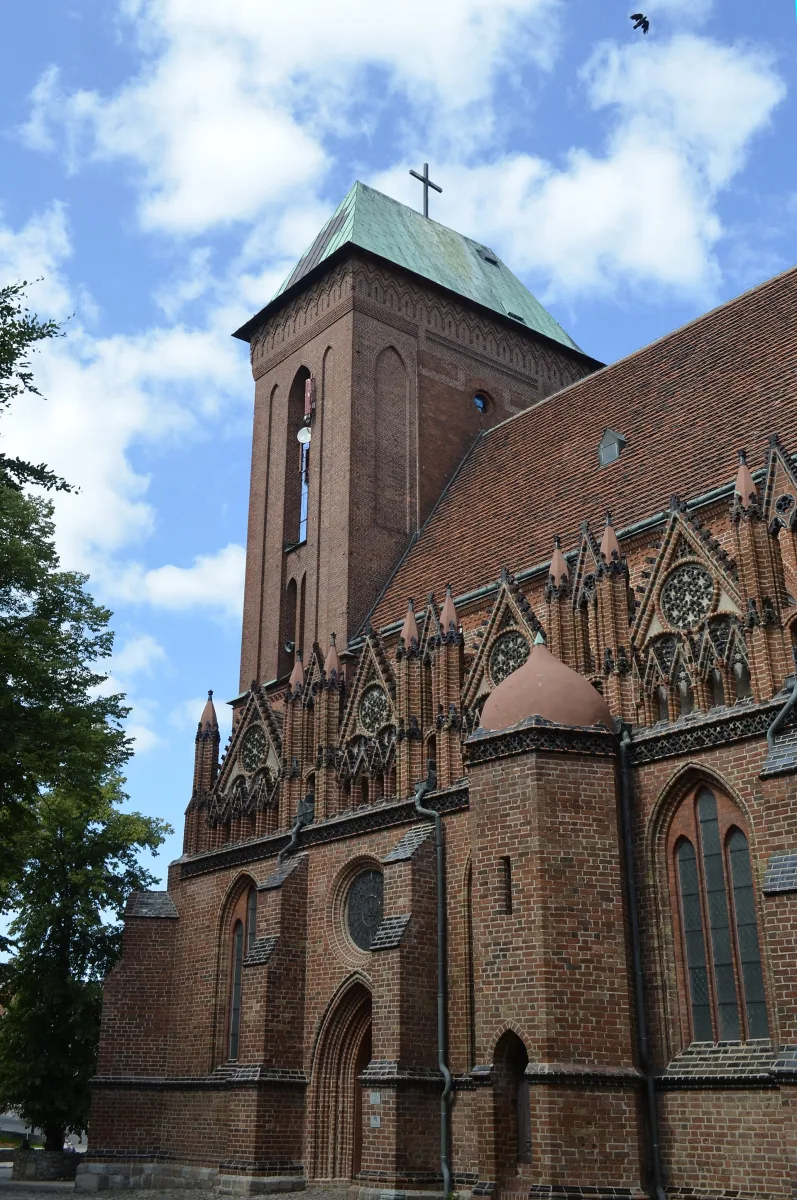
The Castle of the Bishops of Kamień is entered in the heritage register. In the town it is worth combining it with the late Gothic Church of St Michael the Archangel from 1510, which, according to the description of the site, was built on the order of Bishop Martin von Karith, and with the Karlino Land Museum.
Golczewo: a tower between two lakes
The castle in Golczewo stood on the isthmus between Lake Szczucze and Lake Okoń. According to Wikipedia it was built at the turn of the 13th and 14th centuries, probably around 1284, right next to a hillfort, as a knightly seat. The first mention dates from 1304 or 1305 and concerns the sale of the castle to Bishop Henryk von Wacholz of Kamień. In 1308 the bishop fled here from Brandenburg raids, as the entry on the bishopric says.
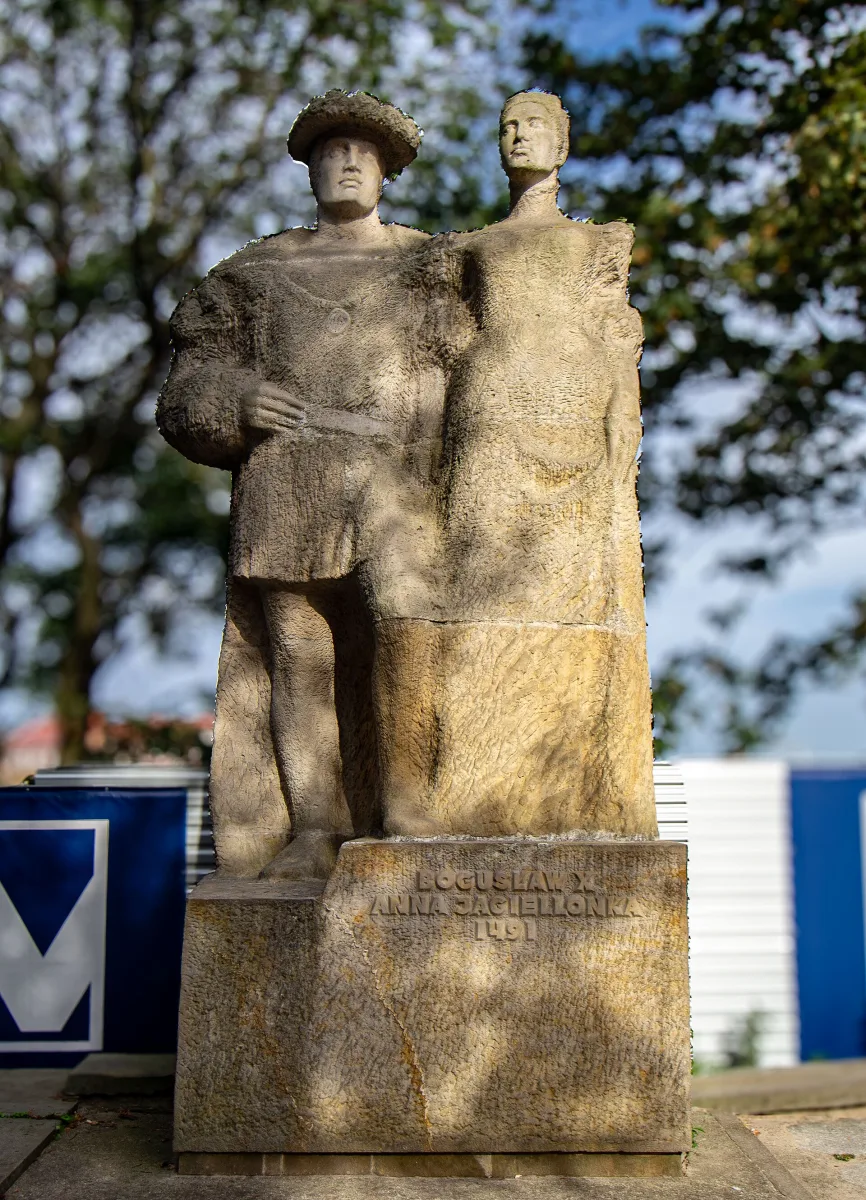
In 1406-1418 the area was extended to a quadrangle measuring 40 by 40 metres. According to the description of the site, from 1500 the castle was an episcopal residence, and Duke Bogislaw X stayed there several times. After the death of the last Bishop of Kamień in 1684 (the entry on the tower names Ernest Bogislaw de Croÿ here, while the entry on the bishopric regards Erasmus von Manteuffel, who died in 1544, as the last bishop) the castle was abandoned. After 1812 the walls were demolished, except for the tower.
Only the Castle Tower has therefore survived. Wikipedia states that it is 31 or 33 metres high, and its lower part is built of erratic boulders. The battlements and the helmet were reconstructed in 1895 and 1929. The old name, Fangelturm, is tied to a legend about knights who supposedly held captured merchants in the tower for ransom. This is a tradition, not a documented fact. After a renovation in 2004 the tower was opened to visitors in summer. Next to it stands the 15th-century Church of St Andrew Bobola.
Kamień Pomorski: the curia manor by the cathedral
In Kamień the bishops had their cathedral, today the co-cathedral, the Cathedral of St John the Baptist, and the curia manor right next to it. According to the heritage register, the Bishop's Palace was built in the second half of the 15th century, on the site of an earlier curia manor from the 14th century. Wikipedia says that in the 14th-17th centuries it served as the seat of the curia.
In 1568 the building was rebuilt in the Renaissance spirit. The northern gable is decorated with tracery that echoes the decoration of the residence of the House of Griffin, and the oriel on the west wall is counted among the best works of this type in Pomerania. After reconstruction from the destruction of the Second World War it housed a public library, and today it houses the church archive and church rooms, and in summer exhibitions.
Koszalin: a residence from 1266 and the castle church
Koszalin was once an important episcopal centre. According to Wikipedia, in 1248 the eastern part of the Kołobrzeg land with Koszalin passed into the ownership of the Bishops of Kamień. In 1266 Bishop Hermann von Gleichen chartered the town under Lübeck law and established in it his main residence and the capital of the episcopal Principality of Kamień.
Koszalin also has the former castle church, which houses the Orthodox Church of the Dormition of the Blessed Virgin Mary. Wikipedia dates the building to the end of the 13th century and states that it was rebuilt in 1602-1609, and that the Orthodox parish received it in 1954. The heritage register speaks of the 14th century and of a chapel. The entry on the town, on the other hand, mentions a castle-residence of the Dukes of Pomerania completed in 1582. Besides the Orthodox church, it is worth seeing the Cathedral of the Immaculate Conception of the Blessed Virgin Mary, built in 1300-1333, and the Dukes of Pomerania Park with the Castle Pond.
Be the first! Add a comment.
You need to log in to add a comment.
Log in