
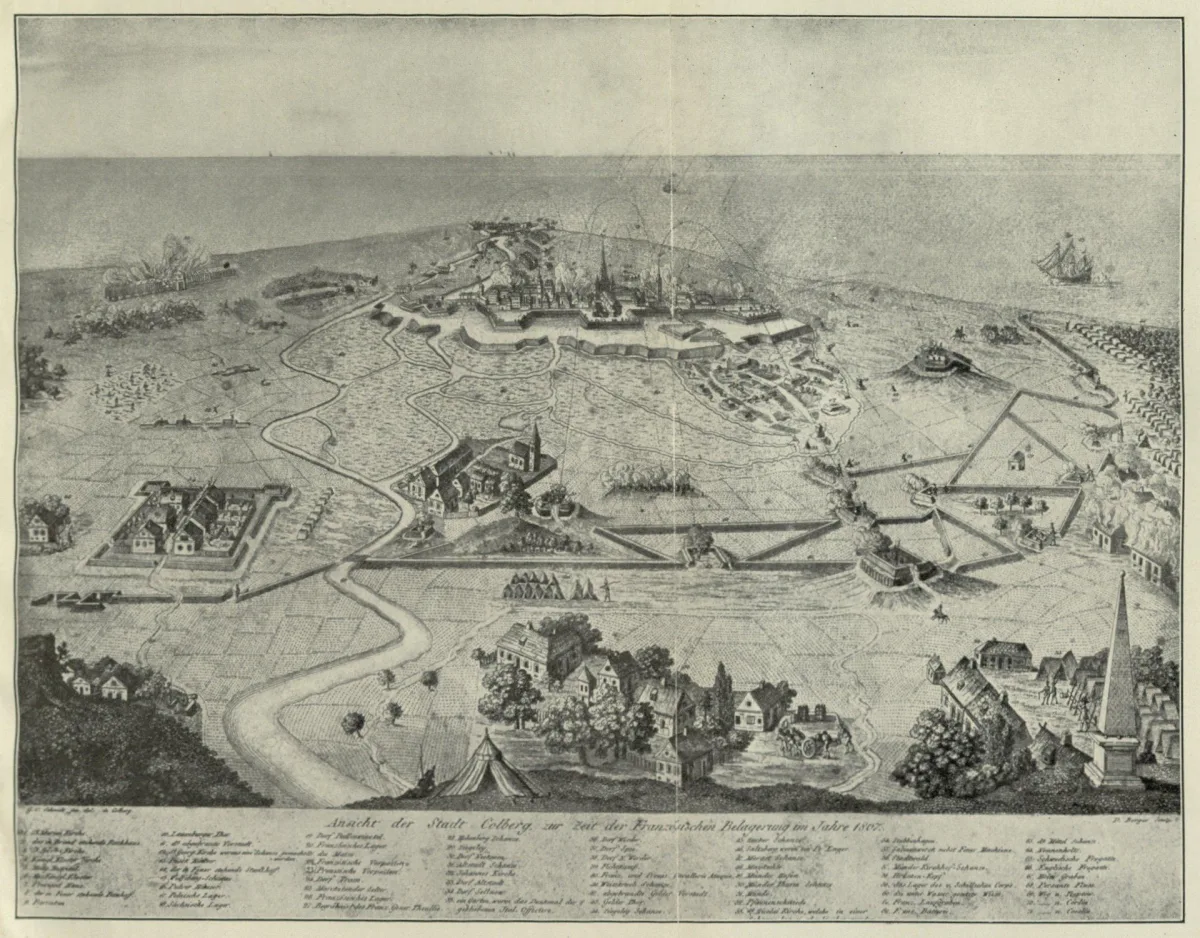
In 1807 Kołobrzeg was one of the few Prussian fortresses that did not surrender to Napoleon. The siege lasted several months and ended without the town being taken, but not because the defenders won a battle: operations were halted by the Peace of Tilsit. For almost a hundred and forty years the defence was presented as a story of courage, and in 1945 propaganda made use of it. It is therefore worth distinguishing what the sources recorded from what the legend added.
The fortress that refused to surrender
After the Prussian defeat at Jena and Auerstedt (14 October 1806) the Prussian army was almost destroyed. Szczecin capitulated on 29 October, but Kołobrzeg refused. According to Wikipedia, the Prussian commandant, Colonel Lucadou, who was of very advanced age, firmly did not want to give up the fortress and ordered preparations for defence. The town was favourably placed: the sea to the north, the Parsęta to the west, and marshes to the south that could be flooded by damming the river.
The defence was reinforced by forts in the foreground. According to the Polish Wikipedia they included Ujście Fort from 1770-1774, the Morast redoubt on the northern tip of Salt Island, and Wilczy Fort (Wolf Fort), built only from the beginning of the siege on the east side of the town, because the main attack was expected from there. The English Wikipedia says that the suburbs, including the Geldernerviertel district, were burned, as was customary in the defence of fortresses. At the beginning of December 1806 the garrison numbered 1,576 men, and in the following months it grew with the influx of soldiers and recruits. According to the same Wikipedia, help came from the Swedes, who sent some rifles, and from the British, whose ships brought supplies from the sea.
Schill, Nettelbeck, Gneisenau: who the three heroes of the legend were
Ferdinand von Schill, an officer wounded at Auerstedt, according to Wikipedia received a royal patent in January 1807 to form a volunteer corps. According to the Polish Wikipedia, on 7 February the corps numbered 424 cavalrymen, 268 infantrymen and 32 artillerymen with four guns. His raids delayed the French, and in January, as the Wikipedias report, General Victor, who was to lead the siege, was taken prisoner. When the French surrounded the fortress, Schill left for Stralsund. According to the English Wikipedia he returned at the beginning of May, but after a dispute with Gneisenau he left again with most of the corps. He was killed in Stralsund in 1809, and he received the Pour le Mérite for the defence of Kołobrzeg, as the English Wikipedia reports, together with Gneisenau. A redoubt later bore his name, today the Reduta Bagienna on Salt Island.
Joachim Nettelbeck (1738-1824) was born in Kołobrzeg. The Polish Wikipedia calls him a mayor, but the German one describes him differently: as a sailor who returned to his home town, became a brewer, and in 1805 joined a ten-member representative body and acted as a representative of the townspeople. According to the German Wikipedia he was the leader of the opposition to Lucadou, whom he regarded as a potential traitor, and he sought his dismissal from the king. The sources therefore differ as to his role. The same German Wikipedia notes that in his youth Nettelbeck sailed on Dutch and English ships engaged in the slave trade, and in his memoirs he distanced himself from this.
Lucadou stood down after Nettelbeck's complaints and also, as the English Wikipedia writes, because of the planned British landing: the king feared that a commandant of French descent would irritate them. According to the Polish Wikipedia the commandant became Major August Neidhardt von Gneisenau, from 29 April 1807. Gneisenau had previously served in the auxiliary units of the British army in North America. After the defence he received the Pour le Mérite order (17 August 1807) and promotion to lieutenant colonel (26 August).
The course of the siege and the figures that do not agree
The beginning is given differently. The Polish Wikipedia speaks of the beginning of March 1807, while the English one gives 20 March in its heading and at the same time says that the Italian troops of General Teulié had encircled the fortress by 14 March. The end is certain: according to the English Wikipedia, at noon on 2 July fighting ceased after the announcement of peace, and an armistice had already been signed on 25 June, after the Russian defeat at Friedland. The French did not enter the town.
On the besiegers' side fought Italian troops, as well as contingents of the states of the Confederation of the Rhine: Württemberg, the Saxon duchies and Nassau, and a Dutch regiment. Among them was the 1st Infantry Regiment of the Poznań Legion under the command of Antoni Paweł Sułkowski, which according to the English Wikipedia numbered about 1,200 soldiers and arrived from Gdańsk on 20 April. The command changed: General Teulié, then Loison, and briefly Marshal Mortier, who had to return to Stralsund. Teulié was mortally wounded, and the English Wikipedia cites three conflicting accounts of the date, from May to mid-June. There was also a shortage of heavy siege artillery, as the Polish Wikipedia writes, and this was one of the reasons why the fortress was not taken before peace came.
The heaviest fighting took place around Wilczy Fort, which the English sources call Wolfsberg. According to the English Wikipedia, on the night of 17 to 18 May the besiegers took part of the redoubt but withdrew after confusion in their own ranks, and eventually the redoubt capitulated on 11 June. Captain Waldenfels was killed there. His name was later borne by the Kamienny Szaniec, which was built only in 1832-1836, so it did not yet exist in 1807 and stands near the sites of the former fighting. In the last days of the siege, as the same sources write, a total of 25,940 rounds were fired, of which 6,000 on 1 and 2 July.
The strength of the sides differs depending on the entry. The Polish Wikipedia in the entry on the siege gives up to 6,500 defenders and up to 13,000 besiegers, in the entry on the history of Kołobrzeg 5,700 defenders and 18,000 French, and the English one about 6,000 and 14,000. Casualties are not clear-cut either. The English Wikipedia, citing the Prussian military archive and a study by Höpfner, gives for the garrison 14 officers killed, 23 non-commissioned officers and 391 rank and file, and in total, including the wounded, prisoners, missing, deserters and those discharged as invalids, 2,861 people. According to this source the civilian population lost 27 killed and 42 wounded. The figures for the besiegers' losses are uncertain: the Prussian archives mention 7,000-8,000 killed and wounded, which Höpfner himself considered possibly exaggerated, while another compilation gives about 5,000. According to the English Wikipedia the suburbs were destroyed, more than half of the Old Town was damaged or demolished, and the damage was estimated at 155,000 thalers.
The legend, the monument and the film
According to the Polish Wikipedia, in Prussian and German historiography the defence of Kołobrzeg was presented, contrary to the facts, as a symbol of the courage of the German nation and of a victorious struggle against an occupier. According to the English Wikipedia the myth was partly dispelled by the research of Hieronim Kroczyński, author of a monograph on the fortress. Joachim Nettelbeck published his memoirs (issued in 1821-1823, edited by Johann Haken), and Paul Heyse wrote the drama Colberg (1865). According to the German Wikipedia, 2 July was celebrated in the town as a holiday with a procession, and the monument to Gneisenau and Nettelbeck was unveiled on 2 July 1903 beside St Mary's Church. After 1945 it was destroyed.
In 1943 filming began on the film Kolberg directed by Veit Harlan. According to the English Wikipedia the script was based on Nettelbeck's memoirs and Heyse's drama, and Joseph Goebbels co-wrote it without credit. The Polish Wikipedia gives a budget of 8.5 million marks and a premiere on 30 January 1945 in besieged La Rochelle and in Berlin, and also states that Wehrmacht soldiers were engaged for the battle scenes. The film shows the French withdrawing from Kołobrzeg, which, as the English Wikipedia stresses, is not historical truth: the siege ended with peace. According to the Polish Wikipedia the film was also meant to encourage the role of the Volkssturm, and its message was weakened by the fact that Kołobrzeg fell while it was being shown.
After the war the town's memory changed along with its inhabitants. According to the English Wikipedia a street was named after Antoni Sułkowski, commander of the Polish regiment. Traces of the fortress, among them the amphitheatre that took the place of Wilczy Fort, remain in the town, and the fortress itself lost its status in 1872.
Be the first! Add a comment.
You need to log in to add a comment.
Log in