
The Hanseatic League, a union of merchants and trading towns from the Middle Ages, is associated with Lübeck, Gdańsk or Rostock, but it also included several towns of today's West Pomeranian Voivodeship. The Wikipedia entry on the Hanseatic League lists among them Szczecin, Kołobrzeg, Darłowo, Goleniów, Koszalin and Stargard, and the entries on individual towns add details and dates. Below we go through them in turn and show what traces of that trade can be seen today.
Who belonged to the Hanseatic League, and since when
Wikipedia gives dates for only some of the towns, and they are not always unambiguous, so for each one we note the source.
- Szczecin: according to Wikipedia it became a Hanseatic town in the 13th century; the table in the entry on the Hanseatic League gives the year 1278.
- Goleniów: according to Wikipedia the further growth of trade led to the town's joining the Hanseatic League in 1368.
- Kołobrzeg: according to Wikipedia it was a member of the Baltic Hanseatic League from the 14th century.
- Darłowo: according to Wikipedia cooperation with the Hanseatic League began during the building of the ducal castle from 1352, and the town became a full member in 1412.
- Trzebiatów: according to Wikipedia the town joined the Hanseatic union in 1416.
- Gryfice: Wikipedia, citing a study by Jan Mitkowski from 1946, writes that in the 14th century the town became an indirect member of the Hanseatic League.
- Koszalin: according to Wikipedia it took part in maritime trade as a member of the Hanseatic League after gaining access to the sea in the 14th century.
- Stargard: according to Wikipedia, after an influx of settlers from Germany and Flanders it became a member of the Hanseatic union; the entry gives no date.
Kamień Pomorski does not appear in these lists, so we do not count it here.
Darłowo: the castle, the market halls and the gate
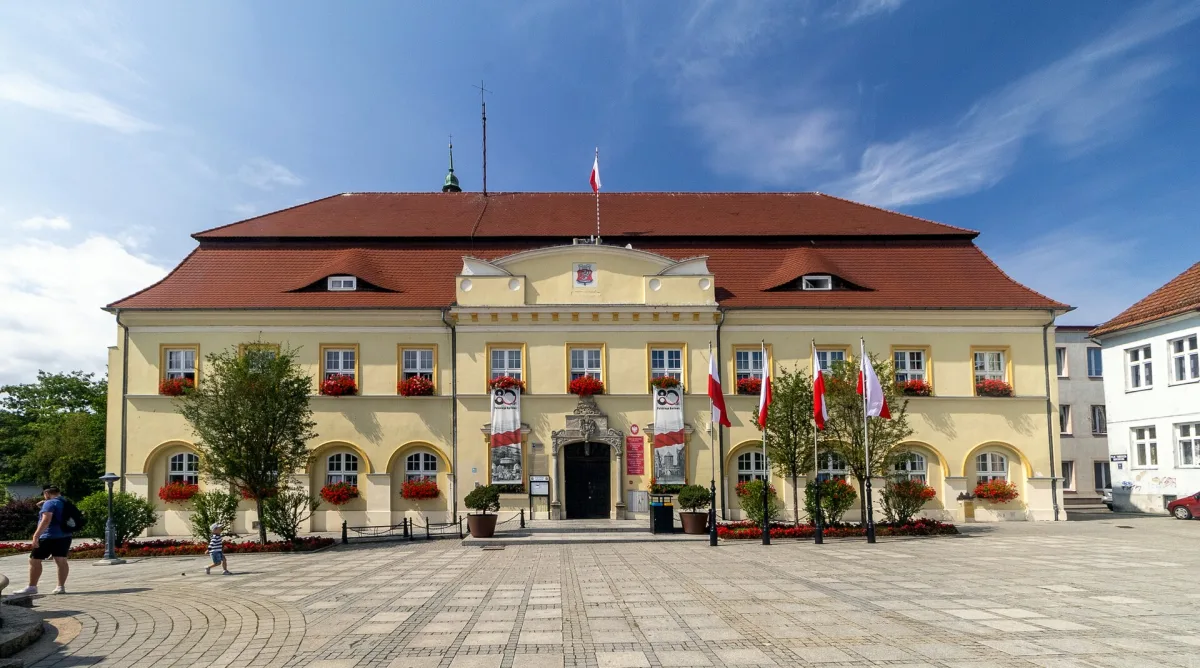
Wikipedia links the beginnings of Darłowo's cooperation with the Hanseatic League to the building of the ducal castle. In the town itself the market halls remain, which today house the town hall. According to Wikipedia the previous town hall burned down in 1722, and the halls were raised by one storey in 1725. Part of the former walls is the High Gate, the only one of four town gates to survive, dated by the heritage register to the 14th-15th century.
Kołobrzeg: the market square, the town hall and the basilica
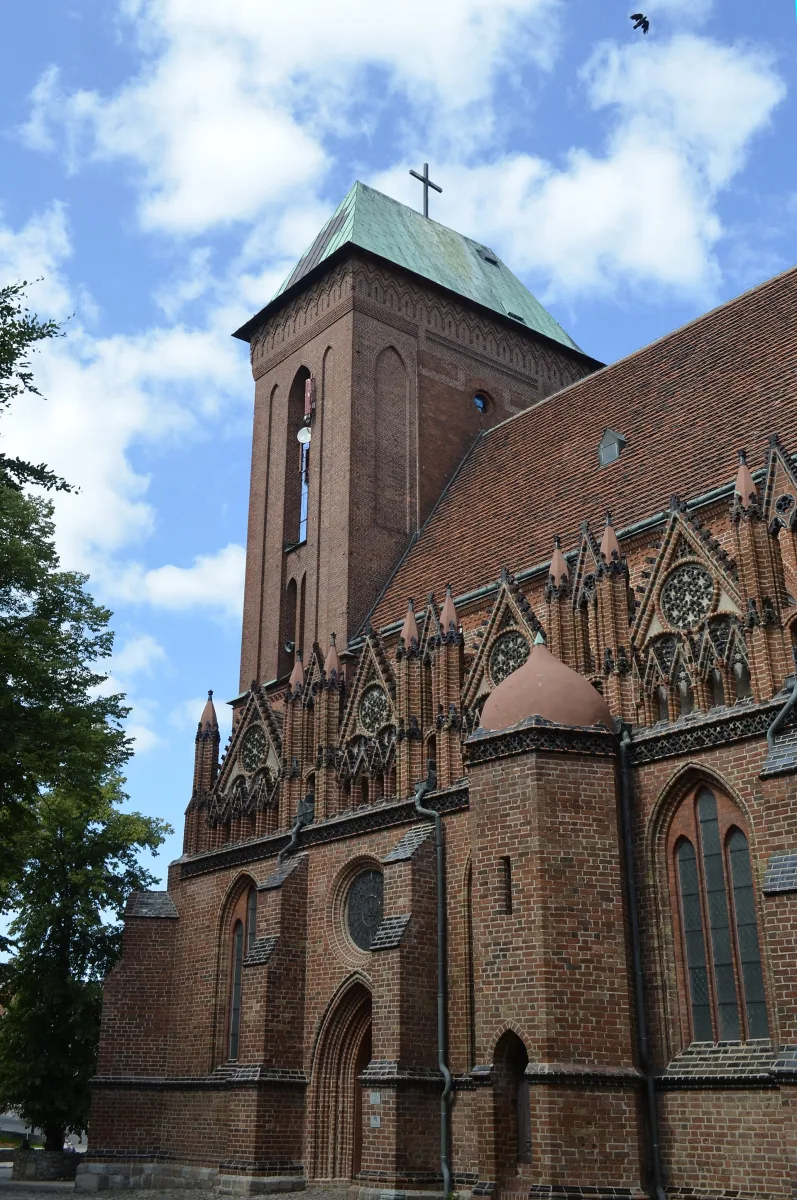
The town was chartered in 1255 and the Town Hall Square was laid out at that time. A Gothic town hall was built in its middle in 1364, and in 1538 a customs chamber was added to it. Today's town hall building, to a design by Karl Friedrich Schinkel, was built after the destruction of 1807, and a corner and cellars of the old one were preserved. The main church is the Co-Cathedral Basilica of the Assumption of the Blessed Virgin Mary: Wikipedia supposes that construction began at the start of the 14th century, while the heritage register indicates the 13th century, so the dates are given differently. Inside, a Gothic seven-branched candelabrum from 1327 has been preserved.
Stargard: merchants in the town hall and gates on the canal
In Stargard, on the site of today's town hall, there first stood a Merchants' House from 1250-1280. At the end of the 14th century it was rebuilt as the seat of the town authorities and the merchant patriciate; in the cellars were the warehouses of visiting merchants. The town was surrounded by walls with four gates, which have survived to this day: the Mill Gate controlled water traffic on the Mill Canal and had the right to collect a toll for the carriage of goods, while the Pyrzyce Gate and the Rampart Gate closed the land entrances. Above the Old Town Market Square rises the Collegiate Church of St Mary Queen of the World, according to Wikipedia a brick hall church from 1292-1324.
In a footnote on the town's former names, the Wikipedia entry on Stargard cites a letter from the Stargard council to the Stralsund council from 1459 concerning damage done by the people of Szczecin.
Goleniów: disputes with a neighbour and the gate
According to Wikipedia, during its early presence in the Hanseatic League Goleniów had numerous conflicts with Szczecin, which sought to monopolise shipping on the Oder. Of the town fortifications the Wolin Gate survives, the only one of four gates to last to our times. In the Gothic St Catherine's Church, the pointed-arch portal in the western elevation of the tower is preserved from the original elements.
Gryfice and Trzebiatów on the Rega
Two towns on the Rega lay by a river that was used for shipping. In Gryfice the High Gate, a brick gate from the 15th century, served, besides defence, as a toll-collection point for merchants, craftsmen and peasants entering for markets and fairs. In Trzebiatów the medieval town layout, with a grid of streets and a market square measuring 94 by 104 metres, arose after the chartering of 1277; according to the description of the layout, a land road linking Kołobrzeg with Szczecin, Stargard and Gryfice ran through the town, and the Rega was an important waterway.
Be the first! Add a comment.
You need to log in to add a comment.
Log in