
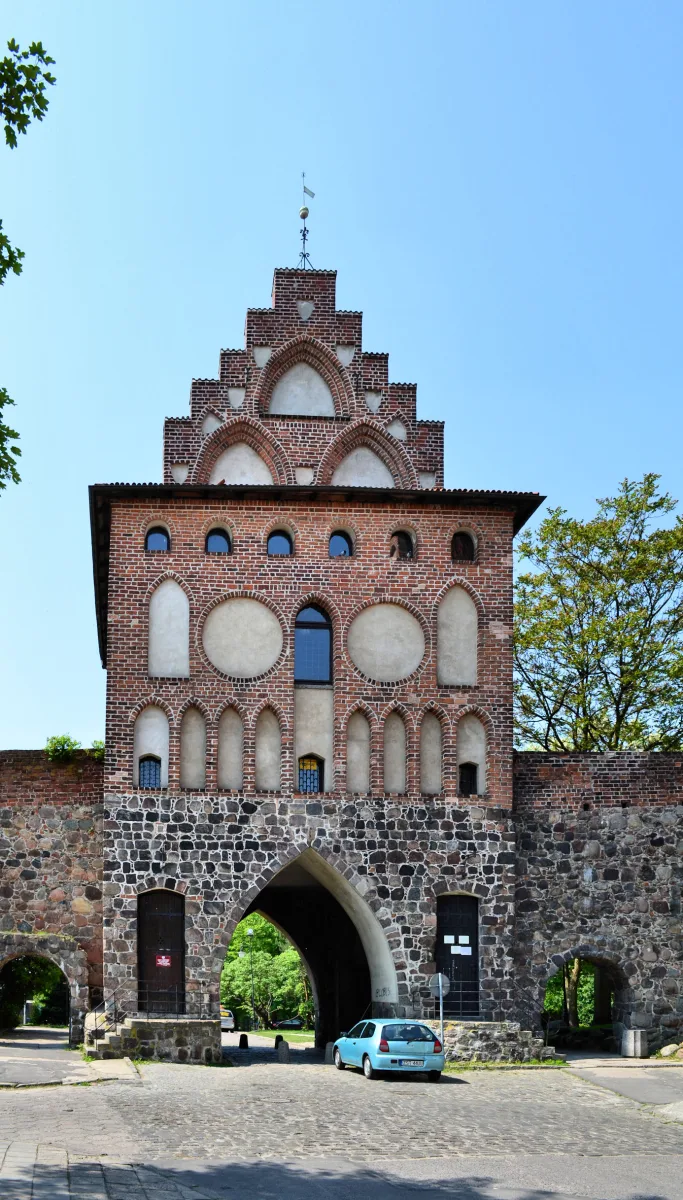
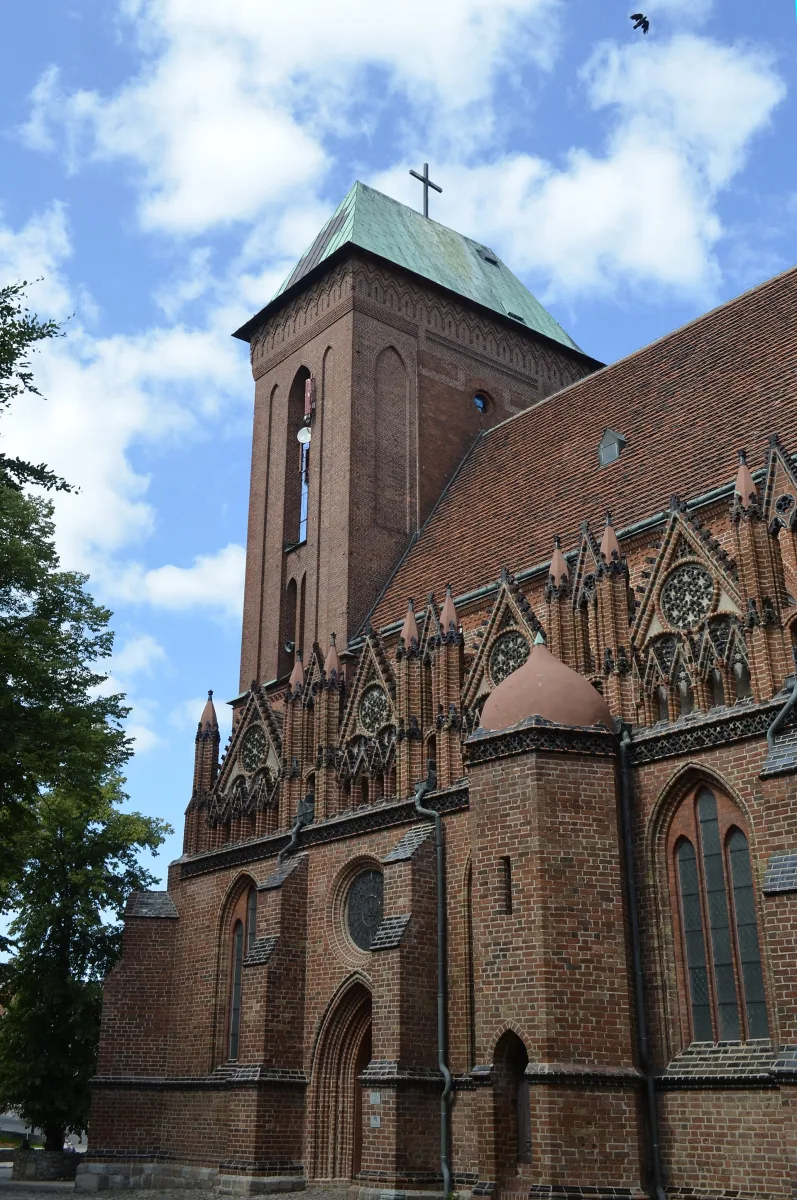
The defensive walls of Stargard are not a single monument but a system: a stone and brick ring with gates, towers, watchtowers, a moat and ramparts, which together worked as one defensive machine. According to Wikipedia this complex is among the most powerful and most interesting fortifications in Poland, and in the article on the town we read that it was the most powerful defensive system in Pomerania. By a regulation of the President of Poland of 17 September 2010 the walls, together with the Collegiate Church of St Mary, were declared a Historic Monument (pomnik historii).
How the walls grew: from ramparts to brick
According to Wikipedia a stronghold existed in Stargard as early as the 10th century in the area of today's Białogłówka Tower, and the stronghold and its suburb were surrounded by earth and timber ramparts. From the north-east side they were additionally defended by the Ina River. Construction of the walls began after the town's foundation charter in 1243. In the second half of the 13th century the earth and timber fortifications were replaced with stone and brick ones, and this stage was completed in 1298. The oldest fragments, of fieldstone topped with brick, reach up to 6 metres in height and are best seen near the Pyrzyce Gate.
From the beginning of the 15th to the mid-16th century, in the face of the threat from Brandenburg and the development of firearms, the walls were raised in brick, and some sections were completely rebuilt. The article on the walls states that the total length of the fortifications was then 2,260 metres. Along them stood 45 watchtowers, that is, three-storey annexes projecting in front of the line of the wall: on the ground floor was an arsenal, on the first floor space for the garrison, on the second an observation and firing position. On the outside, access to the town was defended by deep moats, palisade ramparts and the Ina. In the 16th century Stargard was, according to Wikipedia, among the best fortified towns in the Duchy of Pomerania.
In the 19th century the walls lost their defensive character and more than half of the fortifications were demolished, leaving sections with a total length of 1,040 metres. The ramparts were lowered, the moats filled in, and in their place parks were laid out which today surround the Old Town, among them Bolesław Chrobry Park. Its boundary is marked by the outline of the walls, and only the St John's Bastion has survived there in its original shape.
The gates: four entrances and one on the water
The article on the walls names four gates: St John's, Pyrzyce, Wałowa and Mill. Each of the last three has its own article in Wikipedia and each calls it one of the town's four gates, so the list of gates needs caution, because not all of them survive to this day.
The Pyrzyce Gate has, according to Wikipedia, a stone part 6 metres high from the end of the 13th century and a brick superstructure from 1439, with three storeys above the passage. The base is a square with sides of 11 metres. Those entering the town passed the front gate made up of two low, connected towers, then a brick tunnel called the throat, a drawbridge over the moat and the inner gate closed with a portcullis. The two-part outer gate was rebuilt after a fire in 1666 and demolished at the end of the 19th century. The article on Stargard calls it a gate regarded as the most beautiful in Pomerania, which is the opinion of the article's authors.
The Wałowa Gate stands in the north-eastern part of the fortifications, at the exit towards Maszewo. Wikipedia gives the year of construction as 1439, and according to the description of the structure other sources speak of 1430 or of the 13th century, so the dating is uncertain. It had the most elaborate outer gate in the town, demolished in 1780. After the destruction of the Second World War the gate was completely rebuilt, including the Renaissance section in the upper part. It is 19.4 metres high.
The Mill Gate stands over the bed of the Mill Canal and served as a water passage. According to Wikipedia it was probably erected in the first half of the 15th century, although the heritage register indicates the 13th century. The two octagonal towers are, according to the article, 28 metres high, and the article on the town writes that it is the only gate in Poland and one of two in the world situated over a riverbed. This is the opinion of the article's authors, without confirmation in a second source.
The towers: how many there were and what remains
According to the article on the walls, nine towers stood along the outline of the fortifications, and their height reached more than 30 metres. The article, however, lists seven: Morze Czerwone, Weavers', Prisoners', Białogłówka, Butchers', the tower by the Arsenal and Smiths'. The number nine and the list of seven names therefore do not agree within a single article.
The Red Sea Tower (Morze Czerwone) is 34 metres high. Wikipedia dates it in its article on the tower to the second half of the 14th century, and in the article on the town to the turn of the 15th and 16th centuries and calls it the most imposing and largest town tower in Poland, which is the opinion of the article's authors. The name is explained by tales of fighting during the Thirty Years' War or of condemned people being thrown from the top; the article considers a more probable origin to be the rust-coloured marshes that were here before the tower was built. Inside it has eight levels, and the entrance, according to the article, is open in summer.
The Weavers' Tower, also called the Ice Tower, was built in the mid-15th century and is 31 metres high. The name Weavers' came from the fact that the section of wall between the Pyrzyce Gate and the tower was to be defended in case of danger by the weavers' guild, and the second name from the fact that from the 18th century ice was stored in the dungeon. At the end of the 19th century, when the walls were being demolished, it stood in the middle of the street of the time and was to be demolished; in the end it survived.
Białogłówka dates from the first half of the 15th century and reaches about 30 metres. It took its name from the white, hexagonal top of its helmet. A legend says that when the men were at war, the women defended the town by pouring hot tar on the enemy, and the ruler ordered the top to be painted white in their honour. This is a legend, not a historical fact. The Prisoners' Tower, from the turn of the 15th and 16th centuries, is much lower: it is 13 metres high and has four levels. According to Wikipedia, the Smiths' Tower, similar to it, was demolished in 1871. The name Prisoners' only suggests that prisoners were held here.
How to walk the walls
The easiest place to start is at the Pyrzyce Gate: according to the descriptions of the structures, the Weavers' Tower is about 100 metres further on, the Red Sea Tower about 200 metres, and the Collegiate Church of St Mary, Queen of the World about 300 metres. Further on the walls run along the Ina towards the Prisoners' Tower on Strażnicza Street, and on the opposite side of the Old Town, over a bend in the river, stand the Wałowa Gate and Białogłówka. The Mill Gate lies in another part of the circuit, by the canal, about 700 metres from the Pyrzyce Gate. The interiors of the towers and gates depend on their custodians and the season.
Be the first! Add a comment.
You need to log in to add a comment.
Log in