
Four towns in West Pomerania have kept traces of their walls: Gryfice, Trzebiatów, Goleniów and Gryfino. Each has a different gate or tower that survived, and a different story about why that one did. Below we go through all four in turn, relying on Wikipedia articles about the individual structures and on the heritage register.
Gryfice: a 650-metre wall and three gates
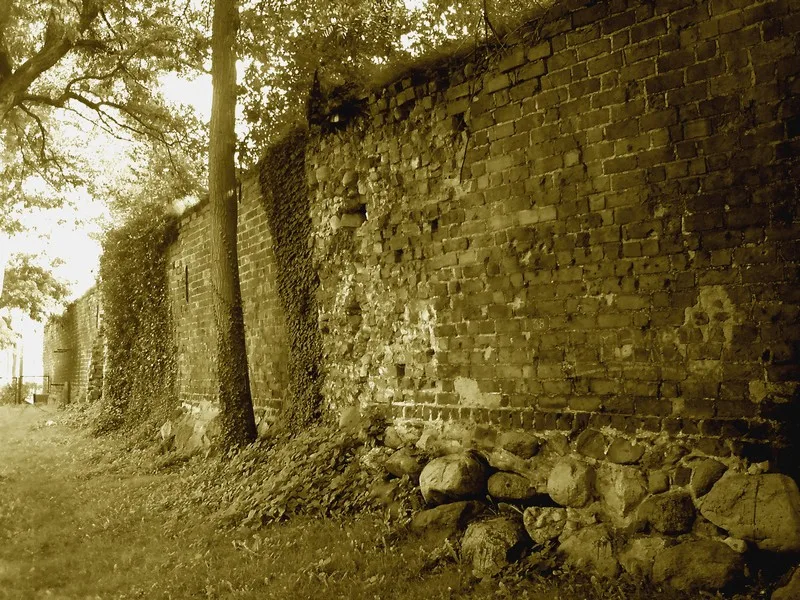
According to Wikipedia, construction of the Gryfice defensive walls began in 1300 on the site of an earlier earth-and-timber palisade. The oval, spindle-shaped line of fortifications marked the boundary of the Old Town, was about 650 metres long and between 3 and 5 metres high. The wall was built of stone and brick, with the brick laid in Wendish bond. It linked the High, Reska and Stone Gates, three towers (the Gunpowder, Mill and Bridge Towers) and six bastions. The appearance of these walls was recorded on the Great Map of the Duchy of Pomerania by Eilhard Lubin from 1618. Today the sections between Wałowa, Górska and Niepodległości streets have their full profile, and part of the stretch along the Rega was rebuilt in 2005 during regeneration work. The remains of the walls were entered in the heritage register in 1955, as the defensive walls in Gryfice.
The oldest surviving gate is the Stone Gate in the northern part of the Old Town. Wikipedia dates its main part to the 14th century and states that the first written mention of the fortification dates from 1333. It took its name from a stone mill that once stood nearby, and was also called the Mill Gate or the Trzebiatów Gate, after the trade route from Greater Poland to Kamień. After a fire in the 15th century the upper storeys were rebuilt, and Renaissance elements were added later, so the structure today has a mixed Gothic-Renaissance style.
In the south stands the High Gate, built according to Wikipedia in the 15th century on the site of an older gate from 1300. In sources it appears as the Szczecin, Kamień, Nowogard or Stargard Gate, because the names referred to the towns to which the roads led. After the town's first fire in 1658 the main body was lowered and covered with a hipped roof. It was entered in the heritage register together with the Stone Gate in 1955. In 2005 the Gryfice Land Museum opened inside it.
The third surviving structure is the Gunpowder Tower on Nadbrzeżna Street, from the turn of the 14th and 15th centuries, according to Wikipedia and the heritage register. The brick tower, made up of two cylinders, is 25.2 metres high, and the entrance is about 3 metres above the ground, because it was once reached by stairs and a wooden platform from the walls. After renovation in 2007 a viewing balcony was opened to the public.
Trzebiatów: walls from the town's foundation and the Kaszana Tower
The foundation charter of Trzebiatów from 1277 gave the town, according to Wikipedia, among other things the right to build defensive walls. The description of the urban layout of Trzebiatów, based on the heritage register, states that between 1299 and 1337 the town was surrounded with walls of stone and brick. At first it was entered through two gates, the Gryfice and Kołobrzeg Gates, and over time the Bath and Sailors' Gates were also mentioned. In the 18th century the moats and fortifications began to be removed and turned into gardens. Today the town lies in a bend of the Rega, within partly preserved walls.
The most recognisable part of the walls is the Kaszana Tower, a brick tower 21 metres high. Wikipedia dates it to the first half of the 14th century, while the article on the town's urban layout gives the turn of the 13th and 14th centuries, so its age is not clear-cut in the sources. It strengthened a corner of the walls and was used to watch the river; in the 15th century it was raised, and in 1994 it was rebuilt with a new roof and floors. As for the name, a legend tells of a bowl of hot porridge (kasza), but this is a tale, not a historical fact.
Goleniów: one of four gates
According to Wikipedia, the Goleniów walls with four gates (the Wolin, Szczecin, Stargard and Mill Gates) were built from the town's foundation, and only the Wolin Gate has survived to this day. Towers also stand by the Ina, including the Mint Tower and the Gunpowder Tower, and fragments of the town walls are best seen on the riverbank. Wikipedia notes that the present state of the fortifications is largely the result of reconstruction after the destruction of the Second World War.
Gryfino: the Bańska Gate and fieldstone
Gryfino has a similar history, but on a smaller scale. According to Wikipedia, defensive walls were built here in the 14th and 15th centuries from fieldstone, and the best-preserved stretch, in the south-eastern corner of the town by the park, is about 70 metres long and 4 metres high, although the walls originally reached about 6 metres. The Bańska Gate, built in the 14th century, is 15.3 metres high. Up to 11.75 metres it was built of fieldstone, and in the 15th century a further 3.55 metres of brick was added. According to the same Wikipedia article, the gate was modernised in 1864, 1979 and 1984. The Swedes, who left the town in 1679, destroyed the walls and bridges, according to Wikipedia, which hastened the decline of trade in Gryfino.
What the gates were for
Wikipedia states for both Gryfice gates that, besides their defensive function, they were points where tolls were collected from merchants, craftsmen and peasants entering for markets and fairs. After the Napoleonic wars both Gryfice gates ceased to serve a defensive role and took on new functions, from an inn and a library to a museum and a tourist information point.
Be the first! Add a comment.
You need to log in to add a comment.
Log in