
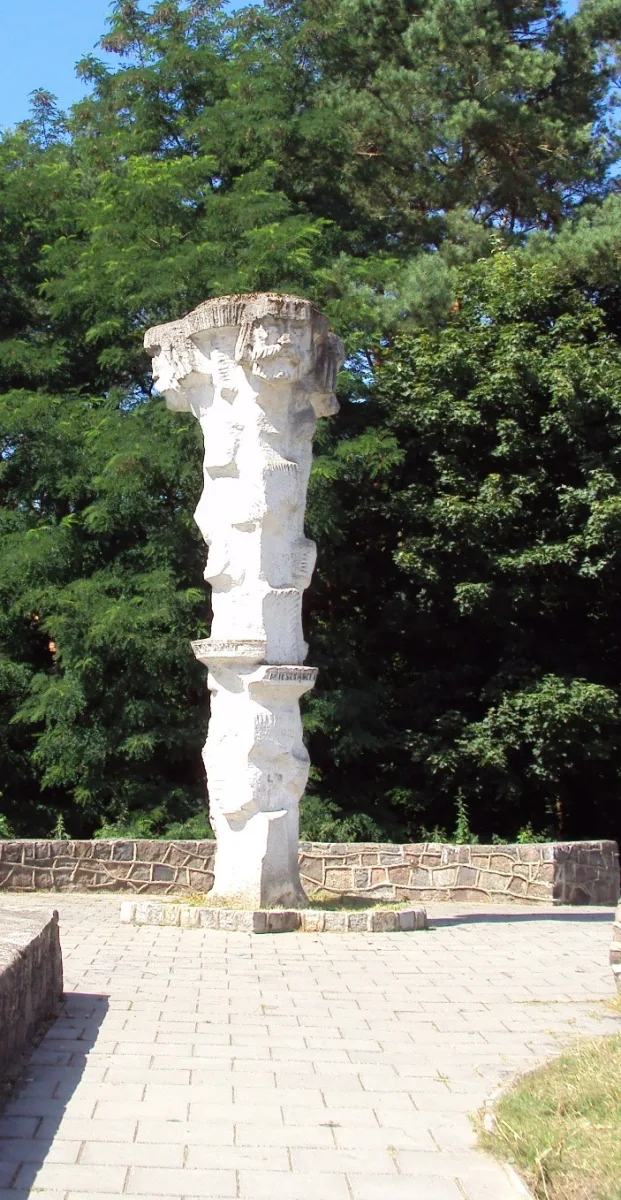
Three lives and one god
Knowledge of Triglav (Trzygłów), the god of the Pomeranians, worshipped according to Wikipedia in Szczecin, Wolin and probably in Brenna, that is present-day Brandenburg, comes from three lives of Otto of Bamberg. The oldest is the anonymous Life from Prüfening, written by 1146. Then came Ebbo's Life of 1151 and Herbord's Dialogue of around 1158-1159. All describe the bishop's missions among the Slavs, and the cult of Triglav is, according to Wikipedia, attested from 1124 and officially ended in 1127.
Szczecin: the hill, the temples and the black horse
The monk of Prüfening writes that in Szczecin two richly decorated temples stood close together, where Triglav was worshipped. In one of them were kept the god's gilded and silvered saddle and a horse used for divination. Spears were laid out on the ground, and if the horse passed between them and touched none, the omen was favourable. According to Herbord, four temples of Triglav stood in the city, and the horse was black. The bishop himself was said to have destroyed the wooden statue, taking three silvered heads, which he sent to the pope as proof that the inhabitants had been baptised. The entry on Otto speaks of the heads being sent to Rome.
Ebbo described the Szczecin statue differently from the Anonymous author: the city had three hills, and the middle and highest was consecrated to Triglav. There stood a statue with three heads, with the eyes and mouths covered by a golden cloth. The priests explained that the god has three heads because he rules heaven, earth and the underworld, and covers his face so as not to see or hear human sins. The hill of the temple is, according to Wikipedia, most probably identical with Castle Hill, on which the Castle of the Pomeranian Dukes stands today. On its summit there was said to be a circle surrounded by a ditch, from the 8th century a sacred enclosure, later a temple of Triglav, and finally a Christian one. According to the description of the site, before 1124 there stood here a Slavic stronghold with the wooden court of Duke Warcisław I.
Wolin: a figurine in a trunk
In Wolin, according to Ebbo, when Otto was destroying the temple and the images of the gods, the priests stole the golden figurine of Triglav, took it out of the country and placed it in the care of a widow in a small village. She hollowed out a tree trunk, hid the figurine in it wrapped in cloth and left a small opening for offerings. The bishop sent a certain Hermann, who posed as a worshipper and dropped a silver coin into the opening. He saw that the figurine was lodged in the tree so firmly that it could not be taken out. So he took Triglav's old saddle, nailed to the wall, and brought it to the bishop. Ebbo does not give the name of the village.
It is worth distinguishing Triglav from the figurine shown in the Wolin collections. According to a study on the website archeologia.com.pl, the four-faced figurine is 9.3 cm high, made of yew wood, and was found in 1974 in a layer from the second half of the 9th century. Most scholars regard it as a cult object, probably for domestic worship, and Władysław Duczko saw an analogy with Scandinavian whetstones. This is a different thread from Triglav, and the descriptions in the lives do not link it with this god. Today one of the rooms of the Andrzej Kaube Regional Museum in Wolin is devoted to pre-Christian beliefs.
Legends of the hidden statue
The lives do not say where the figurine finally ended up. Places appear only in legends. According to Wikipedia, folklorists have collected in western and northern Poland several legends according to which the figurine was hidden in Gryfice, in Świętouść on Wolin, in Tychowo under the Trygław boulder, or in Lake Trzygłowskie. Since the legends point to different places, they exclude one another, and none of them is confirmed by the lives of the 12th century. The best known is Trygław, an erratic boulder in Tychowo, regarded as the largest in Poland. According to the description of the site it lies in a cemetery and has appeared in the town's coat of arms since 1996, and the legend of a golden statue buried beneath it remains a legend, not a fact.
How scholars explain the three heads
Wikipedia sets out several interpretations. Aleksander Gieysztor regarded Triglav as a tribal god, distinct from Perun and close to the chthonic Veles, as is indicated by the black horse and the golden statue dedicated to him. Andrzej Szyjewski also sees in him a chthonic god. Jiří Dynda proposes that Triglav could have been a triple god, combining figures responsible for heaven, earth and the underworld, and links this with the motif of the tree in which the figurine was hidden. Henryk Łowmiański derived Triglav from Christianity, from three-faced depictions of the Holy Trinity, but Wikipedia notes that such a depiction is attested only from the 14th century.
The entry on Triglav does not decide between these views, and the only description of the meaning of the three heads in the sources themselves is the explanation of the priests cited by Ebbo.
Be the first! Add a comment.
You need to log in to add a comment.
Log in