
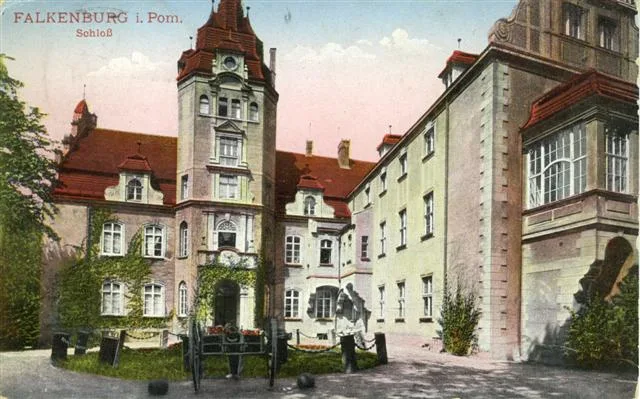
Falkenburg, Złocieniec and the castle on the Drawa
Złocieniec lies in Drawsko County, on the Drawa and Wąsowa rivers. According to Wikipedia, the first mention of the settlement dates from 1311, and the town has had its charter since 1333. The German name Falkenburg was recorded in the same year. From the 14th century the town belonged to the Wedel family, and from the 16th century to the Borckes.
The castle ruins stand on an escarpment above the Drawa. According to Wikipedia, at the beginning of the 14th century Ludolf I the Elder von Wedel received land by the river from the Margrave of Brandenburg and built a small stronghold on a square plan with sides of 36 m. Wikipedia states that archaeological research points to the first half of the 14th century as the time when the cellars, the oldest part of the building, were built. In the same entry the Gothic cellars are described once as 13th-century cellars and, in the description of the monument, as a structure from the late 13th century, so the dating is not consistent. The legend of a Slavic stronghold on this site has not been confirmed by research.
In 1389 the castle was burned by the Teutonic Knights and then rebuilt. In the second half of the 17th century Caspar von Borcke transformed it into a Renaissance palace with a knights' hall. In 1906 Kurt von Griesheim, preparing for a visit by the Kaiser's son, had the residence thoroughly rebuilt. According to Wikipedia, the castle survived the Second World War intact, but it was abandoned and for decades had no owner. Plundered and destroyed, it is now a ruin, of which the Gothic cellars and the castle park with an avenue of elms survive. The heritage register entry for the ruins has the number 18 and is dated 4 July 1954. Wikipedia bases its account of the castle's history on the work of local researchers, Zbigniew Radacki and Jarosław Leszczełowski.
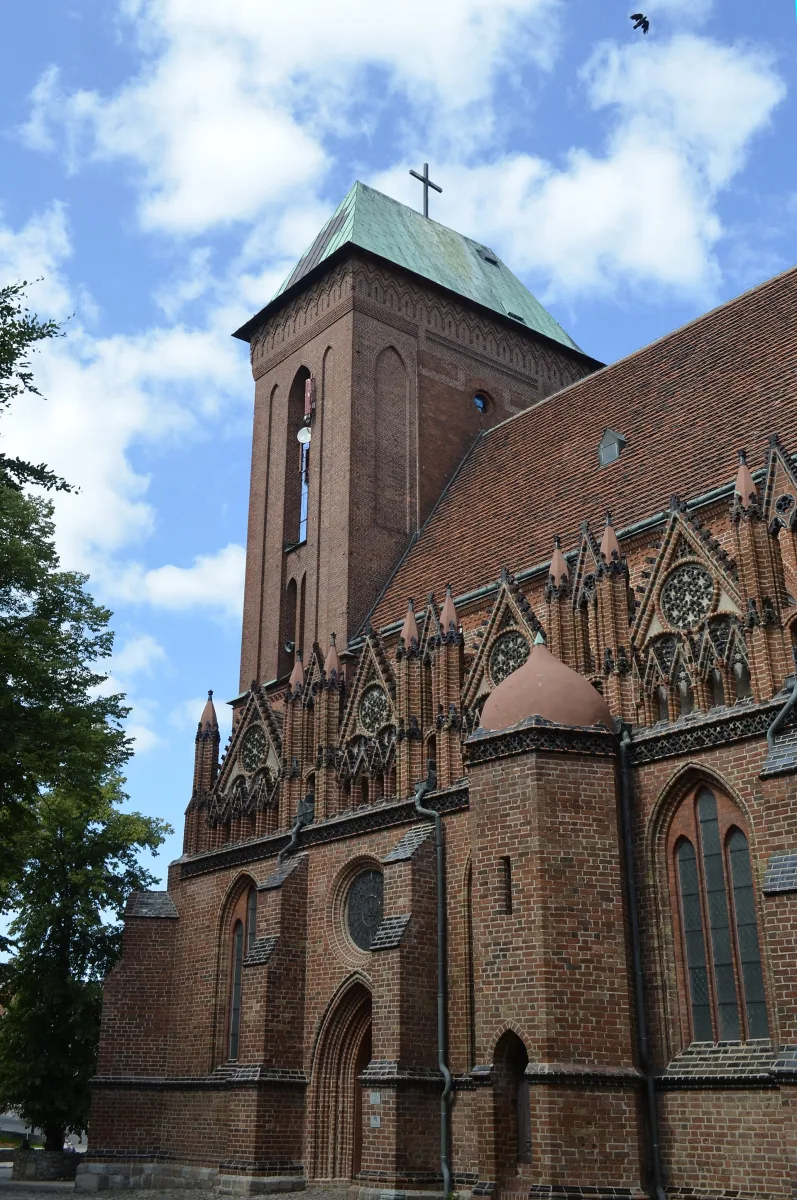
In the town centre stands the Gothic Church of the Assumption of the Blessed Virgin Mary. According to Wikipedia, it dates from the 15th century, was rebuilt in 1723 and 1870, and its neo-Gothic tower was built in 1875.
Ordensburg Krössinsee: construction and purpose
A few kilometres from the centre, by Lake Krosino, within the town's present boundaries (the Krosin district, also known colloquially as Budów and Budowo), the German Nazi training centre Ordensburg Krössinsee was built and operated from 1934 to 1945. According to Wikipedia, the foundation stone was laid on 22 April 1934, the construction was financed by the German Labour Front (Deutsche Arbeitsfront), and the designer was Clemens Klotz, who also designed Ordensburg Vogelsang and the Prora complex. It was one of three such centres in the Third Reich, alongside Vogelsang in the Eifel and Sonthofen in the Allgäu.
Wikipedia translates the name Ordensburg literally as an order fortress. The centre's task was to prepare young Germans for work in the NSDAP party apparatus. All three centres were opened on 24 April 1936, and the one in Złocieniec was opened in person by Adolf Hitler. Histmag, in a text by the regional historian Jarosław Leszczełowski, gives the same opening date, but notes that actual training began only in October 1937. According to the same author, candidates went through a multi-stage selection: under a decree of 1938, only men of German citizenship aged 23 to 26, with a certificate of so-called Aryan descent, could apply for a course. The programme included, among other things, racial science, which Histmag describes as the core of the training, conducted in the spirit of extreme antisemitism.
The complex consisted of residential buildings for the trainees, a community house, teaching and sports facilities, boat landings on the lake, and places for roll calls and ceremonies. A monumental House of Knowledge with four towers was planned. Wikipedia states that in 1939 two of the four planned towers were erected, while Histmag says that by summer 1940 two towers had been built and work on a third was halted. Construction of the House of Knowledge itself was never begun.
Training of cadres and the occupier's crimes
According to Wikipedia, the centre trained more than a thousand people, who during the Second World War were sent to Polish territories, and after the attack on the USSR some of them were transferred east. In August 1939, as Wikipedia writes, Einsatzgruppe IV was formed here, which as part of Operation Tannenberg and the Intelligenzaktion committed numerous crimes during the September campaign and the occupation, including in Bydgoszcz and Warsaw. The figure of more than a thousand people is given by Wikipedia.
Histmag describes another part of the centre's wartime activity: in 1941-1943 its staff ran the Special Staff R here, which trained personnel intended for posts as area commissioners and their deputies for the so-called Jewish question in the occupied eastern territories. According to Leszczełowski, many former trainees were brought to the centre at that time, and some of them were responsible for mass crimes against the Jewish population. In September 1943 the staff was dissolved. This information is given by Leszczełowski.
After 1945 and the situation today
According to Wikipedia, the centre was abandoned on 4 March 1945, and soldiers of the 1st Polish Army took it without a fight. The Red Army was quartered there until 1947. Histmag writes of destruction during the stay of Soviet troops: the boat landings, the commandant's house and the sports hall, among other things, were destroyed. Wikipedia adds that from 1947 to 1952 the Central Sports Centre operated here. Histmag gives the years 1947-1951, a year shorter than Wikipedia. The site was then taken over by the Polish Army.
According to Wikipedia, it is occupied by a military unit that houses the 2nd Legions Mechanised Brigade named after Marshal Józef Piłsudski. Histmag notes that since the 1950s Polish military units have been stationed by Lake Krosino, which makes the site inaccessible. The rules of entry are set by the army.
In 2016, according to Wikipedia, a time capsule placed at the foundation stone in 1934 was found and recovered. It was handed over to the National Museum in Szczecin, where it was opened. Inside were, among other things, the foundation deed, local newspapers from April 1934 and a brochure for the 600th anniversary of Złocieniec.
Be the first! Add a comment.
You need to log in to add a comment.
Log in