
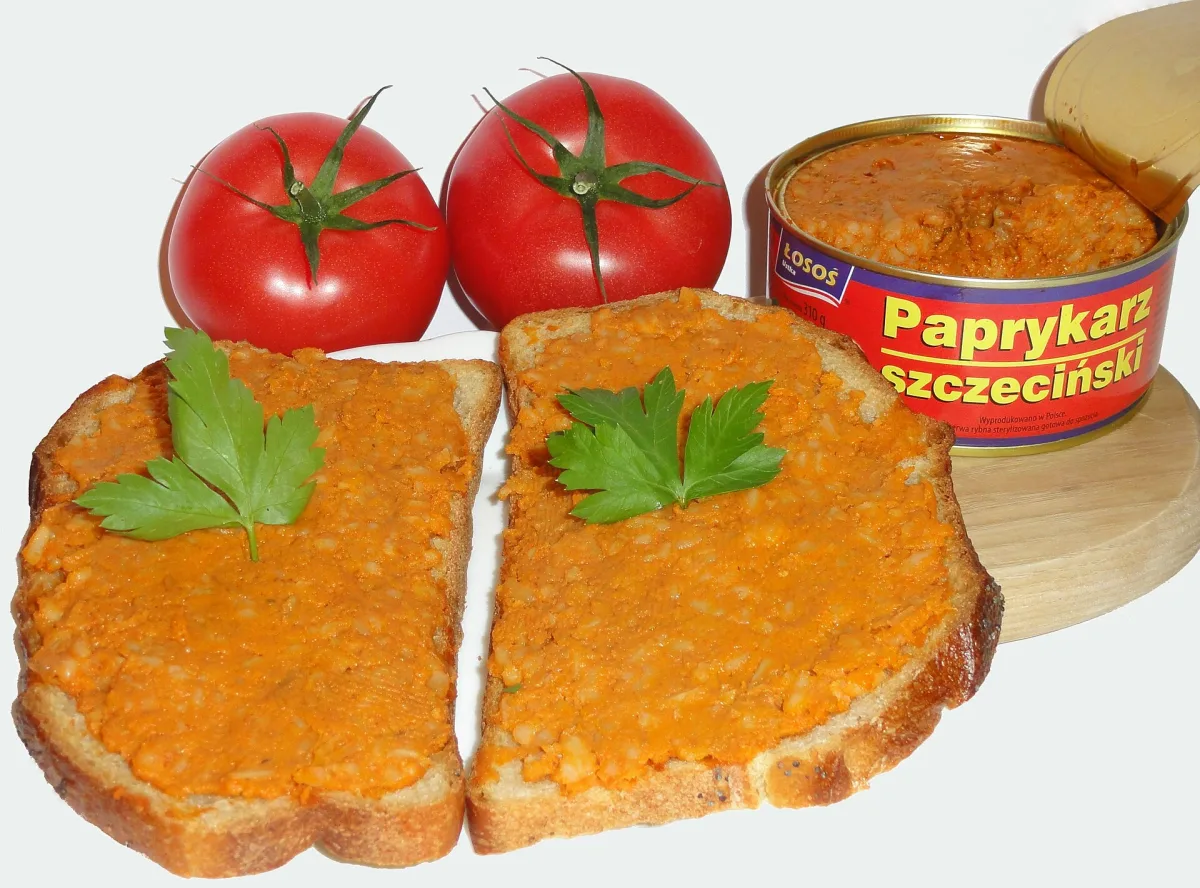
A tin of Szczecin paprykarz is today associated with a grey but faithful companion of Polish sandwiches. Its beginnings, however, are tied to the port and to deep-sea fishing. According to the Encyclopaedia of West Pomerania and Wikipedia, paprykarz was developed in the mid-1960s at a Szczecin fishing enterprise, and the first tins came off the line in 1967.
The Gryf enterprise and the sea fishing grounds
The producer was Szczecin PPDiUR “Gryf”, that is, the Deep-Sea Fishing and Fishing Services Enterprise (Przedsiębiorstwo Połowów Dalekomorskich i Usług Rybackich). According to Wikipedia it was established on the basis of an order of the minister of shipping of 19 April 1957 as the third state deep-sea fishing enterprise in the country. It carried out fishing and fish preservation, and besides the fleet it also had port production of fish products and preserves, together with storage and forwarding to the domestic market and for export. In the second half of the 1960s it renewed its fleet, and new trawlers made it possible to fish in the North Atlantic and on the shelf of West Africa.
Wikipedia states that in 1970 the enterprise caught 73,360 tonnes of fish and produced 3600 tonnes of preserves and fish products. This background explains where the frozen fish blocks and their offcuts in Szczecin came from in the first place.
The laboratory, the fish cube and a rationalisation idea
According to the Encyclopaedia of West Pomerania, Wikipedia and the trade magazine Przegląd Spożywczy, paprykarz was developed in the mid-1960s by employees of the Gryf laboratory, commissioned by the head of production Wojciech Jakacki. The sources describe it as the result of a rationalisation idea: the aim was to make use of the offcuts left from cutting fish cubes from frozen blocks. Wikipedia shows a photograph of a rationalisation certificate from 1967.
Besides the trimmings from cutting blocks into cubes, in the original version fish meat was to make up 50 per cent of the contents of the tin. These were, as the sources write, various species of African fish, including grunt and sea bream. Further, according to the same studies, the original recipe included tomato pulp imported from Bulgaria and Hungary, the hot African pepper pima, vegetables and spices.
Where the African inspiration came from
The prototype of paprykarz was, according to the Encyclopaedia of West Pomerania and Wikipedia, the African dish chop-chop, that is, the Senegalese thieboudienne. Its taste was said to have delighted technologists from Polish refrigerator ships which put into West African ports in the early 1960s.
The name of the spice pima is a matter of conjecture. The author of the culinary blog “Z widelcem wśród książek” quoted the recollections of a cook whose father worked for thirty years at Gryf as a deep-sea fisherman. According to this account pima was powdered wild-growing piri-piri pepper, and the name was a Polonisation of a Portuguese word meaning pepper. This is the supposition of one interviewee and one author, not a finding by historians. The same blog quotes the official description of paprykarz from the list of traditional products, according to which the standard ZN-67/ZGR-09815, in force from 1 February 1967, defined paprykarz as a mass of fish meat, rice, tomato concentrate, oil and onion, seasoned with Nigerian pepper.
Quality mark, export and changes to the recipe
According to the Encyclopaedia of West Pomerania, on 1 December 1968 the Szczecin tin of paprykarz received the Q quality mark. Paprykarz was exported to 32 countries. Przegląd Spożywczy adds that a similar product was made in Colombia, also for export to neighbouring countries.
When Poland lost the African fishing grounds, Atlantic pollock and hake went into paprykarz. In the 1980s Falkland blue whiting was also used, reluctantly accepted by consumers because this fish can be infected with a parasite whose grains resemble rice. During the economic crisis in the Polish People's Republic paprykarz often did not keep to the original standard of 50 per cent fish meat, and scales, fragments of fins, bones, heads and fish spines also went into the tins. There was also a version with pearl barley instead of rice.
The name “paprykarz szczeciński” was not protected, so according to these sources products under this label are made by many companies across the country. On Łasztownia there is also a monument-installation in the shape of a tin, unveiled on 2 October 2020 to a design by Bogusław Dydek.


Be the first! Add a comment.
You need to log in to add a comment.
Log in