

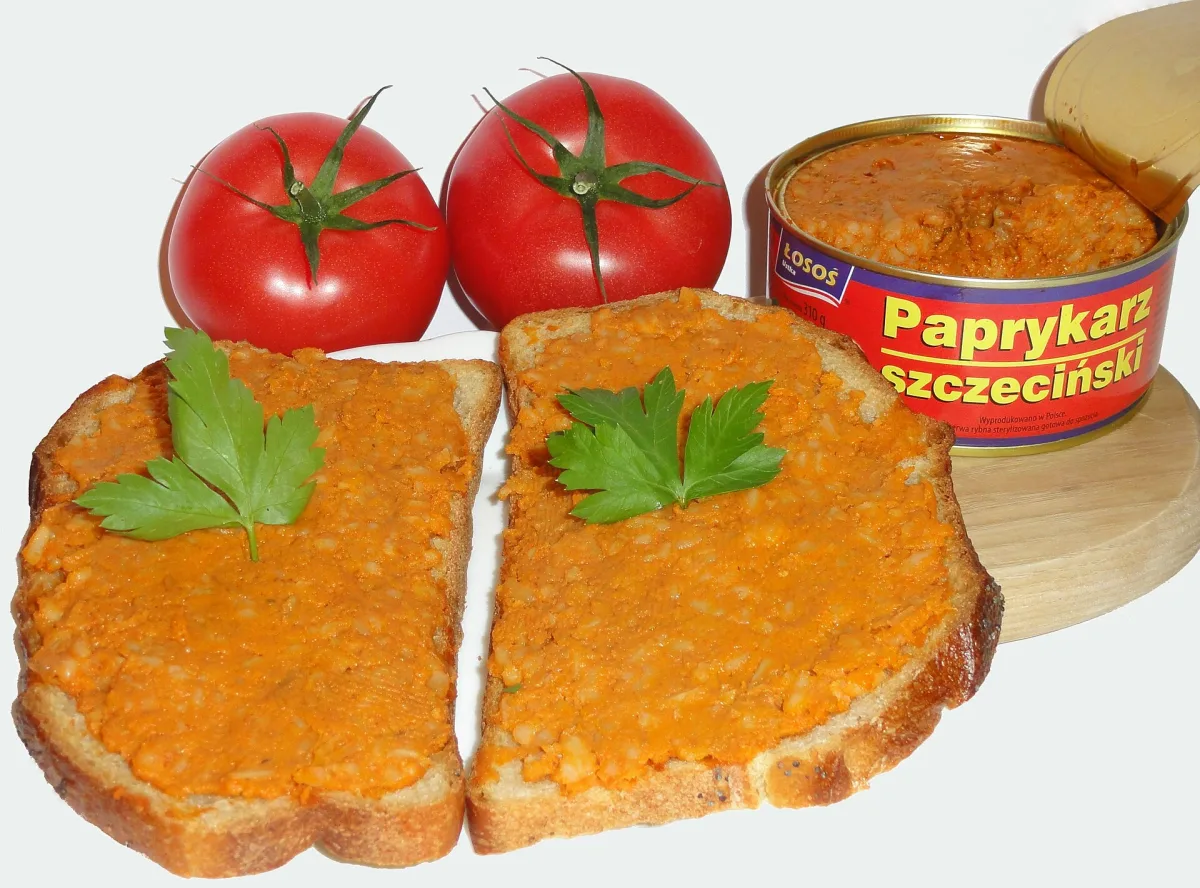
The first tins of paprykarz came off the Gryf line in 1967, according to Wikipedia and the entry in the Encyclopaedia of West Pomerania. This text begins later: from the moment when the preserve stopped being the product of a single enterprise and became a name under which products from various plants appeared, and eventually also a local symbol with its own monument.
Export, the change of fish and the crisis of the recipe
According to Wikipedia, Szczecin paprykarz was exported to 32 countries. The same source states that in Colombia a product similar to paprykarz was made, also sold to neighbouring countries. The trade website “Przemysł spożywczy” also has such a mention.
The raw material changed with the fishing situation. According to the Encyclopaedia of West Pomerania, after Poland lost the African fishing grounds, Atlantic pollock and hake went into the tins. Wikipedia adds that in the 1980s Falkland blue whiting was also used, which customers accepted reluctantly because this fish was sometimes infected with a parasite resembling grains of rice, and rice is a typical ingredient of paprykarz.
In the time of the economic crisis in the Polish People's Republic, as Wikipedia writes, paprykarz often did not meet the original standard, that is, 50 per cent fish meat. Besides meat, offcuts went inside: scales, fragments of fins, bones, heads and spines. There was also a version with pearl barley instead of rice. In an interview with one of the producers, published in the magazine “Hotmag”, the statement is made that Gryf several times departed from the basic recipe, mainly for economic reasons.
The end of Gryf and a name nobody protected
Gryf, according to Wikipedia established in 1957 as a state deep-sea fishing enterprise, produced 42 thousand tonnes of fish products in 1990. The entry states, however, that the lack of stable access to fishing grounds caused the fleet to age: the average age of vessels in 1999 was given as 21.5 years. Wikipedia places the liquidation of the enterprise in 2001-2004, and the last administrator was said to be a receiver.
Wikipedia and the Encyclopaedia of West Pomerania agree in recording that the name “paprykarz szczeciński” was not protected. For that reason fish products under this name are made by many companies across Poland. For this reason the interviewee in “Hotmag” asks whether every tin with such a label is still the same paprykarz.
The list of traditional products
At the end of July 2010 the marshal of West Pomeranian Voivodeship applied to the Ministry of Agriculture to have paprykarz entered on the list of traditional products. Wikipedia presents this as a chance to end the dispute over Szczecin's right to make it. According to the list file published by the Ministry of Agriculture and Rural Development on the gov.pl website, the entry is dated 13 December 2010, West Pomeranian Voivodeship, category “Fishery products, including fish”. On the same day the Szczecin pasztecik (a fried filled pastry) was added to the list.
An entry on the list means recognition of the product as traditional and a description of its recipe. It is not an exclusive protection of the name, so the mere presence on the list does not change the fact that tins under the label “paprykarz szczeciński” are made by various companies.
In 2015, according to Wikipedia, a Szczecin fish manufactory began production of paprykarz to its own recipe, referring to the traditional one. At first the product was sold only in the company shop, and since 2021 also in shops across Poland. The entry also mentions the “Zrobione w Szczecinie” (Made in Szczecin) certificate awarded to this product in 2025.
The monument on Łasztownia
The installation “Paprykarz Szczeciński” by Bogusław Dydek was unveiled on 2 October 2020 at Gryfitów Square on Władysława IV Street, on Łasztownia. In mid-December of the same year it was dismantled on the order of the City Conservator of Monuments, which according to Wikipedia was reported by local websites and the TVN24 television channel. In May 2021 it was decided that the installation would return only for the summer season, while a later paragraph of the same entry calls it a year-round feature of Szczecin. The sources collated in Wikipedia therefore do not settle for how long of the year the monument stands.
On the same Łasztownia stands the neo-Gothic Church of the Holy Trinity. Gryf, for its part, had its management seat in the first years on Chrobry Embankment, in the building where according to Wikipedia the Maritime University now operates.
Paprykarz also has its own mural: in 2022 Jakub Bitka and Łukasz Chwałka created the work “Przystanek Papryk-art” at the Zajezdnia Golęcin bus stop. According to Wikipedia the unveiling was accompanied by a meeting of former Gryf employees.
Be the first! Add a comment.
You need to log in to add a comment.
Log in