
Peat mud from 1895 and the treatment establishment
Trzcińsko-Zdrój lies on the Rurzyca, in the Myślibórz Lakeland, about 12 km east of Chojna. For most of its history it was an agricultural small town of the Neumark (New March), and its German name Schönfließ (in a later form Bad Schönfließ) sounded ordinary, without any spa addition. That was changed by a discovery at the end of the 19th century.
According to Wikipedia, in 1895 a local doctor discovered deposits of medicinal peat in the area, thanks to which Trzcińsko became a spa locality. The entry states that a bathing place was founded first, followed by a treatment establishment to which the sick were to come from all over northern Europe. According to the same entry the town then received the title Zdrój. The entry does not give the name of the doctor, the exact date the establishment opened or the number of patients, so there is no basis for supplying them.
A material trace of those years is the spa house complex. The heritage register, cited in the Wikipedia entry, lists it as a site from the turn of the 19th and 20th centuries: it comprises the spa house, the boiler house, the gymnasium and the kitchen, as well as the spa park. Today it houses a social care home, so it is an area to be seen mainly from the outside, not a site with tickets and visiting hours.
The end of the spa, but not of the name
After 1945 the town came within the borders of Poland. Wikipedia writes that the passage of the front caused destruction amounting to 20 per cent of the buildings, and in 1948 the spa house was closed. The entry adds that the town was deprived of its spa status, but does not say in which year this happened or what the decision was. More than half a century passes between the discovery of the peat in 1895 and the closing of the spa house in 1948.
The element Zdrój nevertheless survived officially. In 1946 a regulation of the ministers of public administration and of the Recovered Territories (the lands taken over by Poland in 1945) introduced the name Trzcińsko Zdrój, replacing the German Schönfließ Nm. Bad. Wikipedia notes that the town did not lose the element Zdrój after being deprived of its spa status. The spelling also has its history: according to the same entry the hyphenated form, Trzcińsko-Zdrój, is the official one, and in 2004 the Council for the Polish Language resolved that two-part place names with Zdrój in second position are written with a hyphen. The spelling without a hyphen is today a colloquial form.
The town before the spa
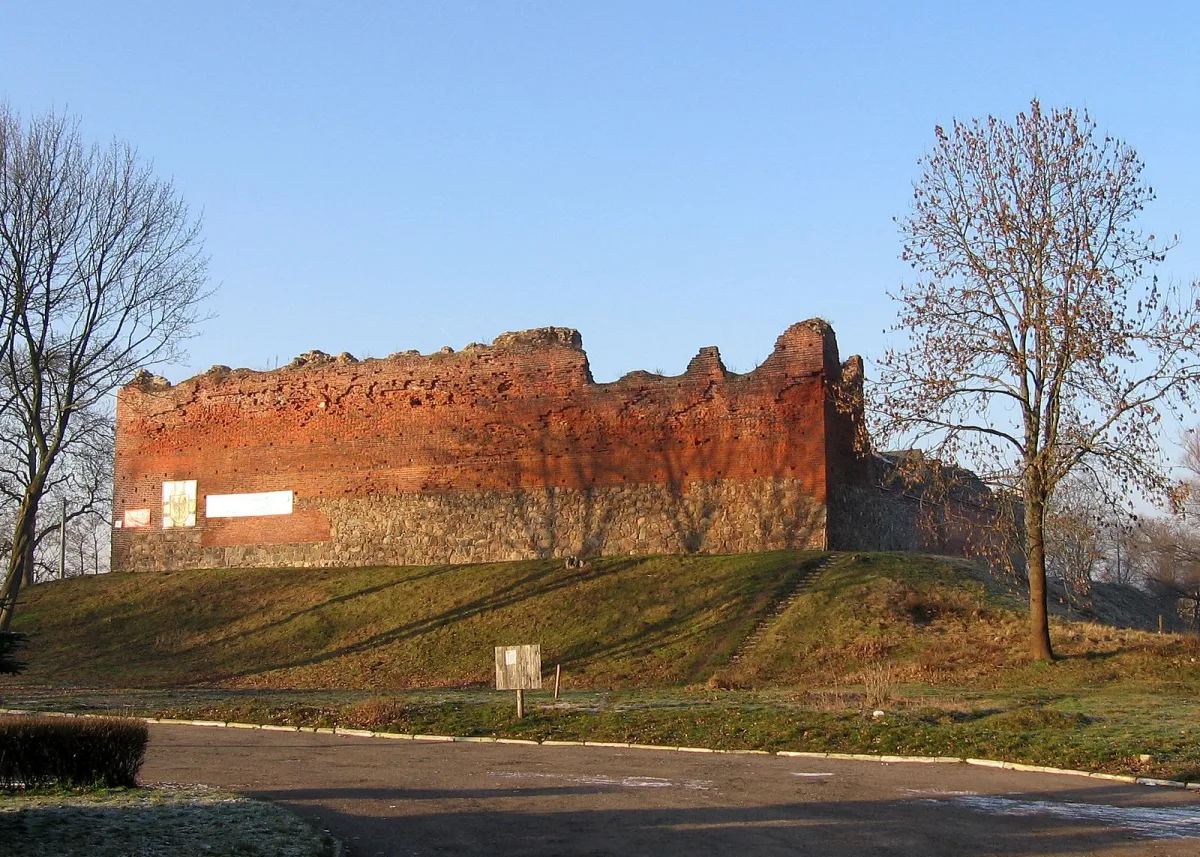
The spa was an addition to a much older town. According to Wikipedia, the beginnings of the settlement probably go back to the early Middle Ages, and in 1248 Bishop Wilhelm of Kamień, visiting the Templars in nearby Rurka, granted the privilege of collecting tithes from the inhabitants of a village recorded as Sconenvlete. In the centre a church and a merchants' house arose, which in time began to serve as a town hall. The layout of the town from those times remains legible to this day, and the heritage register also covers the defensive walls with the Myślibórz and Chojna gates and the towers.
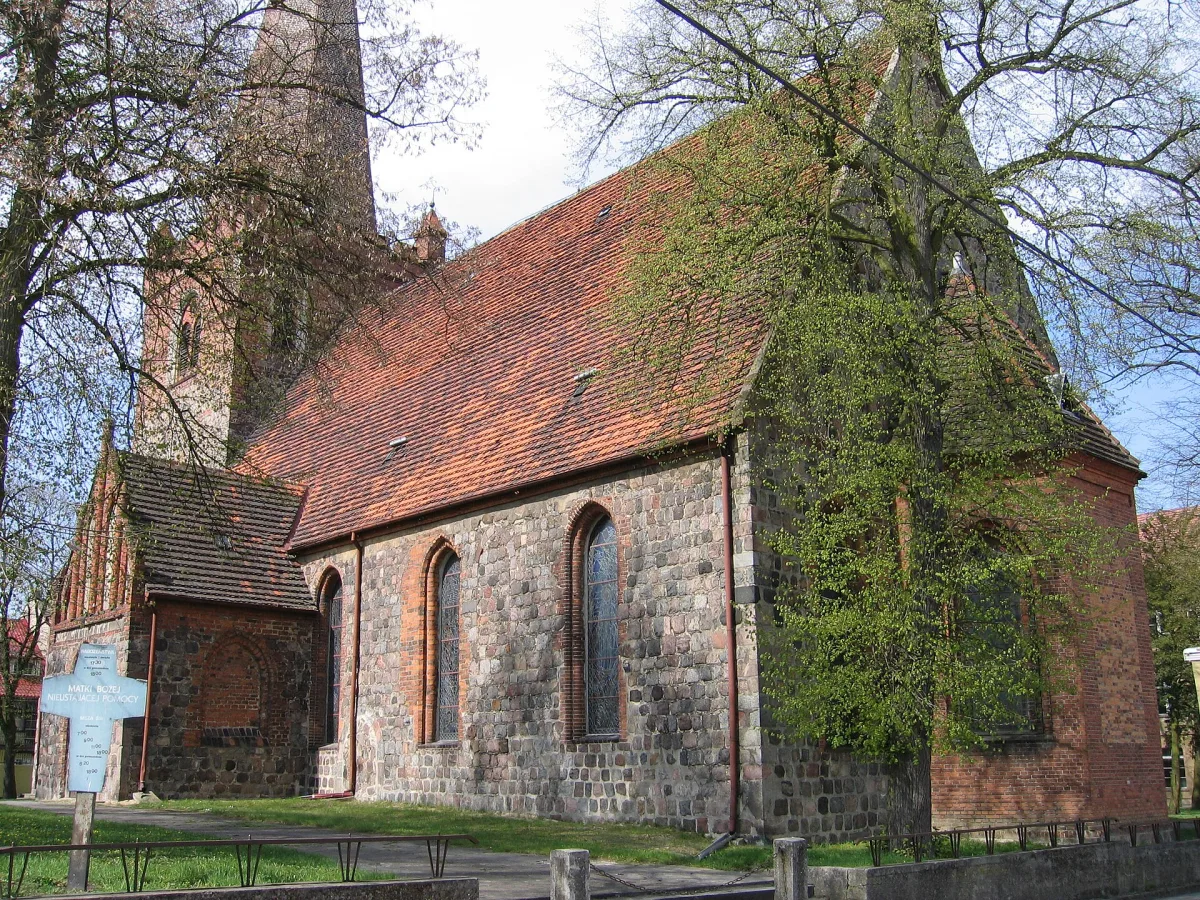
The merchants' house is the nucleus of today's town hall in Trzcińsko-Zdrój. The heritage register gives the second half of the 13th century as the time of its construction, while Wikipedia writes of a rebuilding in the 14th century and the joining of two parts of the building at the turn of the 15th and 16th centuries. Inside, the former court room has survived with a Renaissance polychrome from the 16th century. About a hundred metres further stands the Church of Our Lady of Perpetual Help, built, according to the description, in 1260-1280 as an Early Gothic structure and rebuilt in the 14th century and in 1883-1894, that is just before the discovery of the peat.
Water in the area: Miejskie and Strzeszowskie
Wikipedia states that the Rurzyca flows out of Lake Miejskie, with an area of 43.6 ha, and the municipality has an even larger lake: Lake Strzeszowskie, about three kilometres from the town. According to the Inland Fisheries Institute it has an area of 127.2 ha, an average depth of 7.4 m and up to 14.2 m at its deepest point. Since 2018 a bathing site designated in accordance with the bathing water directive has operated there, and formerly, until 1945, the lake bore the German name Grosser See.
A walk around Trzcińsko-Zdrój is best planned as a circuit of the walls with the market square, the spa park and the shore of Lake Miejskie. It is a good stop on the route between Chojna and Myślibórz, and the name of the town recalls the times when peat mud was the main draw here.


Be the first! Add a comment.
You need to log in to add a comment.
Log in