
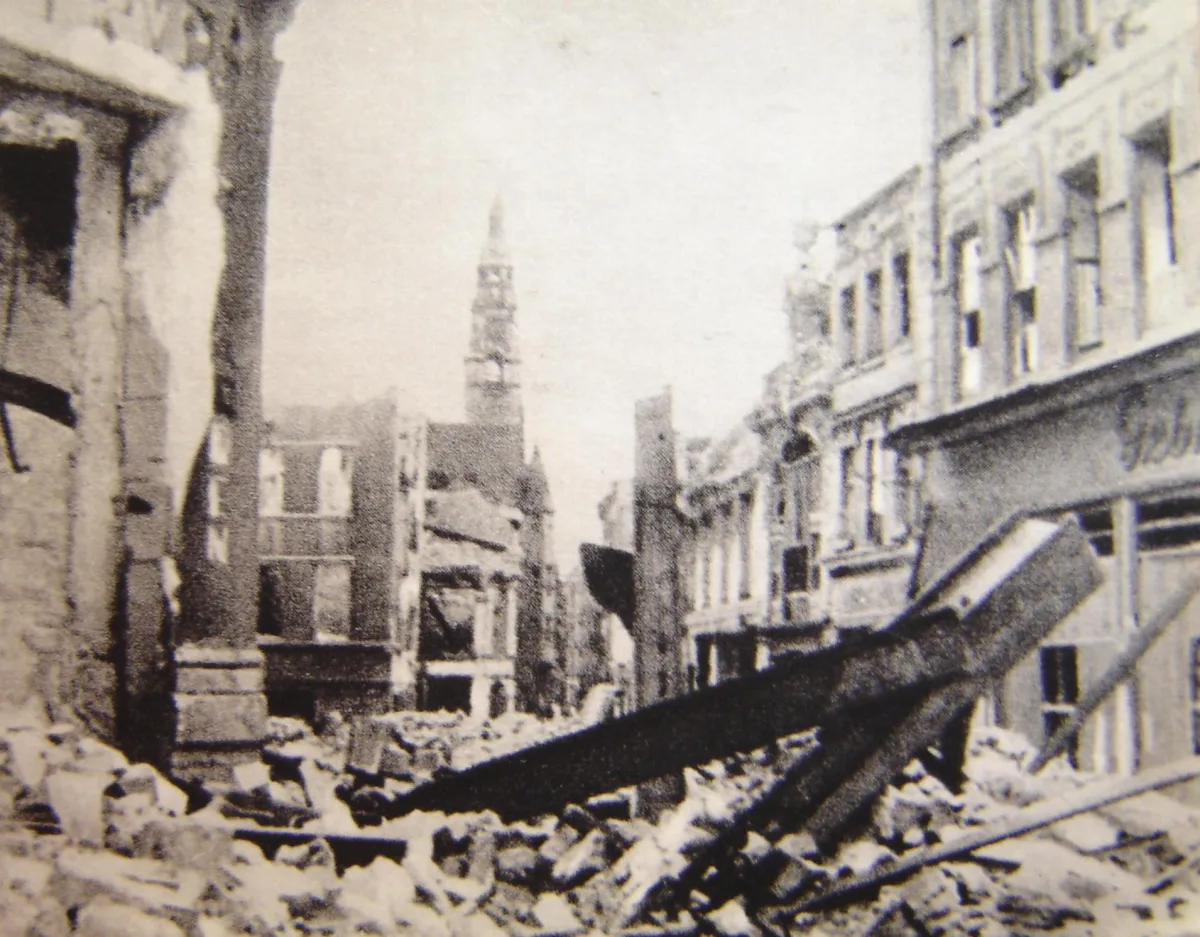
German residents in 1945
When the Polish administration arrived in Szczecin on 28 April 1945, there were, according to Wikipedia, about 200 Poles and about 6 thousand Germans in the city, gathered in the Niebuszewo district. According to the account of Zaremba, cited in Wikipedia, of more than 300 thousand former residents about 6 thousand remained in the ruins at that time. After the Polish administration withdrew in the second half of May, the number of German residents grew. According to Wikipedia, citing a text by Agata Łysakowska in Histmag from 2015, their number rose from about 6 to about 24 thousand.
Further figures are given by Wikipedia, mostly after the Encyclopedia of Szczecin. In May more than 4 thousand Poles who had settled earlier left the city, and Germans who had left earlier returned at a rate of about 1,700 people a day. In mid-June 53,935 Germans were registered, and at the beginning of July 1945, at the moment the city was handed over to the Polish side, 83,765 Germans and 1,578 Poles lived in Szczecin. In December 1945 57,215 Germans were registered. These are data from different dates and different studies, not one consistent series.
Polish settlers and the State Repatriation Office
A rapid growth in the Polish population came after the Potsdam Conference, which lasted from 17 July to 2 August 1945. According to Wikipedia, in August 1945 more than 17 thousand Poles were registered in Szczecin, and in December more than 26 thousand. The total number of residents of the city at the end of 1946 was 108.7 thousand. For the end of 1947 Wikipedia gives 135.7 thousand, while the entry on Piotr Zaremba, citing a table from his study on the Oder Artery, gives 132 thousand. The two results are separated by a few thousand people.
Settlers arrived in Szczecin from the former Eastern Borderlands, from Germany and from various parts of Poland. They were dealt with by a point of the State Repatriation Office on Jagiellońska Street. According to Wikipedia the office operated from 7 October 1944 to 22 March 1951 and in the western and northern territories set up district branches covering a dozen or so counties each. Among those who arrived was also a detachment of soldiers of Gen. Stanisław Maczek, which came by the ship “Izar” and was brought by lorries to Polish Soldier Square.
According to Wikipedia, the period of Polish settlement in the city divides into three stages: until 5 July 1945, when it was not certain whether the city would remain with Poland, from 5 July 1945 to the end of 1947, when migration movements were at their greatest, and from 1948, when they stabilised. According to Wikipedia, migrations after 1945 are among the themes of the exhibition in the Przełomy Dialogue Centre.
Expulsions of Germans 1946-1947
After the Potsdam Conference, according to Wikipedia, implementation began of the plan to expel Germans from West Pomerania, accepted at Potsdam. The entry on the conference lists among its decisions the transfer of the German population from Czechoslovakia, Poland and Hungary. The technical conditions of the operation were agreed in an agreement between the Polish and British governments, signed on 14 February 1946.
The expulsions were carried out in transports. According to Wikipedia, which cites the Encyclopedia of Szczecin, shuttle trains of about 55 carriages were used, heated and fitted for sleeping, guarded by soldiers of the Internal Security Corps and the Citizens' Militia. In 1946-1947, 59 transports left for Germany, by sea to Lübeck and by rail. In 1946 they went to the British occupation zone, in 1947 to the Soviet zone. According to the same source, a total of 50,475 people were expelled in this operation: 11,033 men, 22,683 women and 16,759 children.
Operation Vistula and Ukrainian settlement in 1947
In 1947 the Ukrainian population from south-eastern Poland was resettled to the former German lands, including West Pomerania, under Operation Vistula. According to an article by Witold Bobryk in the journal “Textus et Studia” (2019), 141,175 people were expelled from three voivodeships, Rzeszów, Kraków and Lublin. Of these, 48,465 were settled in the area of the Szczecin voivodeship, within its borders before 1950, that is 34.46% of all those deported. In no county of that voivodeship did their number exceed 5% of all those forcibly settled within its borders. The author describes the dispersal of the settlers as a way of easing their assimilation.
Roman Drozd, in an article in “Słupskie Studia Historyczne” (1997), states that Szczecinek was the distribution station for Operation Vistula transports for the whole of West Pomerania. In the first stage, from 2 to 28 May 1947, 123 transports with 8,107 families, that is 36,547 people, arrived in West Pomerania. The same author writes that the manner in which the resettlement was carried out and the long journey under military supervision meant that the people got off at the final stations in a state of extreme exhaustion.
A caveat on the figures
The figures quoted come from different sources, were counted in different places and on different dates, so they should not be added together. The registers of German residents, the expulsion transports and the settlement under Operation Vistula concern different groups of people and different periods.
Be the first! Add a comment.
You need to log in to add a comment.
Log in