
The plant in Police and its role in the war
Hydrierwerke Pölitz AG, that is, the synthetic petrol factory in Police, was according to Wikipedia one of twelve factories of the IG Farben concern producing liquid fuel from coal. Construction began in 1937 on the site of the Norddeutsche Mineralölwerke plant, which had regenerated marine fuel. For the duration of the war, under a resolution of the German government of 15 October 1939, Police was incorporated into Greater Szczecin.
The fuel was produced by the Bergius process, developed in the 1920s: pulverised coal was hydrogenated under a pressure of 200-300 atmospheres and at a temperature of 400-500 degrees Celsius. According to Wikipedia, citing a study by Jan Matura, seven tonnes of coal were needed to obtain a tonne of fuel. The plant covered 1500 hectares, of which 200 hectares were compact industrial development: buildings, canals, silos, wells, a network of roads and a railway siding.
Wikipedia, citing the work of Raymond Karlsch, states that in 1943 the factory produced 15 percent of German synthetic fuels, that is, 577 thousand tonnes. The production table in the same entry gives figures separately for individual fuels: 22,838 tonnes of VT-708 petrol were produced in 1940 and 296,822 tonnes in 1943, and the table also lists, among others, DHD petrol (163,731 tonnes in 1943) and liquid gas, so the figure for VT-708 petrol alone is not the plant's total output. The fuel went to the air force, the navy and the land forces.
Forced labour camps by the factory
The expansion and operation of the plant relied on forced labourers brought from countries occupied by Germany. According to Wikipedia several camps operated by the factory. Pommernlager, intended for Poles and prisoners of war, existed from 1940 to 24 March 1945. Tobruklager, called Jasenitzlager from 1944, was intended for workers from Western countries, Czechs, Germans and Italians; in 1944, according to this source, 9 thousand people were held in it. There were also the Hägerwelle penal camp and the Wullenweverlager camp. The ship SS Bremerhaven was used as a floating camp.
The figures on victims come in the literature from various estimates. Wikipedia, citing Jan Matura, states that over the five years of the war 30 thousand forced labourers worked at the plant, and 13 thousand of them died of exhaustion, heavy labour, disease and lack of medical care, or were murdered. This is a figure from a single source and there is no confirmation of it in an institutional study.
A subcamp of the Stutthof concentration camp
According to the Institute of National Remembrance (IPN), which describes a book by Józef Jagodziński published in Szczecin in 2016, the Police subcamp of the German Nazi concentration camp Stutthof was established in spring 1944. Its location was determined by the demand for labour at the factory, and prisoners could be supplied by concentration camps and prisoner-of-war camps. Wikipedia gives June 1944 as the time the subcamp was established and lists beside it a subcamp of Ravensbrück.
A transport from KL Stutthof went to a makeshift summer camp, located about a kilometre north-east of the factory. The prisoners worked in the plant and on the construction of the winter camp in Mścięcino, which according to the IPN consisted of more than thirty barracks made of concrete slabs on permanent foundations. They were moved there in autumn 1944.
The IPN states that the number of prisoners in Police ranged from 800 in June to 2.8 thousand in August 1944. Among them were Poles, Russians, Lithuanians, Latvians, Germans, French, Yugoslavs and Greeks, and towards the end of the camp's existence probably also Jews.
Air raids and the end of production
The factory was the target of a Home Army intelligence operation known as Operation Synteza, whose task was to reconnoitre the production technology. The first Allied raids took place, according to Wikipedia, on the night of 4 to 5 September 1940. The Germans responded by building a barrage balloon line and shelters. The plant was still producing fuel in 1944, and according to Wikipedia production ceased a few months before the end of the war.
Wikipedia, citing Matura, lists over a dozen raids. During the attack of 29 May 1944, according to this source, 123 people were killed and the Pommernlager camp partly burned down. On 13 January 1945, within 14 minutes, 250 aircraft dropped 1600 aerial bombs. The last raid took place on 8 March 1945.
After 1945: the Police Enclave
After the Potsdam Conference the factory site came under Polish jurisdiction, but Police and its surroundings were placed at the disposal of Soviet troops. The Police Enclave existed according to Wikipedia from 5 October 1945 to 25 September 1946 and covered about 90 square kilometres. The southern area, from Police to Stołczyn, was liquidated on 19 July 1946, and the northern one, as far as Trzebież, on 25 September 1946.
Most of the equipment of the halls, high-pressure boilers, engines, transformers and workshops were taken from the factory to the USSR. In the enclave, according to Wikipedia, over 20 thousand German prisoners and workers worked. Further destruction was done by scrap collectors. The existence of the enclave delayed the rebuilding of Police and contributed to Szczecin becoming the seat of the rural county.
The site today
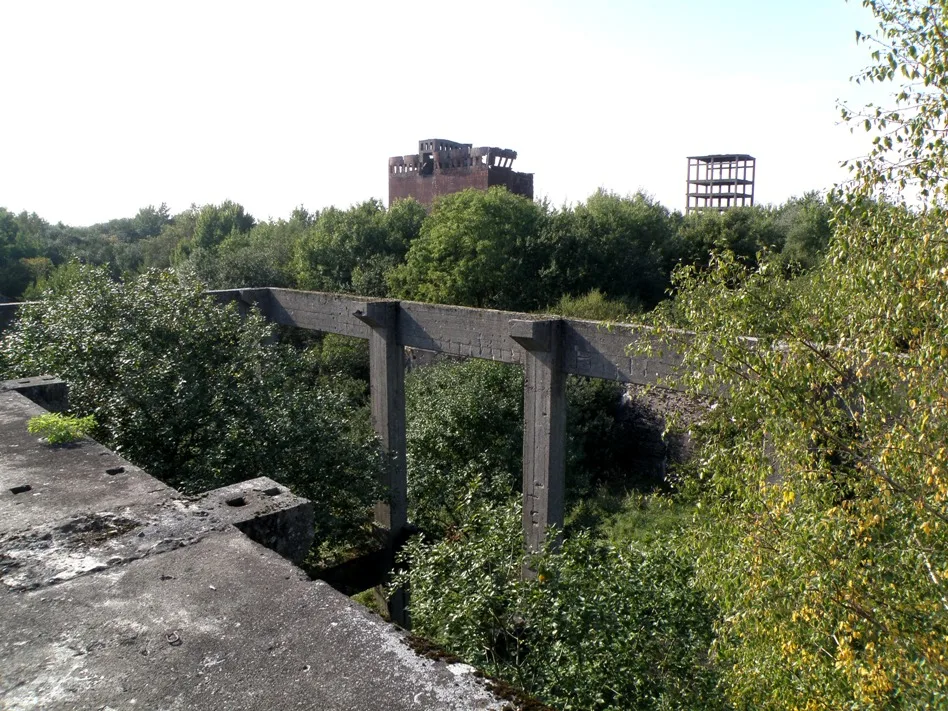
What remains of the plant are a coal elevator, groups of silos, the skeletons of halls and above-ground air-raid shelters, which Wikipedia describes as seven long ones, six small ones and individual shelters of the Splitterschutzzelle and Westermann types. The flooded underground is not open to the public. According to Wikipedia about 600 bats inhabit it, and the area has been protected as a refuge.
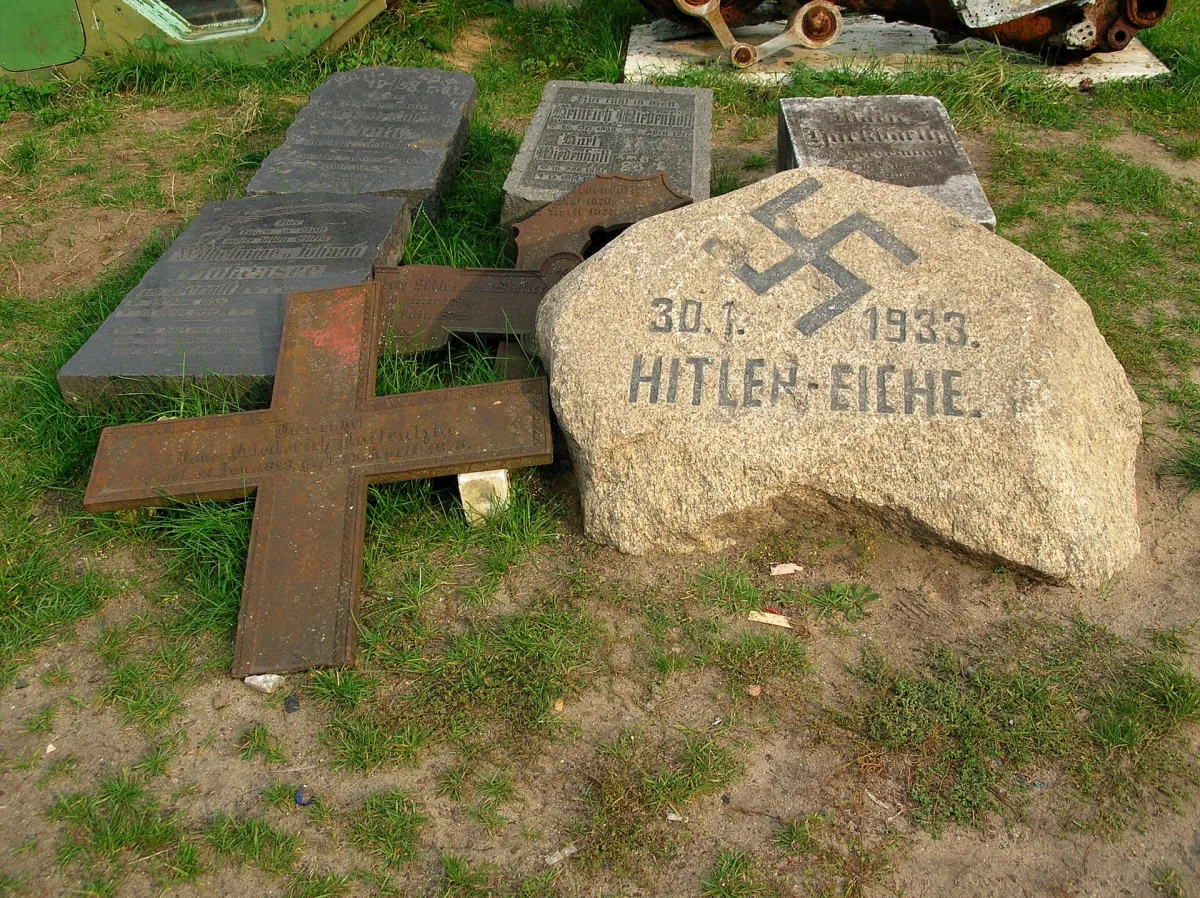
The remains of the plant are open to visitors through the Association of Friends of the Police Land “Skarb”, which has laid out an educational trail. In two shelters on Spółdzielcza Street is the “Skarb” Historical Museum, where since 2010 an exhibition on the history of the town, the plant and the camps has been on display. The ruins of the former synthetic petrol factory are a post-industrial site, where one moves only along the marked route. The rules for visiting are given by the association.
Be the first! Add a comment.
You need to log in to add a comment.
Log in