
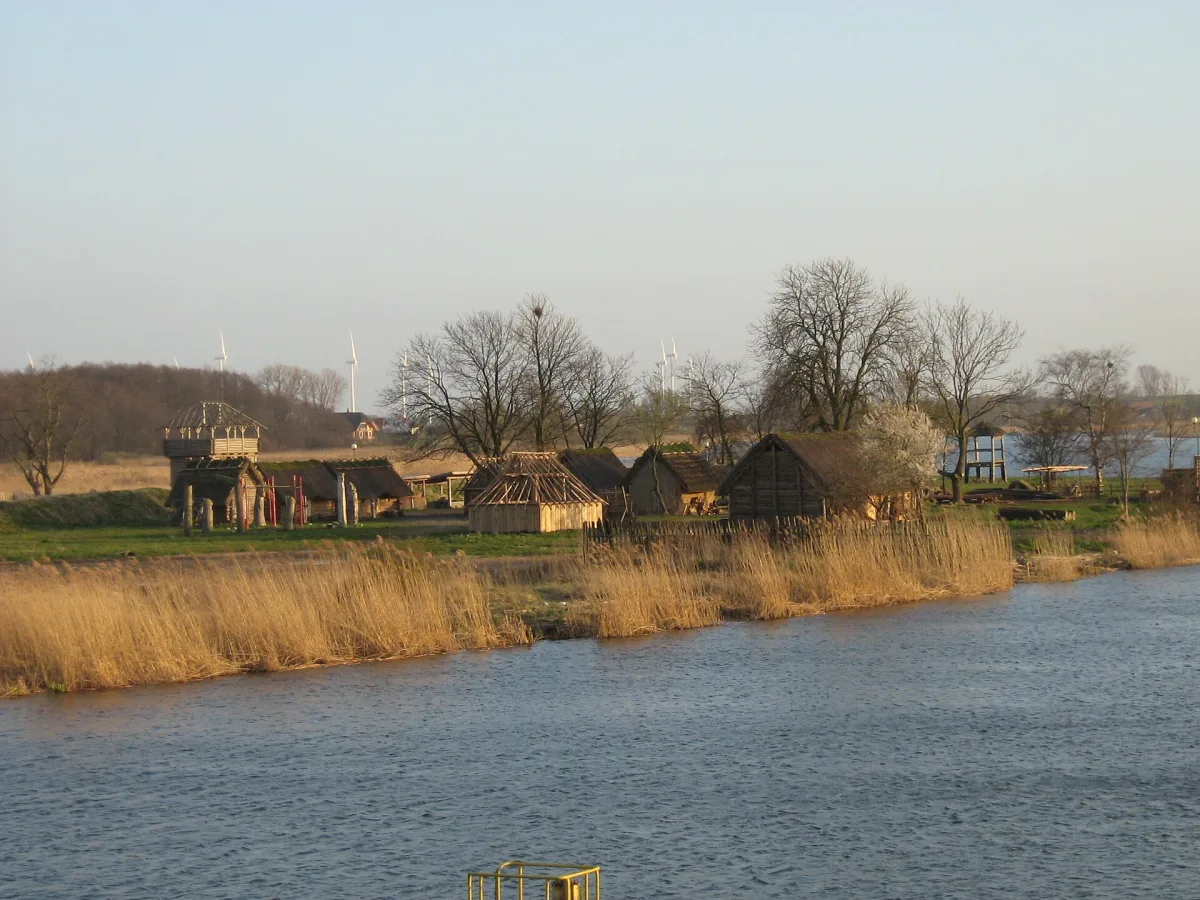
Wolin has two stories about the early Middle Ages. The first is told by the artefacts in the museum, the second by a reconstruction on the bank of the Dziwna: ramparts, a palisade, huts and a quay with boats, built to show what a town of a thousand years ago may have looked like. Behind this undertaking stands the association Centrum Słowian i Wikingów (Centre of Slavs and Vikings), and its best-known event is the annual festival.
The association and the open-air museum: who and when
The full name of the organisation is the Association Centre of Slavs and Vikings "Wolin-Jomsborg-Vineta". Wikipedia gives inconsistent data on its beginnings. The information box shows a founding year of 1990 and registration on 27 March 2002, while in the text of the entry the association is said to have been registered in Szczecin on 3 June 2003. It is safe to say that it has operated since the beginning of the 21st century, and traces of its work go back even earlier, because the festival began in 1993. Wikipedia notes that the aim of the association is to promote Wolin, in particular by building an archaeological open-air museum.
The open-air museum was opened on 7 April 2008 on Wolińska Kępa, within the town limits of Wolin. Wikipedia writes that it was opened by the president of the association. At the beginning visitors could see 13 structures referring to the early medieval buildings of Wolin, surrounded by defensive ramparts and a fragment of a palisade with a gate and a turret. Over time the number of huts grew: according to the same Wikipedia, in 2011 one of 25 huts burned down, and in 2014 two more were destroyed in a fire. The portal polskieszlaki.pl today describes several dozen replica huts, which can be entered to see the modest furnishings. This portal calls the island on which the open-air museum lies Ostrów, while Wikipedia uses the name Wolińska Kępa. This difference is most likely two names for the same area on the Dziwna.
What exactly is reconstructed
The open-air museum recreates the buildings of a settlement from the time when Wolin was, according to the Encyclopedia of West Pomerania, one of the most impressive craft and trading centres on the Baltic. According to the description on polskieszlaki.pl, there are huts, a gate with ramparts and fortifications, and a quay with a large boat. A boatyard was also built, recreating Slavic and Viking clinker-built boats and dugout canoes. The original plans also included the hut of a coiner, a potter, a fisherman and an amber worker, and a medieval port. They are complemented by workshops of vanishing trades: carpentry, blacksmithing, pottery and weaving, in which copies of archaeological artefacts are made, among them many found in Wolin itself.
Craftsmen in period costume work by the huts, and at the open-air museum demonstrations of old crafts and stagings of fights of medieval warriors are held from time to time. According to Wikipedia, films have been shot here several times, among others for Polish Television and the History Channel. The genuine artefacts that served as a model can be seen in the museum in the town centre, and the original burial ground from the 9th and 10th centuries lies on Wzgórze Wisielców (Gallows Hill). The open-air museum is a reconstruction, not a historic monument: the appearance of the huts is based on the results of excavations, but not every detail is confirmed.
The Festival of Slavs and Vikings as a custom
According to Wikipedia, the festival has been held annually since 1993, in August. The idea was taken from the Icelandic Jómsvíkinga saga of the 13th century, which tells of a brotherhood of warriors from the stronghold of Jomsborg, which according to the saga stood on the island of Wolin. The saga is a literary tradition, not a document, and researchers still debate how much truth it preserves. The first festival was opened on 2 July 1993, and the sponsors and organisers were Danes led by Professor Geoffrey Bibby. The main feature then was Icelandic horses brought from Denmark. In 1999 the festival was moved to Wolińska Kępa, where the reconstruction of the stronghold has been gradually built since then.
The programme has been fixed for years. Wikipedia lists reconstructions of battles: the storming of the stronghold, the burning of a village, stagings of raids, as well as rituals based on the sagas, such as a wedding and a funeral. Replicas of Viking and Slavic ships sail on the Dziwna, rowing races are held, and re-enactors pitch tents, cook according to medieval recipes and show crafts: pottery, weaving, blacksmithing, shoemaking, the making of jewellery and chain mail. At the fair one can buy replica weapons and clothes and try old dishes, and children have their own playground and tournaments. Since 2005 international academic sessions devoted to the peoples of the Baltic have been held during the festival. The centre's website also lists a gathering of Slavs and Vikings and experimental archaeology workshops.
How to combine it with the rest of the town
The open-air museum lies close to the centre of Wolin, and in the area there is also the Wolin Port on the Dziwna strait. When looking at the replica huts and boats, it is good to bear in mind that this is a modern interpretation, and the original traces of the town, which Adam of Bremen called the largest in Europe, lie beneath today's buildings and in the museum's collections. From the open-air museum itself one takes away above all an impression of scale and everyday life, not evidence.

Be the first! Add a comment.
You need to log in to add a comment.
Log in