
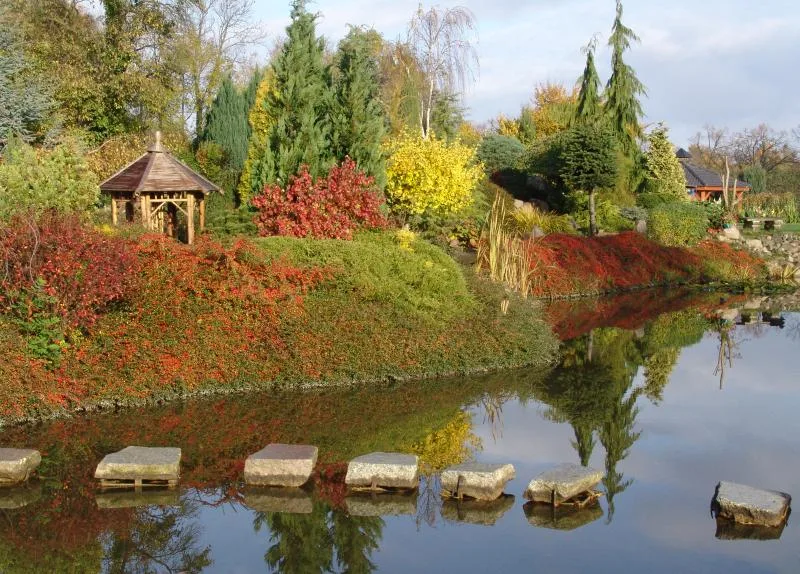
Foresters' arboreta and the Borsigs' palace garden
Tree collections in West Pomeranian Voivodeship have several different origins. Some were founded by foresters to test which foreign species would cope with the Pomeranian climate, others grew out of parks next to palaces, and still others out of cemeteries converted into urban greenery. This is easy to see when the three oldest places are compared.
Karnieszewice Arboretum lies about 15 km north-east of Koszalin, in forests belonging to the Karnieszewice Forest District. According to Wikipedia it covers 19.04 ha, but 4.80 ha with collections are open to visitors. It was most probably founded in 1881, which is commemorated by a boulder inscribed Pom. Forst. Verein 1881: the Pomeranian Forestry Society was then engaged in acclimatising foreign trees that could be useful in forestry. The main axis of the garden is the Douglas fir avenue. According to Wikipedia the Douglas firs here are among the largest in Poland and reach up to 48 m in height. Among the younger plantings, collections of rhododendrons, maples, beeches and oaks are being developed. Entry is free, and the current rules are given by the forest district.
Glinna Dendrological Garden is an arboretum on the edge of the Beech Forest, managed by the Gryfino Forest District. Wikipedia states that the garden was most probably founded around 1911, but detailed archive data are lacking. As early as 1823 private tree nurseries were set up on this land, and in 1870 they were taken over by the state forest district in Śmierdnica. Most of the oldest exotic trees date from that time. According to the forest district the garden lies on the south-eastern edge of the Beech Hills, sheltered by moraine hills, and the favourable microclimate allows plants sensitive to frost to be grown. More than 800 species and cultivars of trees and shrubs grow here, and the oldest tree is a shagbark hickory, according to Wikipedia about 180 years old. According to Wikipedia the garden covers about 6 ha, and selected specimens are described under QR codes in the garden.
Przelewice Dendrological Garden has a completely different history, because it grew out of a park next to a palace in Pyrzyce County. The sources give the starting dates differently: the garden's website gives 1805 as the beginning of an English-style park, while Wikipedia writes of a palace park from about 1814. The present character of the garden, however, is the work of 1933-1938, when the owner of the estate, Conrad von Borsig, converted the park into a dendrological collection to a design by Karl Heydenreich of the Späth firm. Wikipedia therefore gives 1933 as the moment the arboretum was founded, and the park was entered in the heritage register in 1976. The whole covers about 45 ha, of which 30 ha, together with the palace, are open to visitors, and about 1200 species grow here. The symbol is the dove tree, whose flower found its way into the coat of arms of Przelewice municipality. The garden is now looked after by the institution Ogrody Przelewice, and its website gives opening hours and tickets.
A dendrological park in the centre of Koszalin
Not every tree collection requires a trip into the forest. Koszalin Dendrological Park lies in the city centre, in the valley of the Dzierżęcinka river, and covers 7.74 ha. According to Wikipedia, trees growing here include Japanese maple, leatherleaf viburnum and numerous cultivars of spruce. On the grounds stands a historic mill known as the Millers' Palace (Pałac Młynarzy). The park is the northernmost part of the green belt crossing the city, so it is well suited to a short walk before a visit to the museum, which is about 200 metres away.
Dobrzyca: themed gardens and a maze
Another idea for a garden altogether is the Hortulus Gardens near Koszalin. These are two separate sites belonging to the same company, which the gardens' website suggests visiting in a single day.
Hortulus Theme Gardens in Dobrzyca, in Będzino municipality, were founded in 1992. According to Wikipedia, on about 5 ha 28 gardens of different styles were combined, created in 1992-2009. There is a Japanese, a French, a Mediterranean and an English garden, as well as a garden in the style of Antoni Gaudí. A separate group is formed by the gardens of the senses: colours, light and shade, scent and aroma, and sound and silence. Wikipedia states that about 6 thousand species and cultivars grow here, and the location in hardiness zone 7B has made it possible to gather plants rarely found in Poland, for example Japanese umbrella pine, giant sequoia and dawn redwood.
Hortulus Spectabilis Gardens is the second complex, usually given under the address Kolonia Smolne. Visits began here in June 2014, and the project itself has been under way since 2003. According to the gardens' website the hornbeam maze was created in April 2003 from 18 thousand seedlings, covers 1 ha, and its corridors together are over 3.2 km long. Wikipedia calls it the largest hornbeam maze in the world and gives 3250 m of paths. In the middle stands a 20-metre viewing tower, built in the form of a double strand of DNA, from which the Baltic can be seen in good weather.
Two traces of Stefan Kownas
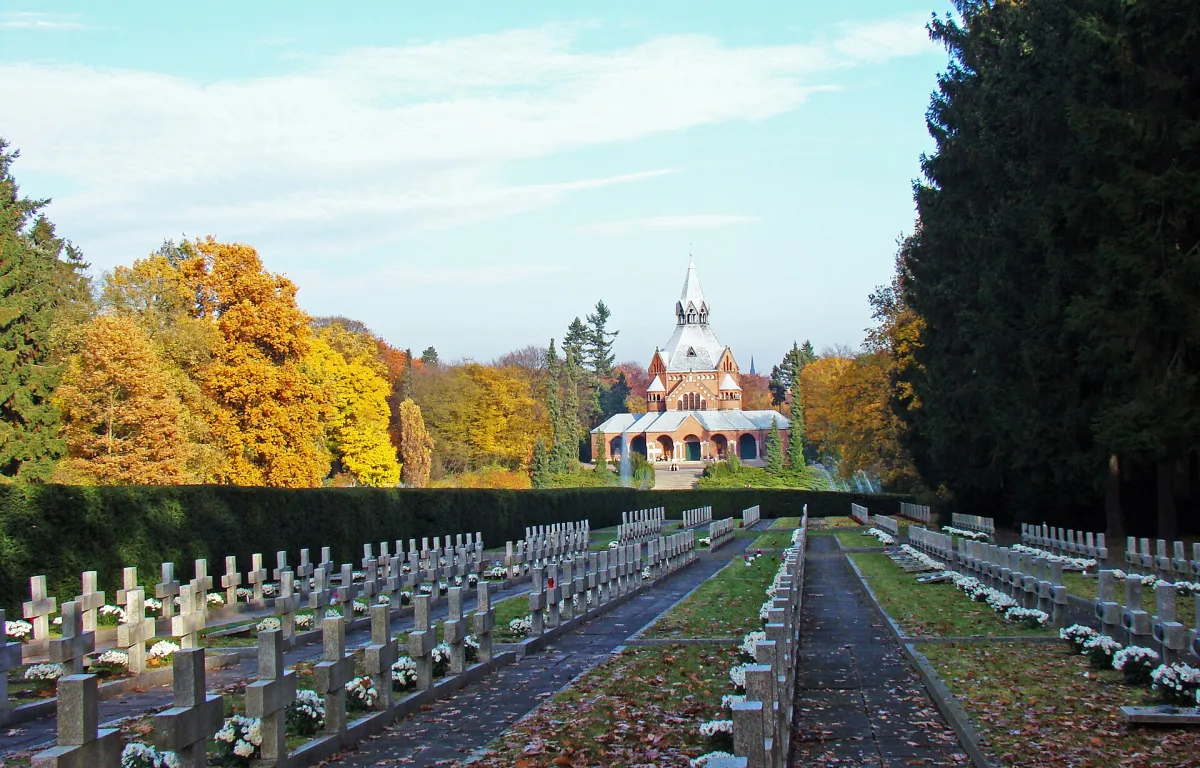
In Szczecin and its surroundings two places bear the name of the botanist Stefan Kownas, and they differ from each other as much as is possible. Stefan Kownas Dendrological Garden is a city park of 15.5 ha in Niebuszewo-Bolinko, laid out in 1973-1974 on the site of the former Majdański Cemetery. According to Wikipedia, Kownas organised and headed the Department of Botany at the Agricultural Academy in Szczecin. The layout of paths and terraces still recalls the cemetery past, and in the park grow more than 300 yews and old beeches. This is the site of a former cemetery, so it is worth keeping quiet there.
The professor's name is also borne by the Trawiasta Buczyna nature reserve on the south-eastern edge of the Beech Forest, established in 1956. It protects old beech woodland on a flat moraine with numerous erratic boulders and covers 78.56 ha. The reserve is a forest, not a collection of trees brought in from other parts of the world.
The Rose Garden as a garden with a history
Szczecin also has a specialist garden in the city. The Rose Garden, known as Różanka, was founded in 1928 on the occasion of a gardeners' congress. According to Wikipedia, the Bird Fountain with sculptures by Kurt Schwerdtfeger was added in 1935, and in 2006-2007 the garden was rebuilt in the style of the 1930s. Besides roses, exotic trees grow here, including ginkgo and dawn redwood.
How to fit it into a plan
For one day Glinna combines well with the nature reserves of the Beech Forest and with Szczecin, while Karnieszewice, Koszalin and Dobrzyca lie in one area, so they make a second route. Przelewice is a separate trip towards Pyrzyce County. Opening hours, tickets and rules of entry are given by each garden on its own website.


Be the first! Add a comment.
You need to log in to add a comment.
Log in