
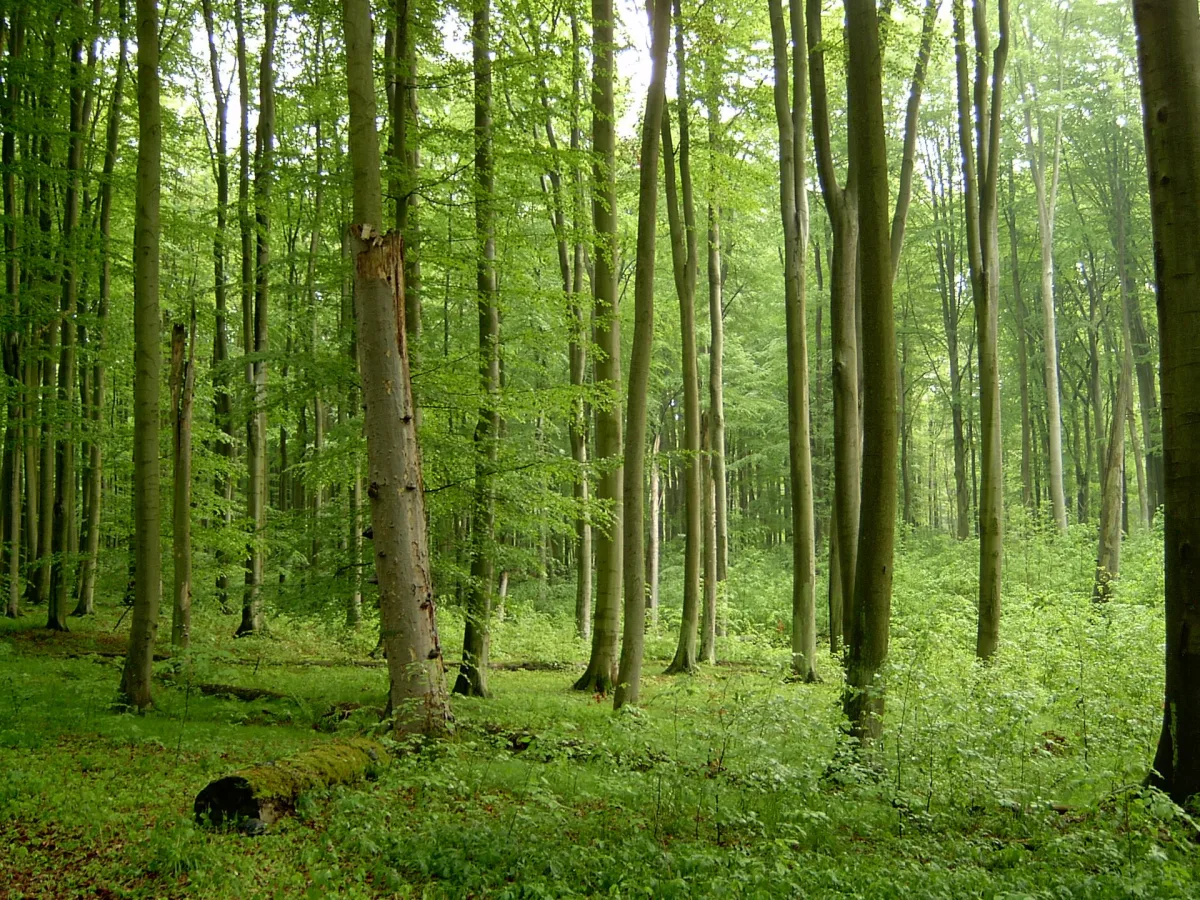
In the Szczecin Landscape Park “Puszcza Bukowa”, areas of special natural value have been placed under reserve protection. According to the park manager, the Complex of Landscape Parks of the West Pomeranian Voivodeship, there are seven of them: five established in 1956, one in 1959 and one in 2008. Wikipedia, in its entry on the Beech Hills, also speaks of seven reserves. Each of them is described here, and along the way it becomes clear that the areas given are not uniform.
What a Pomeranian beech forest is
The descriptions of the reserves repeatedly use the term Pomeranian beech forest (buczyna pomorska). Wikipedia redirects this entry to the fertile lowland beech forest, that is beech woodland on fertile soils, typical of the lowlands. In the Beech Forest it occurs in several varieties, and alongside it grow acidic beech forests, spring beech forests, riparian woodland and alder carr. The variety comes, according to Wikipedia, from the rich relief of the Beech Hills and the dominance of fertile, fresh and moist habitats. There are many springs here because, as the park manager writes, a varied relief of the terrain is superimposed on the arrangement of permeable and impermeable layers.
The reserves of 1956
Bukowe Zdroje, named after Prof. Tadeusz Dominik, is a forest reserve established in 1956. The park manager gives an area of 205.90 ha, and Wikipedia's entry on the reserve itself 221.28 ha, with the information that the area was enlarged in 2005. It protects varied woodland: Pomeranian beech forest, riparian woodland and oak-hornbeam forest in the valleys, and on the slopes acidic beech forests and oak-beech woods. In 1982 the reserve was named after Tadeusz Dominik, a botanist and founder of the Polish school of mycorrhiza, that is research on the coexistence of fungi with tree roots. According to the entry on the reserve it is the largest reserve in the Beech Forest.
Trawiasta Buczyna, named after Prof. Stefan Kownas, has according to the manager 78.52 ha, of which 20.12 ha is under strict protection. Wikipedia, in its entry on the reserve, gives 78.56 ha. It was established to protect a fragment of beech woodland with rich communities of herbaceous plants in the undergrowth, mainly wood melick. The forest also contains transitional bogs, riparian woodland and alder carr. The reserve has borne the name of the botanist Stefan Kownas since 1985.
Źródliskowa Buczyna, named after Jerzy Jackowski, protects, according to Wikipedia, a spring beech forest rich in orchids in the undergrowth. The manager gives 121.02 ha, including 58.16 ha of strict protection. The entry on the reserve speaks of 155.44 ha and of an enlargement in 2005. The reserve has commemorated its patron, the forester Jerzy Jackowski, since 1984, and a granite boulder with a plaque stands by the trail.
Kołowskie Parowy, named after Józef Lewandowski, covers 24.01 ha according to the manager, and 24.34 ha according to Wikipedia in its entry on the reserve. It is the smallest of the park's forest reserves. It takes in high moraine rises, cut by ravines, karst springs and small streams. In stands about a hundred years old, beeches reach, according to Wikipedia, up to 40 m in height. Through the reserve flows the Utrata stream, which according to the entry suddenly disappears and just as suddenly reappears on the surface. The reserve received the name of the forester Lewandowski in 1982.
Buczynowe Wąwozy protects a fragment of old-growth Pomeranian beech forest and of alder riparian woodland. The manager gives 39.94 ha. Wikipedia's entry on the reserve describes 56.53 ha, all of it under strict protection, and adds that in 2005 the area was enlarged and given the name of the geobotanist Florian Celiński. Among rare plants Wikipedia lists coralroot bittercress, wood fescue, wood melick and mountain buckler-fern.
Yews in Zdroje and fungi in Osetno
Zdroje is the smallest reserve in the park: a floristic reserve, established in 1959 on 2.12 ha. It protects a site of naturally regenerating yew. Formerly the park of Toepfer, owner of the nearby chalk mine, stood here. After the park was destroyed the yews ran wild and according to the manager grow today in the forest, as they once did. The reserve lies in Zdroje Forest Park in Szczecin.
Osetno is the youngest reserve: it was established in 2008, on 14 November according to Wikipedia. The aim of protection is to preserve numerous sites of rare and endangered fungal species and a complex of beech forests, riparian woodland, spring alder carr, springs, bogs and small ponds. Wikipedia calls it one of the first mycological reserves in Poland. The area has three values: the park manager gives 122.22 ha, Wikipedia in its entry on the Beech Forest 111.59 ha, and in its entry on the reserve 112.22 ha.
Springs and ravines: where the relief comes from
The park manager indicates that the emergence of springs in the Beech Forest is influenced by the geological structure, that is the alternating arrangement of permeable and impermeable layers. The spring areas lie in the reserves of Bukowe Zdroje (where there is a spring called Ciurkadełko), Osetno and Kołowskie Parowy, and the waters feed, among others, the Rudzianka, the Wielka Niedźwiedzianka, the Kłobucki Stream and the Dobropole Stream. The ravines and valleys are part of the moraine Beech Hills, shaped by the ice sheet and later erosion, as Wikipedia writes in its entry on the Beech Hills.
Walking among the reserves
The park manager states that all the reserves are open to visitors, but only along marked trails, and some have strict protection. The trail junction by Źródliskowa Buczyna lies on the side of the Glinna Dendrological Garden. In turn, Lake Glinna Wielka lies at the southern end of the forest. Wikipedia also lists three proposed reserves: Węglino, Lisi Potok and Jezioro Czarne, which do not yet have reserve status.


Be the first! Add a comment.
You need to log in to add a comment.
Log in