
An island joined by a causeway
Nowe Warpno lies on the Szczecin Lagoon, right on the border with Germany. According to Wikipedia the settlement of Wapene was first mentioned in a document of Duke Barnim I of 1184 and lay on an island joined to the mainland by a causeway. The town was chartered, as the same article states, most probably in 1295, by transfer from nearby Podgrodzie, where a Slavic stronghold stood.
The present peninsula on which the centre lies was formerly not joined to the land. Wikipedia describes how the great Swedish fortifications were taken down in the 19th century, the moat was filled in and the island became a peninsula. In 1846 a decision was made to build a causeway joining Stare Warpno (today German Altwarp) with Nowe Warpno. The project was approved only in 1908 but, according to Wikipedia, was never carried out.
The Swedish fortress and the fire of 1692
The Peace of Osnabrück after the Thirty Years' War awarded these lands to Sweden, which ruled the town until 1720. According to Wikipedia the Swedes sought to fortify the town on the island quickly, and in 1678 the fortification engineer Christian Kanxdorff presented a design for a fortress joining three islands. The plans were only partly carried out.
In 1692 the main part of the town burnt down in a great fire. The article on Nowe Warpno states that the town hall and the church, among other buildings, were destroyed, and after the fire most of the inhabitants moved to Altwarp. After reconstruction they returned, and in the 18th century the town had about 1,300 inhabitants, although Wikipedia marks this figure as needing a source note.
A half-timbered town hall
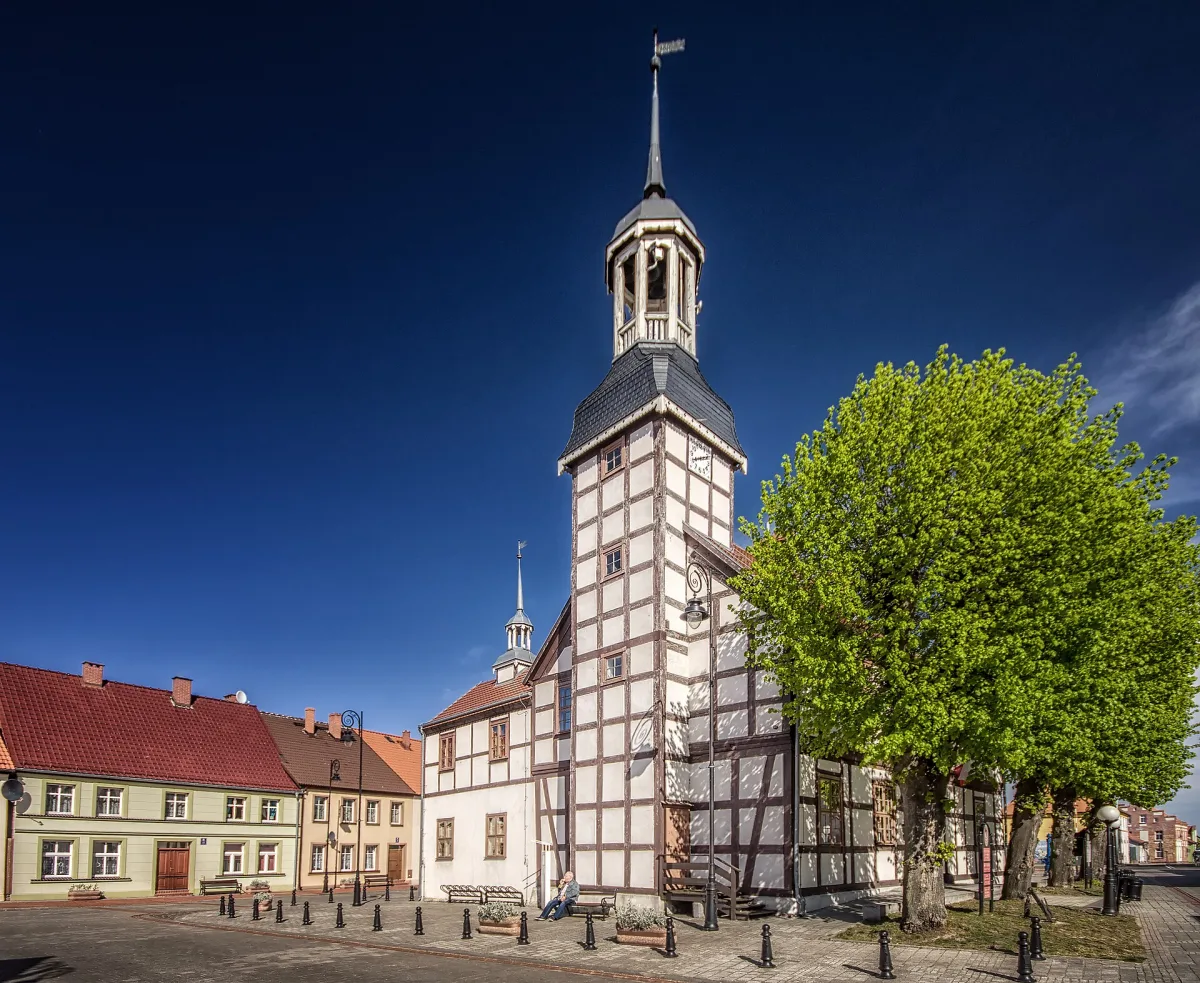
The Town Hall on Zwycięstwa Square was built after this fire, in 1697. This date is given both by the article on the town and by the separate Wikipedia article on the town hall. The building has a half-timbered structure, that is, Prussian wall (mur pruski); all the wings were built in this technique, and on the western side stands a square clock tower. The article on the town hall describes it as one of the architecturally most interesting buildings of this type in Poland and the most valuable historic monument of the town. It has been the seat of the town authorities from the start and still houses the office today, so the interiors are official in character.
The church was also rebuilt. The Church of the Assumption of the Blessed Virgin Mary stands right next to the town hall. According to Wikipedia the present brick body dates from the 15th century, and the tower was added in 1693, after the fire. The tower was thoroughly rebuilt in the Neo-Gothic style in the 19th century. The Baroque high altar inside is dated to 1704.
The battle on the lagoon in 1759
In 1715 the town was taken by the Prussians, and in 1720 they incorporated it into the Prussian state. During the Seven Years' War, as Wikipedia states, on 10 September 1759 a naval battle between the royal navies of Sweden and Prussia took place on the Szczecin Lagoon. The article on Nowe Warpno places it in the vicinity of the town, calls it the first naval battle in the history of the Prussian fleet and notes that it ended in a Swedish victory, with the Swedish flotilla commanded by Captain Rutensparne.
The article on the lagoon itself describes the same event somewhat differently: the battle was said to have taken place near the Rzepczyńska Shoal, and the Prussian fleet lost to the Swedes. Wikipedia gives no separate name for the battle. On land there is no single place that commemorates it, and the lagoon is best viewed from the marina or from a trail. The cycling loop around the Szczecin Lagoon is, according to the West Pomeranian cycling portal, 296 km long and is Polish-German, and for the route on the Polish side the portal mentions in Nowe Warpno the town hall and the marina.
Karszno, a former suburb
In the 18th century the town expanded to the south. According to Wikipedia there was a suburban district there called Albrechtsdorf, today's Karszno, with a mill and a town weigh-house. In Karszno stands St Hubert's Church. The article on the town gives it as half-timbered from the 18th century, but the date is disputed: the weathervane on the tower bears the year 1793, while Swedish maps from before 1709 already show a church in Karszno, although it is not known whether it is the same building. After the war the building fell into ruin, and it was rebuilt in 1998. The interior has a hunting decor.
Not far away, on Lake Nowowarpieńskie, stands the Neo-Renaissance palace in Karszno of 1898. According to the heritage register and Wikipedia it was built by Albrecht von Enckevort, of a family that owned the Karszno estate from 1766 to the end of the Second World War. The palace is privately owned, so it is viewed from the outside, with respect for the owner.


Be the first! Add a comment.
You need to log in to add a comment.
Log in