
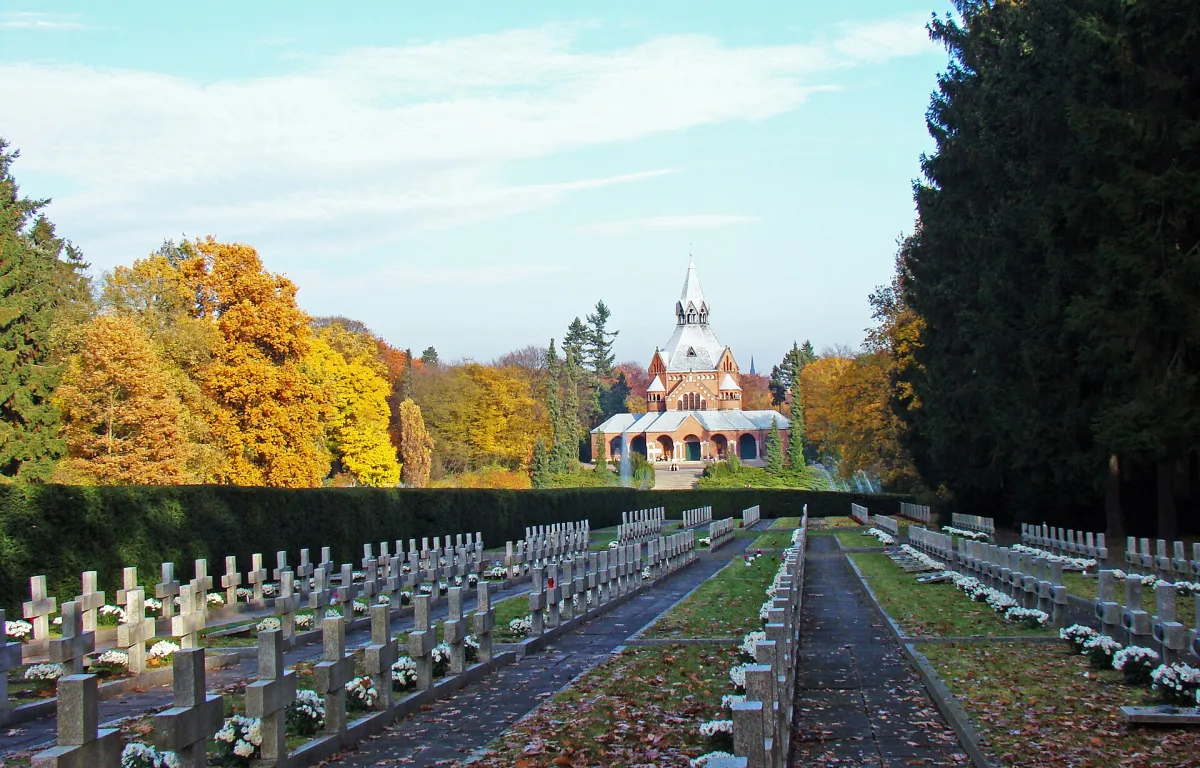
A cemetery designed as a park
Szczecin decided on a new necropolis after 1873. According to Wikipedia, the small churchyards were by then overcrowded, and the city had ceased to be a fortress, so open land became available. Farmland was chosen between today's Mieszka I and Ku Słońcu streets and the railway line. This is how the Szczecin Central Cemetery came into being, which until 1945 was called the Hauptfriedhof, that is, the Main Cemetery.
The design was prepared by Wilhelm Meyer-Schwartau, and the layout was given its final shape in 1918 by Georg Hannig, the cemetery's first manager. Meyer-Schwartau's authorship is given consistently by Wikipedia and by the website devoted to the cemetery. According to Wikipedia, in 1891-1921 he was the municipal building councillor of Szczecin and also designed the Chrobry Embankment, together with the building that today houses the National Museum.
The model was Hamburg's Ohlsdorf. Wikipedia adds that for the planting, the necropolises of Vienna and Berlin were also referred to. The designers wanted, as Wikipedia puts it, to depart as far as possible from burying the largest possible number of graves on the smallest possible area, and to make the cemetery resemble a park-garden. A large part of the site was given over to lawns, water bodies, hedges and wide avenues lined with rows of trees. In the older, eastern part the avenues run in curves and make use of the natural lie of the land; there are steps, wooden bridges and even viewpoints. The regulations specified what kinds of gravestones were permitted. In the western part two streams flow, the Cicha and the Jasna Woda.
Size and differences between sources
The data on the opening and the area differ depending on the source, so they are given with the names of the sources.
- Opening: Wikipedia gives 6 December 1901, National Geographic Polska 1 December 1901. Wikipedia also says that the cemetery was laid out in 1899-1900, and that work on the gate, chapel and administration buildings continued in 1900-1903.
- Area: the website devoted to the cemetery and Wikipedia give 172.33 ha, National Geographic Polska 173 ha. The Wikipedia entry on Szczecin lists 163 ha.
- Place in Europe: according to Wikipedia the cemetery is third by area, after Ohlsdorf in Hamburg and the Zentralfriedhof in Vienna. National Geographic Polska ranks it behind the cemeteries in Manchester and Hamburg.
- Number of burials: according to Wikipedia, more than 300,000 people since the opening, including 57,000 before 1918. The cemetery's website gives the same figure.
Wikipedia and the cemetery's website both call it the largest cemetery in Poland.
The gate, the chapel and the crematorium
The neo-Romanesque main gate, 77 metres wide, was built in 1901-1903, and the sculptures were made by the Szczecin artist Bolcke. In September 1941 it was damaged by an air raid in which all the cemetery's documentation burned. Rebuilding began in 1959 and was completed in 1963. The dome with a cross was not recreated, and a funeral chapel was built in place of the eastern wing. A thorough renovation of the gate was carried out in 2008.
The main chapel was built to a design by Meyer-Schwartau in 1900-1902 on a Greek cross plan, with a tall dome. It stands on a rise, and to the west an open space with a basin and a fountain extends in front of it. In 1924-1925 a crematorium with a sixteen-metre chimney was added. After the war the chapel was not used. In May 1981, during renovation, a fire broke out in it that consumed a large part of the building, including the dome. The rebuilding took 13 years, and the first funeral took place in March 1994. A second, modernist chapel from 1928-1930 on Leszczynowa Avenue was destroyed in an air raid in 1943, and its ruins were demolished in 1984.
Trees and the botanical trail
According to Wikipedia, about 415 species and varieties of trees and shrubs grow here. Wikipedia lists North American trees, such as the eastern hemlock, northern red oak and ponderosa pine, Far Eastern ones, such as ginkgo and Japanese larch, and European ones, such as yew, plane and Serbian spruce. Among the more interesting specimens it names the Caucasian wingnut, the yellowwood, the tulip tree and the sweet chestnut. A similar layout with species gathered from different continents is found at the Stefan Kownas Dendrological Garden, laid out on the former Majdan Cemetery.
In October 2010 a botanical trail was marked out in the eastern part of the cemetery, devised by Dr Marcin Kubus of the West Pomeranian University of Technology. According to Wikipedia, 32 boards about trees and shrubs were set up along it, although in the list of boards in the same entry the numbering goes up to 33. The trail begins and ends at the main gate. According to Wikipedia, the historical trail has 21 stations with bilingual boards.
Monuments and well-known names
According to Wikipedia, several dozen monuments stand in the cemetery. One of them is the monument dedicated to the sailors who did not return from the sea, unveiled on 15 October 1989 and designed by Małgorzata Szubert-Radnicka and Maciej Radnicki. Wikipedia also lists the monument to the Siberian deportees with a fragment of railway track, and the Katyn Cross.
Among those buried are figures linked to the history of the city. The gravestone of the Lord Mayor Hermann Haken was designed by Ludwig Manzel, and in 2006 it was reconstructed with funds from former German residents of Szczecin. On the historical trail stands a boulder commemorating the manufacturer Bernhard Stoewer, the founder of a car factory. In the plot of distinguished persons lie, among others, the painter Guido Reck and Florian Krygier, one of the founders of Pogoń Szczecin. A red sandstone stele of Meyer-Schwartau, also commemorating his wife, two sons and brother, was found by chance in 2002. In the lapidarium laid out in 2006-2007, several dozen gravestones from different parts of the cemetery have been gathered. The care of historic gravestones is the work of the Association for the Szczecin Central Cemetery (Stowarzyszenie na Rzecz Cmentarza Centralnego), founded in 2003.
Memorial plots
On the main axis of the cemetery lies the war plot, in which, according to Wikipedia, 3,379 Polish and Soviet soldiers are buried. Near the second gate the victims of December 1970 are buried. On Lipowa Avenue is the Jewish plot, the only active Jewish cemetery in the West Pomeranian Voivodeship. These are places of remembrance, and the cemetery is active, so the rules of entry and conduct are set by the administrator.


Be the first! Add a comment.
You need to log in to add a comment.
Log in