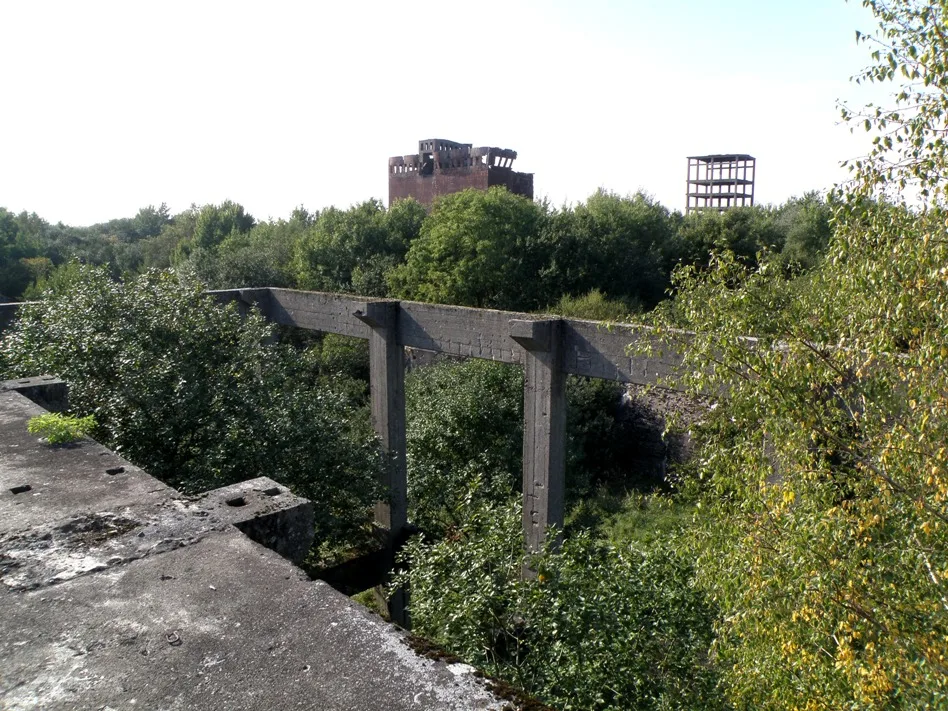
The former Hydrierwerke Pölitz plant with forced labour camps, today ruins and an educational trail of the “Skarb” Museum.
The synthetic petrol plant in Police, the German Hydrierwerke Pölitz, was one of twelve IG Farben plants producing liquid fuel from coal. During the Second World War forced labour camps and a concentration camp subcamp operated at the plant. Today ruins, bunkers and an educational trail remain.
Construction began in 1937 on the site of a plant that regenerated marine fuel. The plant covered 1,500 ha, of which 200 ha was compact industrial development. The fuel, produced by the Bergius process, went among other places to the German armed forces: the air force, the navy and the army. In 1943, according to the Wikipedia entry, the plant supplied 15 per cent of German synthetic fuels. During the war Police was incorporated into the city of Szczecin.
The expansion of the plant during the war relied on the labour of people brought in from conquered countries. Several camps operated on the plant's grounds and next to them, among them Pommernlager for Poles and prisoners of war, Tobruklager (from 1944 Jasenitzlager) for workers from western countries, Czechs, Germans and Italians, and the penal camp Hägerwelle. From June 1944 there was a subcamp of the Stutthof concentration camp and a branch of the Ravensbrück camp. The numbers of dead and murdered given in the literature vary widely, and given the gravity of the subject we give only numbers confirmed by institutions, which is why none are given here.
The plant was bombed many times by Allied aircraft, from September 1940. Information about the plant was passed on by Home Army intelligence as part of the so-called Operation Synteza. The last raids took place in early 1945. After the war, during the so-called Police Enclave, most of the equipment was taken away to the USSR, and further destruction was done by scrap collectors.
A coal elevator, groups of silos, the skeletons of production halls and above-ground air-raid bunkers have survived. Underground there are flooded tunnels and cellars, which are not open to visitors and are a protected refuge for bats. The remains have been adapted for visiting as part of the “Skarb” Historical Museum: a tourist and educational trail has been marked out, looked after by the “SKARB” Association of Friends of the Police Land. Exhibits connected with the plant are shown in the bunker at Spółdzielcza 31.

Be the first! Add a comment.
You need to log in to add a comment.
Log in