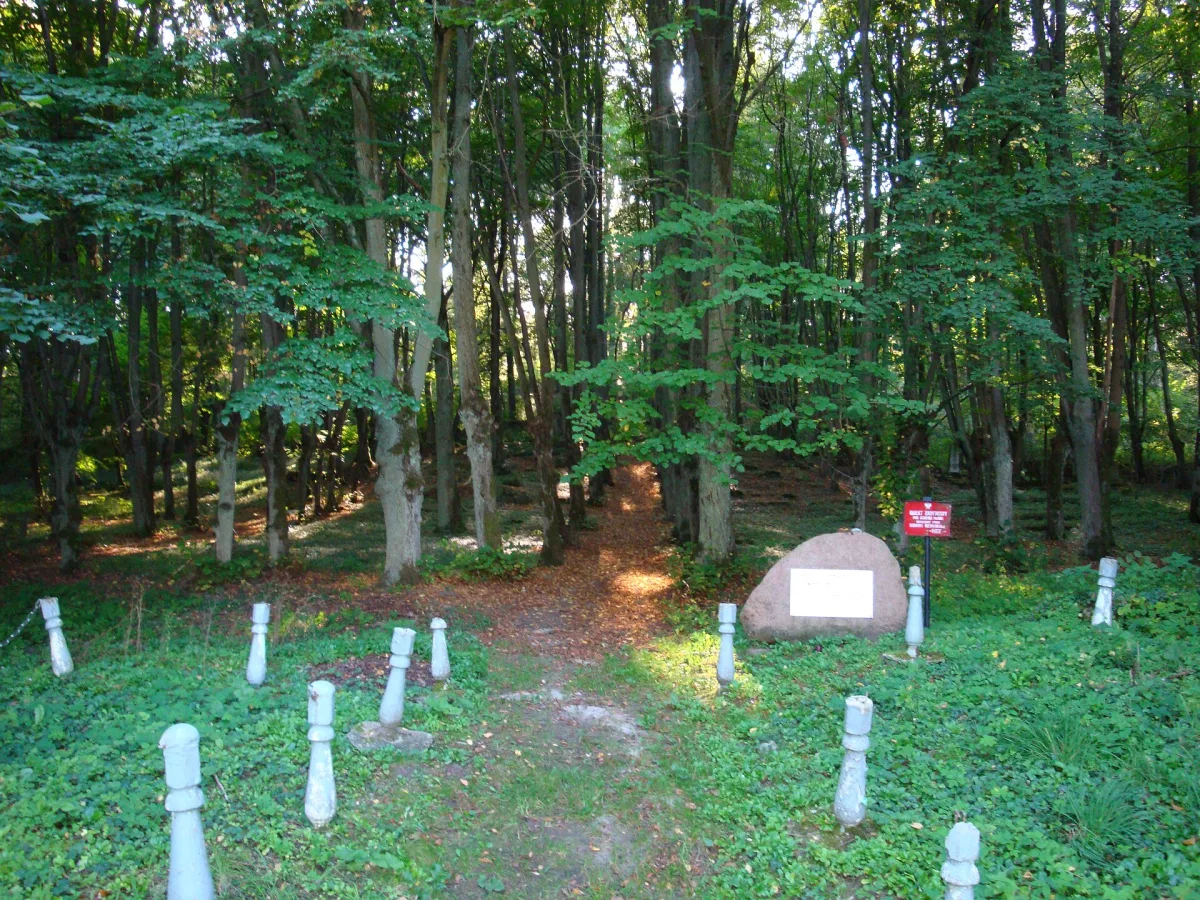
A Jewish cemetery with about 70 surviving gravestones, entered in the heritage register in 1989.
The Jewish cemetery in Świdwin lies about 3 km south-west of the market square, on Dobra Rycerskie Street, on a hill known as the Jewish Hill. A small part of the former necropolis has survived: about seventy gravestones, the layout of the plots and paths, and old trees. The description on the zabytek.pl website, prepared by the POLIN Museum of the History of Polish Jews, calls it the best preserved Jewish necropolis in West Pomerania.
The first Jewish family settled in Świdwin at the beginning of the 18th century. The cemetery was established in the 1770s and 1780s, and Jews from Sławoborze were buried here as well. The number of members of the community grew after 1820 and reached 387 around 1880, and then declined. At the beginning of the 1930s only 187 of them lived in the town. By the 1930s an estimated 400 to 500 people had been buried here.
On the night of 9 to 10 November 1938 both the cemetery and the synagogue were destroyed. The destruction of the necropolis continued in the following years. After 1945 graves were dug up and stone gravestones were stolen. Acts of destruction still occurred at the beginning of the 21st century.
The plot covers 0.41 ha and is roughly square. Mainly stelae and obelisks, the bases and surrounds of gravestones, and the remains of tomb chapels have survived. The site is enclosed by an old stone wall, in places low and damaged. Rows of lime trees grow here, along with individual oaks, sycamores and ash trees. The cemetery was entered in the heritage register in 1989. The documentation at that time recorded 72 surviving gravestones and 29 graves, and most of the inscriptions were in German on one side and in Hebrew on the other.
Since 2001 the cemetery has been looked after by members of the local Pentecostal Church. A stone with an information plaque in Polish and Hebrew was also set up then. Residents of Świdwin tidy the site several times a year, and since 2009 it has been owned by the Foundation for the Preservation of Jewish Heritage.

Be the first! Add a comment.
You need to log in to add a comment.
Log in