The largest library in West Pomerania, operating since 1905, with a Pomeranian studies reading room, special collections and a digital library.
The Stanisław Staszic Pomeranian Library is the largest library in West Pomerania, one of the largest in Poland, located on Podgórna Street in the centre of Szczecin. It began operating in 1905 as the City Library, and today it occupies two pre-war buildings joined by a connecting section and a modern building from the end of the 20th century.
The City Library of Szczecin (Stadtbibliothek Stettin) was given premises in an adapted mid-19th-century grammar school building and was opened on 3 October 1905. It owes its development to Dr Erwin Ackerknecht, who directed it in 1907-1945 and brought together valuable collections from the area of present-day West Pomerania. Among the nearly 200 thousand volumes with which the collection began were the holdings of school, church and society libraries and of donors, including the library of a Masonic lodge and of the Pomeranian Historical and Archaeological Society.
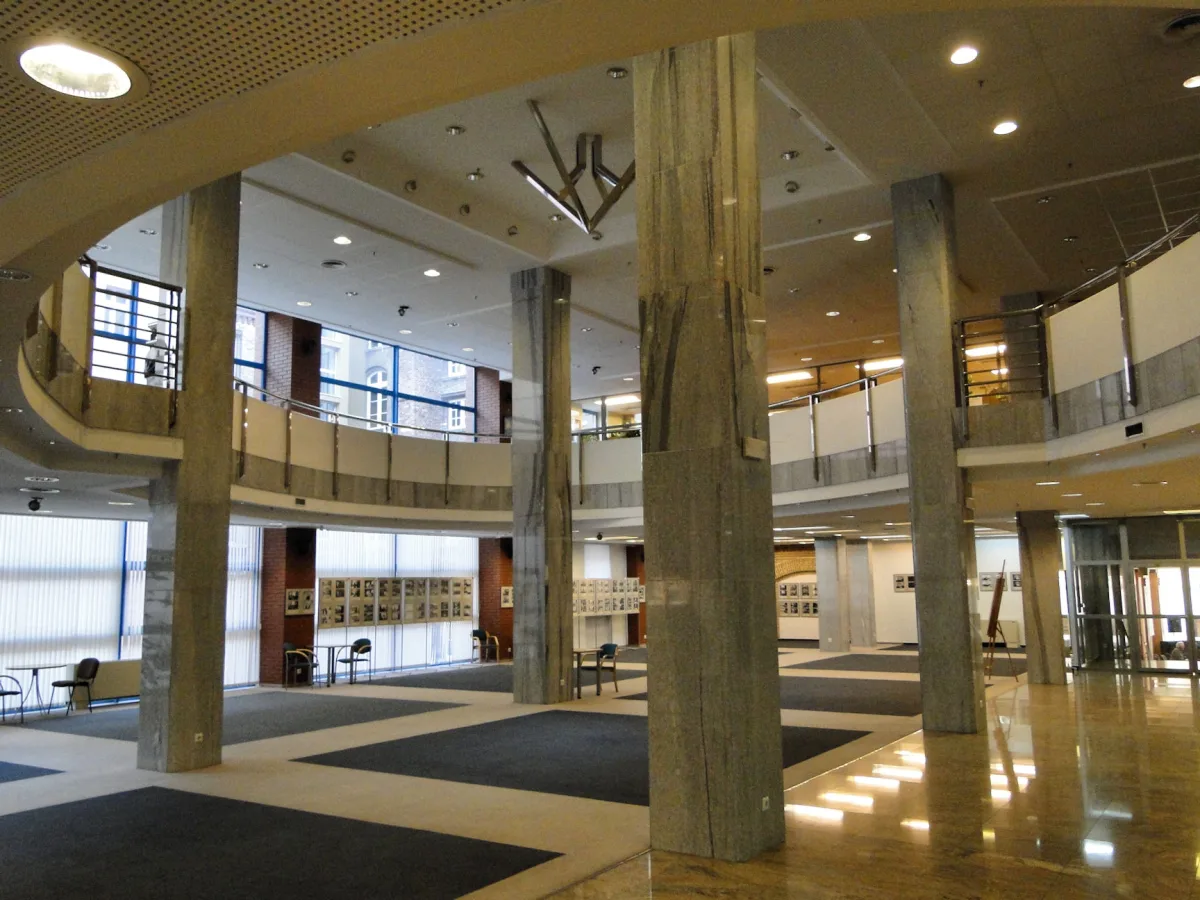
During the bombing in 1944 the building was partly damaged. On 12 July 1945 the library resumed operation as the first Polish library in the ruined city. In 1962 a new connecting section joined the two pre-war buildings, and in 1999 a modern building with an area of 10 thousand m² was opened, to a design by Zbigniew Paszkowski. The library has borne its present name since 3 October 1994, and the name of Stanisław Staszic was given to it in 1966, on the occasion of the Millennium of the Polish State.
The collections number about 1.5 million items: books, periodicals and special collections. Among the reading rooms and lending libraries there are also specialised ones:
The special collections include manuscripts and early printed books, iconographic collections and works of art, as well as cartographic ones. Since 2009 the West Pomeranian Digital Library “Pomerania” has operated, in which the region's historical collections can be viewed online. The library also organises exhibitions, lectures, book launches and literary meetings, and it is visited by about 300 thousand readers a year, most often students, researchers and pupils.

Be the first! Add a comment.
You need to log in to add a comment.
Log in