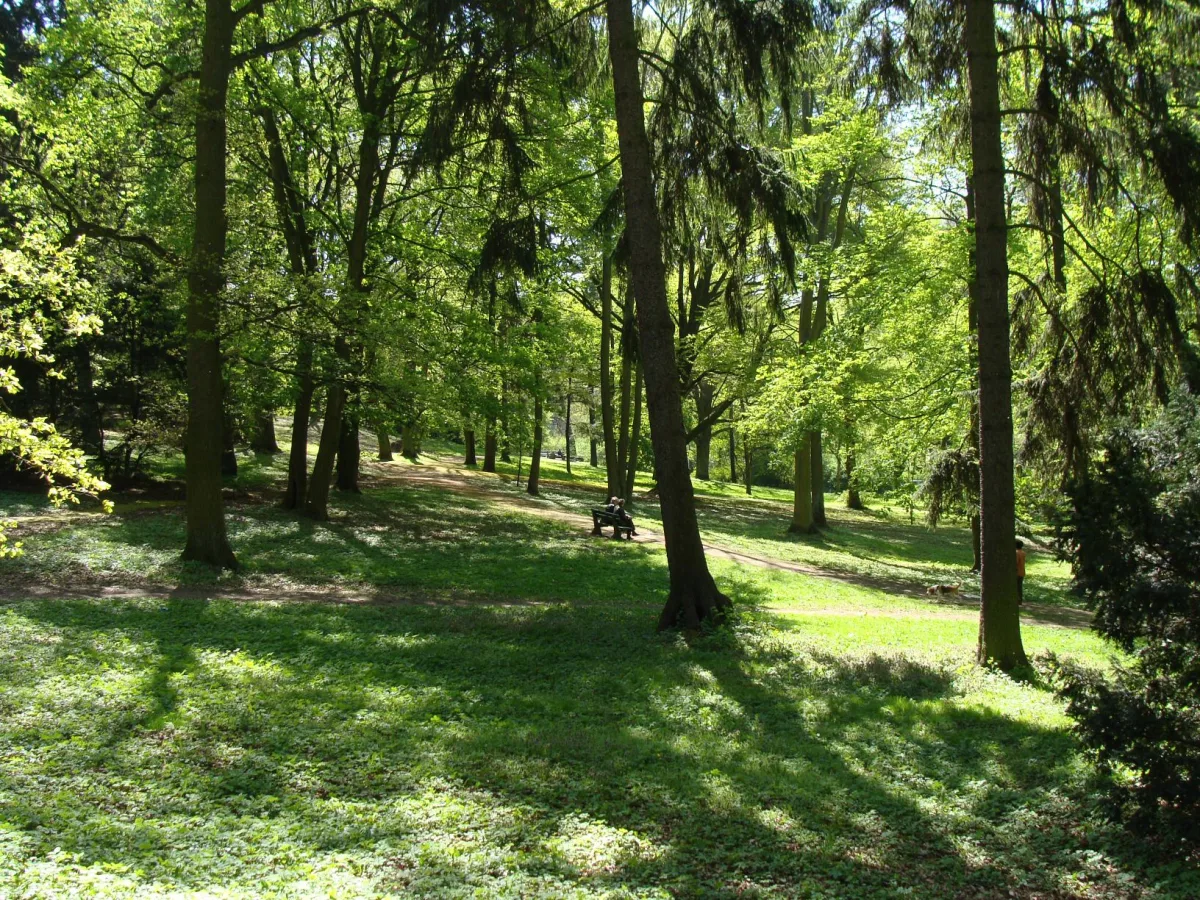
Municipal dendrological garden of 15.5 hectares on the former Majdański Cemetery, with ancient beeches, more than 300 yews and glacial boulders.
The Stefan Kownas Dendrological Garden is a municipal park of 15.5 hectares in Szczecin's Niebuszewo-Bolinko district, between Niemierzyńska, Żupańskiego and Słowackiego streets. It was laid out in 1973-1974 on the site of the former Majdański Cemetery, which until 1945 bore the German name Nemitzer Friedhof. The layout of the paths and terraces still clearly recalls the cemetery past.
The cemetery was in use until the early 1950s, and gravestones stood here until the early 1970s, when, as a former German cemetery, it was levelled. It was then turned into a park, at first called the Dendrological Park. It was named in honour of Dr Stefan Kownas, an organiser and head of the Department of Botany at the Agricultural Academy who had done great service to Szczecin.
The former purpose of the site is shown by the level terraces on the slopes beside which the gravestones stood, the steps (the difference in level in the park is 13.5 metres) and a fragment of the cemetery wall on the Niemierzyńska Street side. Low walls enclosing the park on the north and south were built from grave plaques and fragments of gravestones.
The garden does not have many exotic species, but it has impressive, ancient trees, with trunk girths often over 200 centimetres. Dendrological surveys have recorded 82 species and varieties of trees and shrubs. The oldest group is made up of beeches, including the weeping and copper varieties, and a rarity is two tricolour beeches with trunk girths of 182 and 225 centimetres. There are also ancient pedunculate and sessile oaks.
The avenues are planted with pedunculate oaks, small-leaved limes, horse chestnuts and Weymouth pines. More than 300 common yews grow here, as well as European ash trees; on one of them, with a trunk girth of 267 centimetres, common ivy flowers and bears fruit, which the Wikipedia entry calls a phenomenon. Varieties of trees with hanging shoots were often planted in cemeteries, so this too recalls the former function of the site.
Several glacial boulders lie within the park. In 1999, on the 150th anniversary of the poet's death, the largest was given Juliusz Słowacki as its patron. The second boulder, on a plinth by the entrance, has a metal oak leaf and an inscription about the patron of the garden.
A few hundred metres away lies Jan Kasprowicz Park, and not far off are the Museum of Technology and Transport and the Rose Garden. In the direction of the centre is the Mieczysław Karłowicz Philharmonic.

Be the first! Add a comment.
You need to log in to add a comment.
Log in