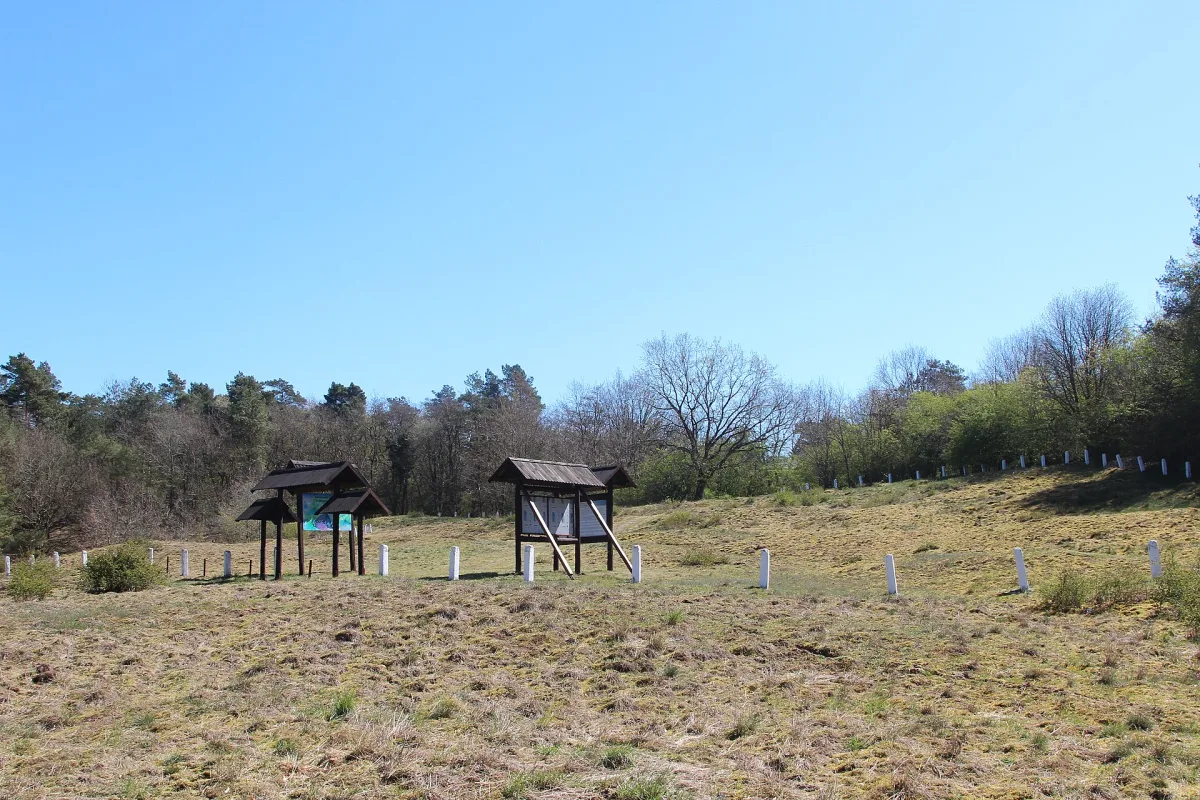
A fenced barrow cemetery from the 9th and 10th centuries above the Dziwna, an archaeological reserve near Wolin.
Gallows Hill is an archaeological reserve south of Wolin, on a rise above the Dziwna known as Gołogóra (21 m above sea level). The fenced barrow cemetery dates from the 9th and 10th centuries.
The necropolis is one of the oldest early medieval cemeteries in West Pomerania and was part of the extensive settlement complex of Wolin. The dead were buried both by cremation and by inhumation, which researchers interpret as the influence of different cultural centres: Scandinavian, and Christian from Poland and Germany. Originally the mounds were circular, with diameters from 3 to 20 metres. At the end of the 19th century 93 barrows were counted, of which 34 survived, and according to the current state of research the necropolis consists of about 120 barrows.
The name Gallows Hill is later and is linked with the executions of pirates and criminals. The grave of a young man without a head, found at the highest point of the rise, points to the possibility that the sentence was carried out by beheading.

Be the first! Add a comment.
You need to log in to add a comment.
Log in