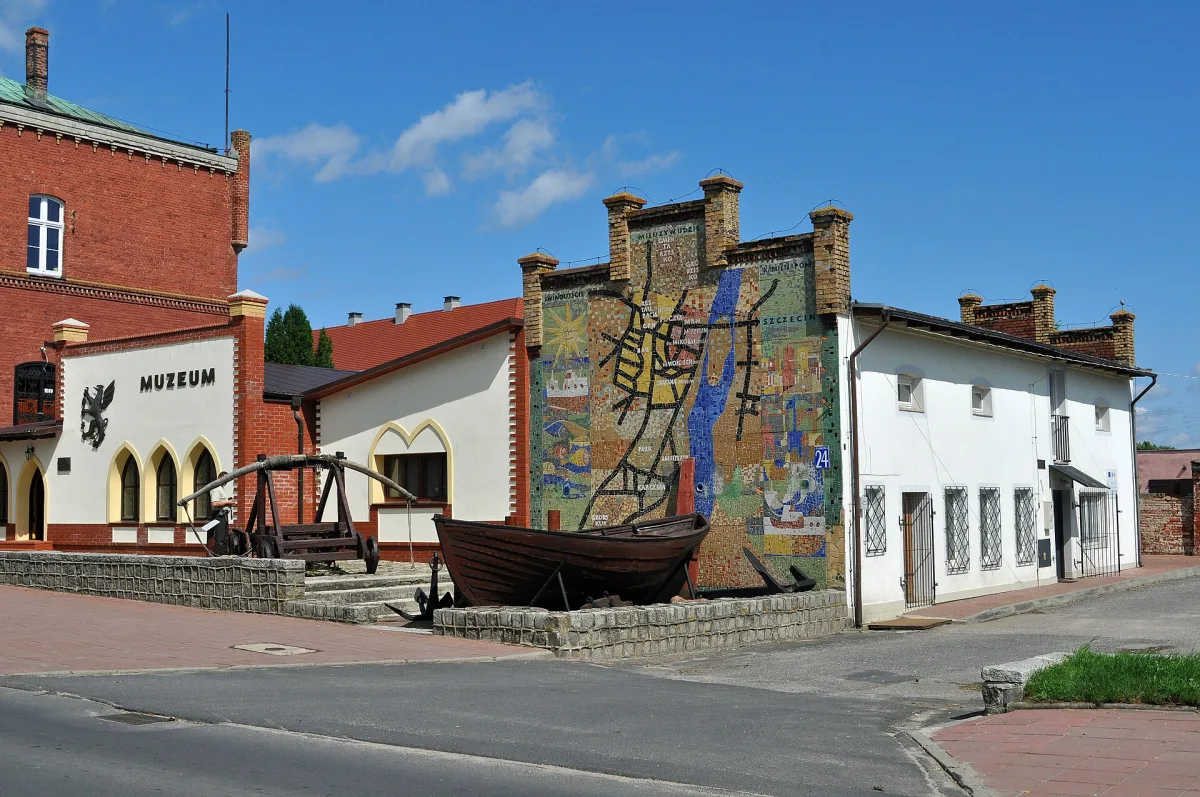
A museum on the market square in Wolin with a permanent exhibition on early medieval Wolin, Jomsborg and Slavic beliefs, with exhibits from excavations in the town.
The museum stands on the Wolin market square, next to the town hall, and tells the story of a town that in the early Middle Ages grew from a small settlement on the Dziwna into a large port centre. Since July 2024 a permanent exhibition, “Wolin - więcej niż legenda” (Wolin - more than a legend), has been on show here, in Polish and English.
The exhibition has four thematic parts, each in a room of its own. “Wyspa” (The Island) reaches back to the geological history of the Baltic and the earliest history of Wolin Island, and shows, among other things, a Bronze Age hoard found in 1988 in the town cemetery. “Emporium” describes the growth of Wolin from a settlement to the largest port town on the southern coast of the Baltic, its links with Pomerania, Poland and Scandinavia, and the story of Jomsborg and the Jomsvikings.
The “Świętowit” room concerns pre-Christian beliefs in Pomerania and presents a Slavic cult figurine found in the town. The last part, “Wolin”, leads from the late Middle Ages to the present day: the legend of Vineta, the chartered town, the castle, the time of the Third Reich and the post-war period, including excavations that have been carried out for more than seventy years. In this room stands a large-format model of the centre of Wolin from the 1930s.
The museum's website presents several finds from research in the town centre. A wooden idol from the first half of the 11th century, made of yew or maple, was discovered in 1975 next to a hut and a stove. A gilded bronze horse from the 11th century, found in 1954, was probably an amulet connected with a pagan cult. A horn pin from the 11th/12th century has a head shape and ornament indicating Scandinavian influence, but was most probably made locally.
The museum was opened on 22 July 1966. The first exhibition, on the history of Wolin in the 9th to 12th centuries, was prepared by scholars from the Institute of the History of Material Culture of the Polish Academy of Sciences together with staff of the Museum of West Pomerania in Szczecin, today the National Museum. In 1968-1992 the institution was headed by the archaeologist and photographer Andrzej Kaube, whose name the museum has borne since 1993. The organiser is the Municipality of Wolin.
The collections include archaeological, ethnographic, art-historical and numismatic collections (over 200 items of a regional character), as well as a photographic archive with Kaube's negatives and prints, a sound archive with oral history recordings from 1970-1988 and a library of more than 3,000 volumes.
The museum lies in the very centre of Wolin, so it is easy to combine with a tour of the town: nearby stands the Collegiate Church of St Nicholas, and less than half a kilometre further on is the open-air museum in Wolin.

Be the first! Add a comment.
You need to log in to add a comment.
Log in