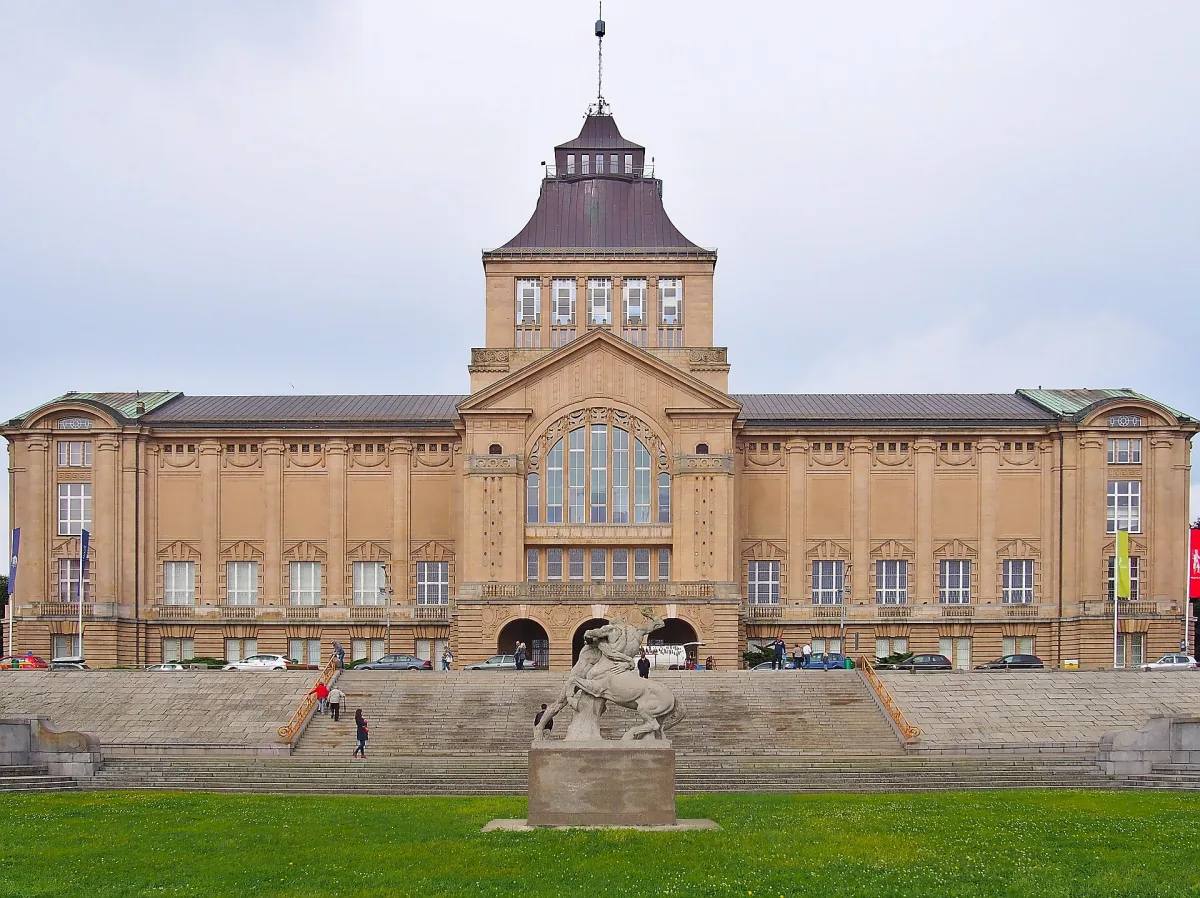
The largest museum in West Pomerania, with its main building on the Chrobry Embankment, four branches in Szczecin and an exhibition in Gryfice.
The National Museum in Szczecin is the largest cultural institution in the West Pomeranian Voivodeship and, according to Wikipedia, looks after more than 150 thousand objects. Its main seat is the building at Wały Chrobrego 3, and the museum also has four branches in the city centre and an exhibition in Gryfice. The collections range from archaeology and medieval sculpture to African and contemporary art.
The institution was established on 1 August 1945 as the Polish Municipal Museum in Szczecin. It took over the remains of the collections of the former Stadtmuseum and Pommersches Landesmuseum. In the autumn of 1947 the museum gained the status of a regional institution as the West Pomerania Museum, and in 1970 it was raised to the rank of a national museum. In the 1970s further buildings joined the museum: the Old Town Hall and the former commandant's office of the Szczecin fortress garrison.
The building at Wały Chrobrego 3 is the centre of the architectural ensemble on the Oder, designed by Wilhelm Meyer-Schwartau. The museum's website calls it one of the best-known and most prestigious buildings in the city. It stands on the Chrobry Embankment, with which it forms a single whole.
The museum's other seats are:
The permanent exhibitions in the main building include “Mystery of Light. Medieval Art in Pomerania”, “Hidden Meanings. Art in Pomerania in the 16th and 17th Centuries” and “Ancient Roots of Europe. The Dohrn Collection of Szczecin”. Wikipedia also lists three African exhibitions, including “In an African Village”, because the Szczecin museum has the largest collection of evidence of the material culture of non-European countries in Poland.
Among the most valuable collections Wikipedia lists the Madonnas with Child from Gardno, the Romanesque columns from Kołbacz, the crucifix from Kamień Pomorski and the “beautiful Madonna” from Bukowo. In all, the branches run about 20 permanent exhibitions as well as temporary ones.
After your visit you can walk on to the Castle of the Pomeranian Dukes or go down to the Oder towards the port.

Be the first! Add a comment.
You need to log in to add a comment.
Log in