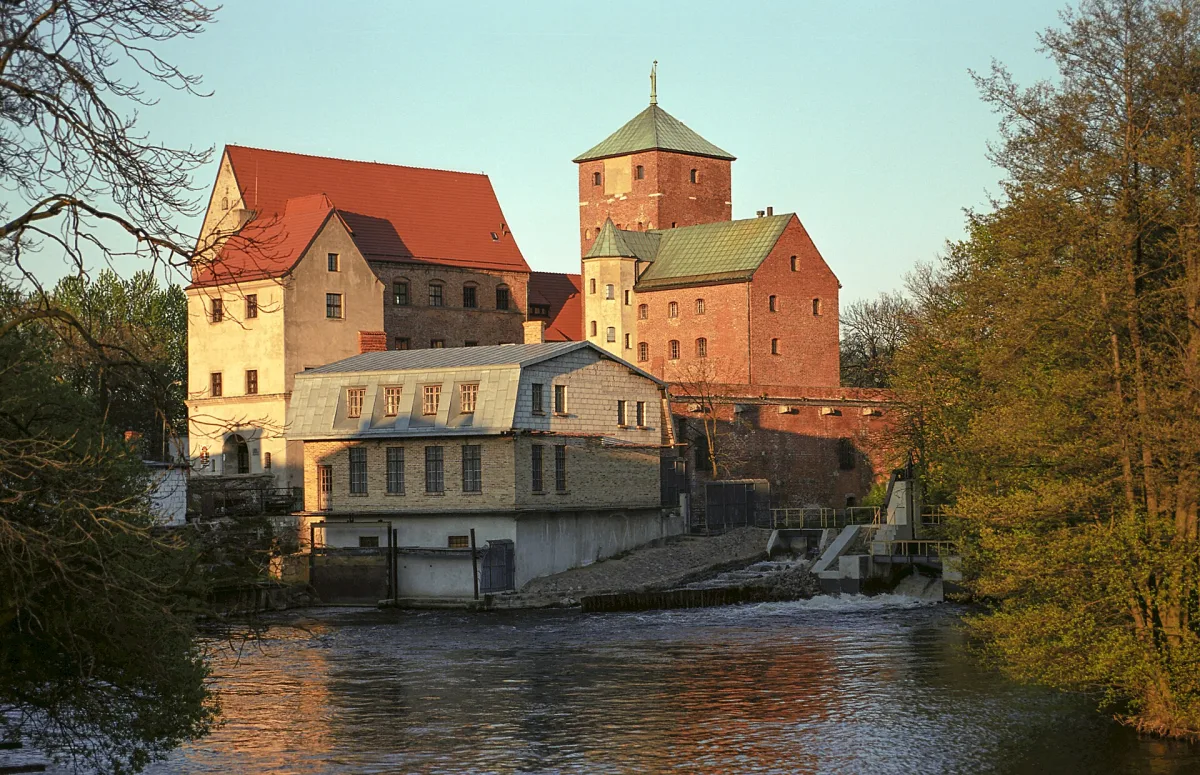
A Gothic castle from the 14th century on an island in the centre of Darłowo, a museum since 1930, with exhibitions on Oriental art, sculpture and an old map of Pomerania.
The Castle of the Pomeranian Dukes in Darłowo is a brick Gothic stronghold on an artificial island between the Wieprza River and the Mill Canal, the seat of a museum since 1930. Wikipedia describes it as the only Gothic coastal castle in Poland on a plan close to a square, with a tower 24 metres high. Today the castle and the museum are one place: you visit the rooms, the tower and the permanent exhibitions.
In 1352 Duke Bogislaw V bought an island with a mill from a burgher woman of Darłowo and began to build a stronghold on it. The museum's website states that the years 1352-1372 were a time of rapid work, and in 1372 a meeting of the Dukes of Pomerania was held within the castle walls. The original castle had a plan close to a square measuring 32 by 34 metres and a defensive wall about 14 metres high.
In 1449-1459 the castle was rebuilt by Eric I of Pomerania, who returned to his ancestral lands after losing the thrones of Scandinavia. He strengthened the defences and added the west wing, and Wikipedia adds that he modelled it on his earlier residence, Kronborg Castle. Further extensions were carried out by Bogislaw X, Barnim XI (the tower then grew to 26 metres), John Frederick and Bogislaw XIV, who rebuilt the castle after the fire of 1624.
After 1622 the castle came under the rule of the Danish Oldenburgs, and in 1773 it passed to the King of Prussia. In the 18th and 19th centuries it housed warehouses, a hospital, a court and a prison. A renovation in 1929-1935 prepared the castle for a museum, and the first exhibition was opened on 1 July 1930. The history of the museum is linked with Karl Rosenow, its first head.
The castle was not damaged in the Second World War, and on 1 July 1945 the Regional Museum was opened here. In 1971-1988 a major renovation was carried out with the participation of archaeologists and conservators, and after it the museum was reopened on 22 October 1988.
The permanent exhibitions occupy several wings and the tower. Among the museum's treasures it lists three late Gothic sculptures from the 16th century: St Anne Selbdritt, St Christopher and the Madonna and Child. In the renovation of 1971-1988 the star vault of the knights' hall was recreated.
On the upper floor of the south wing, Oriental art is shown, from the Middle East to Japan, with 19th-century Japanese tsuba, that is, the sword guards of samurai swords. On the wall of the staircase hangs Eilhard Lubinus's map of Pomerania from the early 17th century (125 by 221 cm). In the connecting section there is an exhibition of Pomeranian folk art, and according to Wikipedia also a maritime exhibition and a collection of birds in a side chamber of the tower.
Next door stand St Gertrude's Church, St Mary's Church and the High Gate, and the town hall is about 300 metres from the castle.

Be the first! Add a comment.
You need to log in to add a comment.
Log in