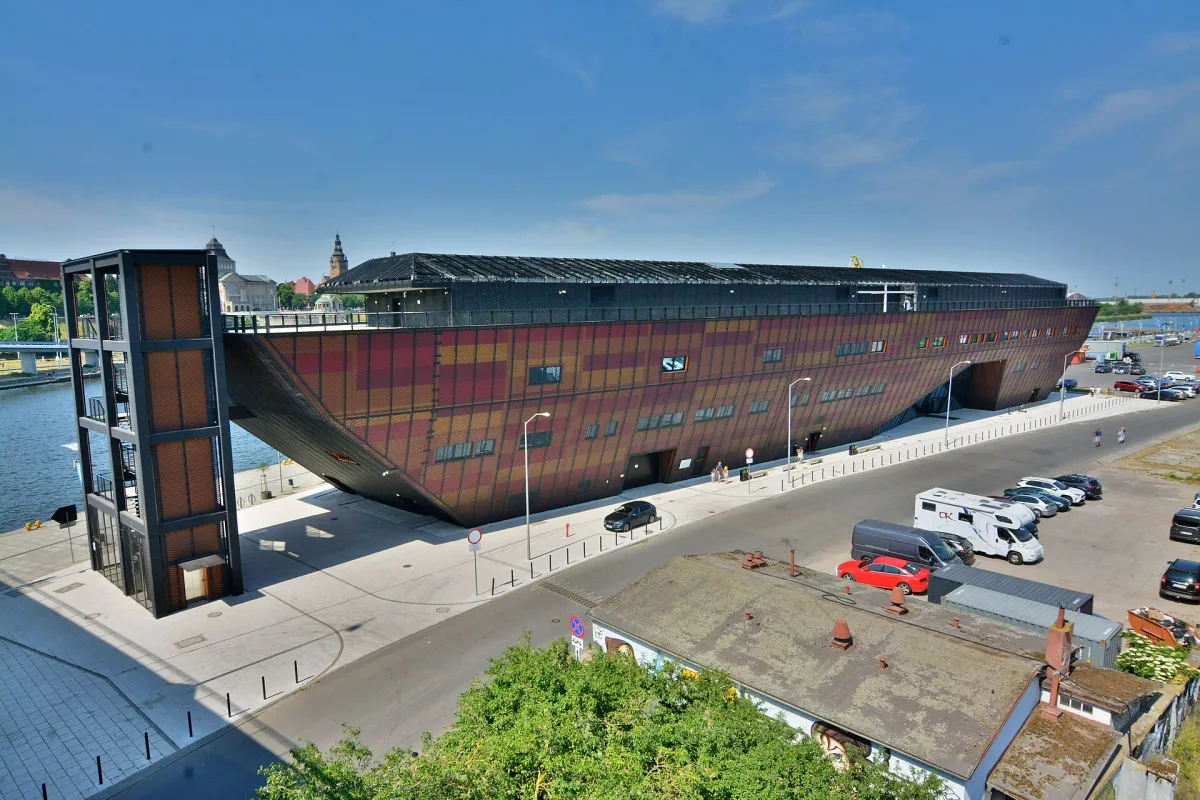
An interactive science centre about the sea and navigation in a ship-shaped building, with a planetarium and a viewing terrace on Łasztownia.
The Maritime Science Centre is an interactive exhibition about the sea, ships and life on the water, housed in a building modelled on a ship's hull. It stands on Łasztownia, and inside are more than two hundred exhibits that you have to touch and set going yourself.
The building is 14 metres high and 122 metres long, and its form refers to the shape of a ship's hull. On three exhibition levels, with a total exhibition area of 3.1 thousand m², are the permanent exhibition, a conference room, two educational rooms and a planetarium. On the roof there is a viewing terrace connected with a restaurant.
The Centre is a cultural institution of the West Pomeranian Voivodeship, established by a resolution of the regional assembly in September 2017. Its patron is Prof. Jerzy Stelmach.
The permanent exhibition consists of five thematic zones, and most of the exhibits are self-service devices for hands-on experiments. The Wikipedia entry speaks of 212 interactive devices, the Centre's website of more than 200 exhibits.
Alongside the interactive stations, original objects are also shown: parts of vessels and their equipment, sailing tools and instruments, models, mock-ups and maritime souvenirs. The content covers physics, mathematics, astronomy, geography, medicine, technology, history and art, always in relation to life at sea, navigation, fishing and the work of the port.
The Centre has its own planetarium, called the Wolszczan Planetarium, with an audience of 43 people. The programme of shows and tickets are given on the Centre's website.
Workshops are held in the studios, including model-making and boatbuilding. For children aged 9-12 there is the Children's University named after Prof. Jerzy Stelmach, that is the Szczecin School of Ship's Boys (Szczecińska Szkoła Jungów), run jointly with the West Pomeranian District Sailing Association. The programme covers marine science, sailing and the exact sciences.

Be the first! Add a comment.
You need to log in to add a comment.
Log in