
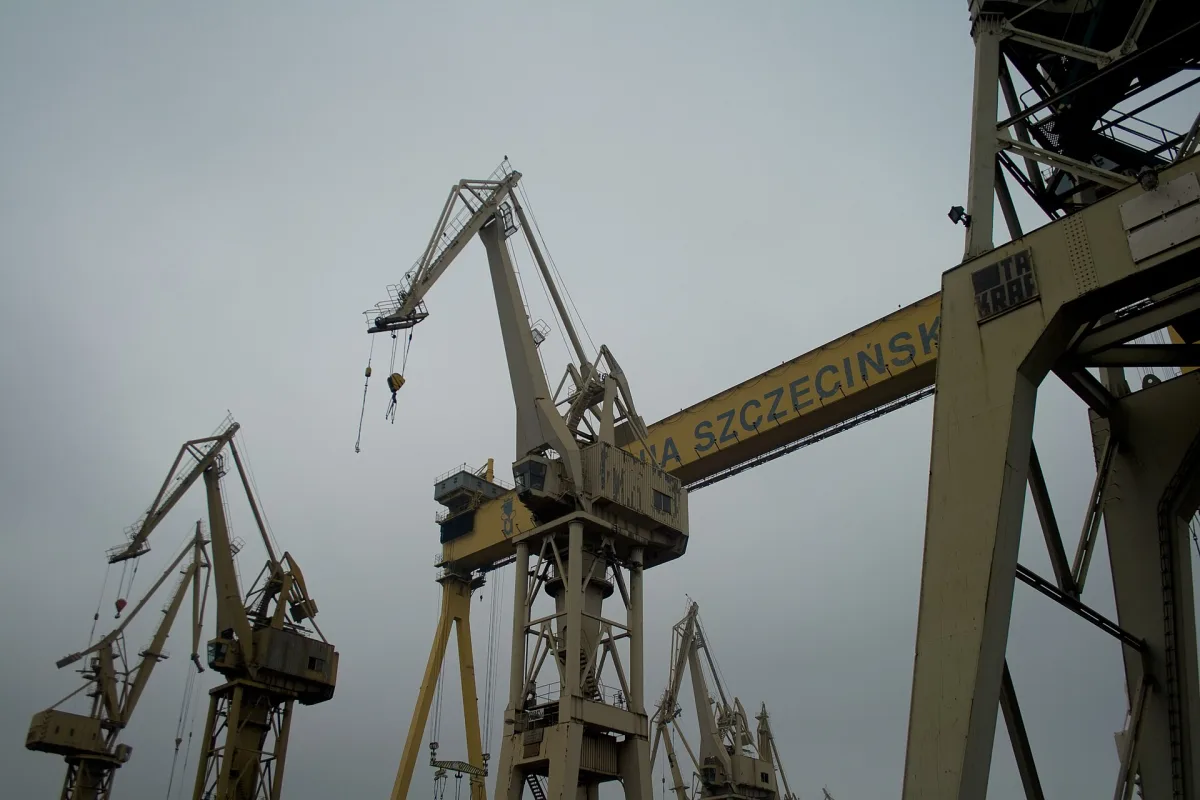
A month after the fighting of December, in January 1971, the Adolf Warski Shipyard in Szczecin came to a halt again. The strike lasted several days and ended with a talk of many hours between the shipyard workers and Edward Gierek and Prime Minister Piotr Jaroszewicz. The text describes the course of those days on the basis of articles by historians published by the Institute of National Remembrance (IPN) on the Przystanek Historia portal, a description by the National Museum in Szczecin, and entries of Wikipedia and the Encyclopedia of West Pomerania.
A newspaper article as the spark
According to Sebastian Ligarski, after December 1970 the price rises were not withdrawn and those responsible for the deaths of the workers were not punished. In January 1971 the Security Service (SB) recorded work stoppages in several dozen plants across the country, most of them in the Gdańsk, Bydgoszcz and Szczecin voivodeships. In Szczecin the spark was an article in “Głos Szczeciński”, the organ of the Provincial Committee of the PZPR, of 20 January 1971. It wrote about an alleged production pledge by the crew of the Pipe Mill, that is department W-4. According to Magdalena Dźwigał, it was said to have declared a production “feat” and work on Sundays. The workers learned of their pledges from the press and regarded the text as a provocation.
The dates of the start of the strike vary between the accounts. According to Dźwigał, the workers of the Pipe Mill gathered in front of the management building on 21 January and demanded a correction. The Przełomy Dialogue Centre and the Encyclopedia of West Pomerania give 22 January as the day the strike began. The Encyclopedia adds that already on 21 January sit-in strikes had begun at the Parnica and Gryfia repair shipyards.
The gathered workers were addressed from the roof of a kiosk by Edmund Bałuka, who had earlier chaired the December protest. He warned of the consequences of leaving the shipyard and called for a sit-in strike, for taking control of the plant and for choosing a strike committee through strike fives. According to Wikipedia, the strike committee, of more than thirty people, had Zdzisław Andrzejczyk and Adam Ulfik as deputy chairmen, and Marian Jurczyk among its members.
A sit-in strike in a fortified shipyard
Thanks to the experience of December, the protest was organised quickly. According to Dźwigał, all the gates were closed, banners were hung, order services were set up and discipline was enforced, with acts of vandalism and alcohol abuse condemned. The crew took over the radio system and broadcast announcements over it. Most of the administrative staff and the technical and engineering staff left the plant. According to Ligarski, the strike spread to other departments of the shipyard and then to most of the plants in Szczecin.
On 22 January the shipyard was surrounded by a cordon of militia and army. Ligarski writes of a blockade from the land and from the water and of psychological operations against the strikers. The local authorities called the protesters hooligans and troublemakers, which according to Dźwigał deepened divisions in the committee: some of its members feared a pacification and wanted to end the strike. In the end it was decided to write a letter to the First Secretary of the Central Committee of the PZPR explaining the causes of the strike and the demands. According to the Encyclopedia of West Pomerania, on 23 January a strike by the city's public transport crew paralysed transport in the city and ended after the arrival of the minister of municipal economy.
According to Wikipedia, the strikers formulated twelve demands. They concerned the withdrawal of the price rises, as well as immediate, democratic elections to trade union authorities, workers' councils and the leadership of party and youth organisations at department and plant level. They also demanded that Gierek and Jaroszewicz come to the shipyard. Ligarski notes that economic and social matters predominated among the demands, although political ones were also among them.
24 January: Gierek in the shipyard's common room
On the evening of 23 January, at a meeting of the Politburo, Gierek decided to travel to Szczecin. According to Ligarski, he appeared in the city on 24 January at about 14.00 together with the members of the Politburo who were also members of the government. After a meeting with the local authorities, General Franciszek Szlachcic, head of the interior ministry, went to the shipyard to settle the conditions of the talks. A dozen or so minutes later Gierek and his companions unexpectedly appeared at the shipyard gate. The delegation was led into the main common room. The members of the strike committee, surprised by this turn of events, had to settle who would take part in the talks, the scenario of the meeting and the final form of the demands. According to the IPN, Gierek waited nearly two hours, and his secretary Jerzy Waszczuk called it “the first lesson in humility”.
The meeting took place in a common room that could hold about three hundred people. The Przełomy Dialogue Centre writes of more than three hundred delegates of shipyard workers and of workers from other plants. Ligarski notes that the make-up of those present was mixed, because many random people had entered the building and did not leave it, and the room also held representatives of the authorities and the media, including television. At the table, only Edmund Bałuka and Franciszek Wilanowski sat on the side of the strikers. Opposite them sat Gierek, Jaroszewicz, Szlachcic, General Wojciech Jaruzelski, Franciszek Kaim, Eugeniusz Ołubek and Kazimierz Barcikowski.
The talks began before 18.00. Bałuka read out the twelve demands, then Gierek spoke, followed by speakers on the workers' side and members of the government. According to Ligarski, the meeting lasted more than eight hours and ended at about 2.00 at night; Dźwigał also writes of eight hours, while Wikipedia and the Encyclopedia of West Pomerania give nine hours. Among other things, the establishment of a Workers' Commission was agreed. According to Wikipedia, the strike was ended the next day, while the entry in the Encyclopedia of West Pomerania gives 16.00 as the time the protest ended.
After the meeting Gierek spoke once more with the party activists, and in the morning he flew to Gdańsk for talks with the workers of the Gdańsk Shipyard. Ligarski writes that the idea of a visit to the Tricity arose during the Szczecin debate and came from Gierek and Jaroszewicz. The words “Will you help?” (“Jak, pomożecie?”), which passed into memory as a symbol of that January meeting, were spoken by Gierek in Gdańsk, not in Szczecin.
The Workers' Commission and its end
According to the IPN, the result of the talks in the Przełomy Dialogue Centre, whose exhibition describes December 1970 and January 1971, was the end of the strike and the establishment of the Workers' Commission, described as the first democratically elected representation of workers in the Polish People's Republic. Its existence was very short. Ligarski and Dźwigał write that the authorities tried to diminish the significance of the debate, and that the Security Service in Szczecin kept members of the strike committees under surveillance, intimidated them and discredited them. According to these authors, the price rise was withdrawn only after further protests in February 1971, while according to IPN publications on December 1970 the authorities backed down from it on 1 March 1971, after the strike of the textile workers of Łódź.
Bałuka's own fate is described by Wikipedia: according to it, in 1973 he left Poland on board a ship, and years later learned that the Security Service had helped him do so. A recording of the Szczecin talks reached the West, and on its basis British television company Granada made the dramatised documentary “Three Days in Szczecin” in 1976. The Przełomy Dialogue Centre stresses that what remained in the memory of the people of Szczecin was the excellent organisation of the striking workers and the meeting of the delegates with Gierek in the shipyard's common room.
Be the first! Add a comment.
You need to log in to add a comment.
Log in