
From the seizure of the city in 1630 to the Peace of Westphalia
According to Polish Wikipedia, during the Thirty Years' War Szczecin was occupied by imperial troops in 1627 and by the Swedes in 1630, which the Peace of Westphalia later sanctioned. The Chronology of the History of Szczecin gives 24 October 1648 as the moment when the city, together with the whole of Hither Pomerania and Rügen, became part of the Swedish Crown. Wikipedia notes that military operations during the Swedish Deluge contributed to the economic decline of the city.
In this period Szczecin served as the capital of Swedish Pomerania, and Wikipedia gives it as the seat of the province in the years 1648-1720. According to the same source, after the extinction of the House of Griffin the castle was from 1637 the seat of the Swedish governor. The Swedes also built modern bastion fortifications: according to the entry on the fortress, eight bastions were erected in 1631-1639, and after 1677 a ninth, known as the Green one.
The fortifications confined the city. Wikipedia writes that the built-up area shrank to about 54 hectares on the left bank of the West Oder and about 10 hectares on the right, in the area of Łasztownia, and that the number of inhabitants fell in the Swedish period to about 6000. After the Thirty Years' War a survey of the city was carried out, lasting from 22 November 1658 to 26 January 1659. It recorded about 960 houses and booths and 319 cellars, whereas the register of 1628 listed 1446 houses and booths and 459 cellars.
The sieges: 1659, 1676 and 1677
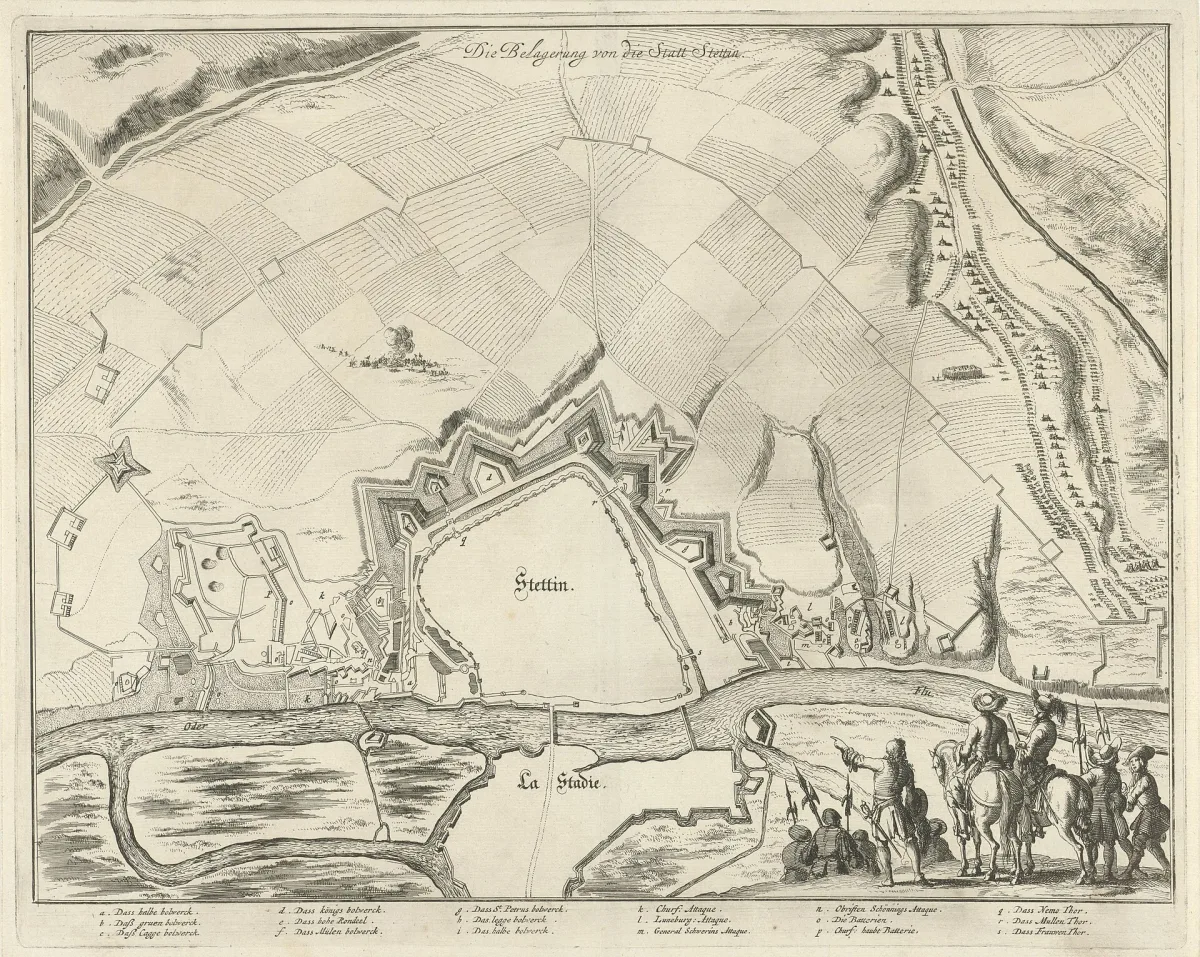
According to Wikipedia, Szczecin underwent sieges in 1659, 1676 and 1677. In 1659 the city was besieged by imperial troops. Wikipedia notes that the city suffered relatively little then, and that the greatest damage was to the Passau Gate, hit on 29 September by the fire of three batteries. A breach was made in it through which a cart could have passed, and on 5 October the roof with its timber structure between the walls collapsed. German Wikipedia judges that in 1659 the city held out.
The Swedish-Brandenburg War brought much heavier experiences. According to the Chronology, in 1676 Swedish troops under Jakob von Wulffen held Szczecin after a siege of many months by Brandenburg forces ten times more numerous. Wikipedia describes that earlier, in June 1675, a war council had been set up in the city, and the inhabitants swore an oath of loyalty and received regulations for guard duty. In the summer of 1677 the Elector Frederick William personally directed the siege works, drawing on the experience of 1659: a redoubt and a bridge across the island on the river were built to cut the city off from the water side as well.
The Chronology states that the siege begun in 1677 ended with the surrender of the city, and records the surrender under the date 1678, estimating the losses at 2.5 thousand killed inhabitants of Szczecin. According to German Wikipedia, in 1677 St James' Church was destroyed, and the Old Town Hall was rebuilt from 1677 in the Baroque style.
The return to Swedish rule and the end in 1713
The capture of the city did not change the borders for long. According to the Chronology, in June 1679, under the Peace of Saint-Germain-en-Laye, Sweden regained Szczecin. Wikipedia gives that in 1679 the islands of Uznam and Wolin and the localities on the right bank of the Oder were ceded to Brandenburg.
The Great Northern War reached Pomerania in 1711. According to German Wikipedia, in 1712 Russian and Saxon forces briefly surrounded Szczecin, and in August 1713 an army numbering, according to this source, 24 thousand men arrived again. The Swedes defended the city from the beginning of August to 29 September 1713. The siege ended with the surrender of the Swedish garrison, and the city was placed under Prussian administration. In Polish sources the descriptions differ in emphasis: Wikipedia's entry on the fortress writes of the capture of the city by Russian-Saxon troops, and the entry on the history of Szczecin says that in 1713 the city was taken by Prussia. The Chronology describes how the governor-general Johan August Meijerfeldt surrendered the city in September 1713, and it remained under Prussian administration until the end of the war.
Stockholm 1720 and the price of Szczecin
Swedish rule ended formally in 1720. According to the Chronology, the provisions of the Stockholm peace treaty stipulated that Sweden cedes Szczecin with the adjoining lands to Prussia for 2 million thalers. Wikipedia, in its entry on Swedish Pomerania, describes this differently: it writes that in 1721, as a result of the Peace of Nystad, which ended the Northern War, Sweden sold Szczecin and its surroundings to Prussia for 2 million thalers, keeping only a fragment of Hither Pomerania. The sum is thus the same in both sources, but they give the year and the treaty differently.
After taking over the city, Prussia began expanding the fortress in 1724-1740. The castle, which in Swedish times had been the seat of the governor, served as a Prussian garrison from 1720.

Be the first! Add a comment.
You need to log in to add a comment.
Log in