
18 August: the strike at the shipyard
According to the Institute of National Remembrance (IPN), little is said about the thirty-six demands that Szczecin workers formulated in August 1980. Yet it was in Szczecin, as the IPN writes, that the first agreements with the government were signed, announcing the creation of trade unions free and independent of the authorities. Twenty-one Gdańsk demands were placed on the UNESCO “Memory of the World” list, while the Szczecin ones are far less well known.
On Monday 18 August 1980 the Adolf Warski Szczecin Shipyard went on strike. According to the IPN, stopping work had been discussed since Friday 15 August. In the morning a motor launch arrived at the shipyard quay from the “Parnica” Repair Shipyard, where a strike had already been declared after six o'clock. Aleksander Krystosiak, associated with the Free Trade Unions of West Pomerania, and his companions found the Warski workforce in a state of continuous discussion.
At about 10.30, after the first breakfast break, the shipyard stopped work. According to the IPN several thousand people gathered in front of the main gate and demanded talks with the authorities, while according to Wikipedia it was about three thousand shipyard workers. The First Secretary of the Provincial Committee of the PZPR, Janusz Brych, came to the plant. He spoke to the workforce standing on a tractor trailer, and later urged them to move the meeting to the common room and to elect delegates and formulate demands in the departments.
The shipyard workers dispersed to their departments. The delegates then met in the common room, where they read out the demands of individual departments. According to the IPN these included economic and social demands, for example lowering the retirement age to 60 or free Saturdays, but also political ones: permission for opposition parties, writing the right to strike into the Constitution of the Polish People's Republic and the release of political prisoners. Among the demands of the first day, Wikipedia lists the creation of free trade unions and the setting of a plaque in the shipyard walls commemorating those killed in December 1970.
Marian Jurczyk and the Inter-Enterprise Strike Committee
The chairman of the shipyard strike committee became Marian Jurczyk, a storekeeper. The IPN and Wikipedia give different accounts of the moment of his election. The IPN writes that the strikers elected him before the next meeting with Brych in the common room, and that he was nominated by Krzysztof Kasprzak. Wikipedia states that the committee headed by Jurczyk was elected in the evening, after the meeting with department representatives at 3 p.m., even though Jurczyk had not been among the department trios. The IPN recalls that Jurczyk was known from the strike in December 1970.
According to the IPN the demands were drafted on the night of 18 to 19 August by three people: Maria Chmielewska, Kazimierz Fischbein and Stanisław Wiszniewski. They shut themselves in the office of the production director and by morning had drawn up a list of thirty-six points. Earlier Antoni Szatkowski had written down a combined list of about seventy demands that were not repeated in the delegates' speeches; the IPN writes that the Szczecin version may have come from this list, but does not settle the matter.
On 19 August at 2 p.m. the shipyard strike committee became, according to the IPN, the Inter-Enterprise Strike Committee, with Jurczyk as chairman. In its article on the August Agreements, Wikipedia says the committee was formed on 17 August, while the IPN gives 19 August. The committee demanded that representatives of the central authorities come to Szczecin, and the government sent a commission headed by Deputy Prime Minister Kazimierz Barcikowski. When the committee was being constituted 20 plants joined it, and on the day the agreement was signed there were, according to the IPN, more than 360 from the voivodeship and from other regions.
The strike in the city
According to Wikipedia, during the strike in Szczecin no city transport ran, rubbish was not collected and the dead were not buried. On 24 August the first issue of “Jedność” (“Unity”), the organ of the Inter-Enterprise Strike Committee, appeared. The talks between the government commission and the committee took place at the shipyard from 21 August. The IPN quotes the recollections of participants: some describe the goodwill between people, even when people stood at stops despite there being no trams, others the fear of how Moscow would react and whether the strike would end in repression.
30 August: the agreement
On 29 August Prime Minister Józef Pińkowski asked Brych about the possibility of retaking the ports by force. According to Wikipedia the First Secretary replied: “It is possible, but there will be a fight. And what then? December 1970 again?”. In the night of 29 to 30 August, at about one o'clock, Barcikowski and his advisers arrived at the shipyard, and for several hours the agreement was refined, especially point one on independent unions.
According to the IPN, Barcikowski did not have the consent of the Politburo of the Central Committee of the PZPR to sign the agreement. In his memoirs, which the IPN quotes, he described unsuccessful attempts to reach Kania and Pińkowski and a conversation with Central Committee Secretary Olszowski, after which he and Brych decided to sign. According to the Minister of Heavy Industry Aleksander Kopeć, whose account the IPN also cites, the decision to sign sooner was taken by Edward Gierek.
The signing began at 8 a.m. in the shipyard common room, in the same hall in which Edward Gierek spoke with shipyard workers in January 1971. There were 41 press accreditations in the hall. On behalf of the strikers the agreement was signed by Marian Jurczyk, Kazimierz Fischbein and Marian Juszczuk, and on behalf of the government by Kazimierz Barcikowski, Andrzej Żabiński and Janusz Brych. Wikipedia states that the protocol of arrangements was signed at 8.30. The Gdańsk agreement was signed a day later, on 31 August 1980.
Point one provided, as the IPN quotes, for the creation of self-governing trade unions which “will have a socialist character in accordance with the Constitution of the Polish People's Republic”. On the end of the strike the strike committees were to become Workers' Commissions and call universal, direct, secret elections to the union authorities. The IPN notes that the final wording was far from the formulation contained in the demands, and yet the strikers had a sense of victory.
Remembering August today
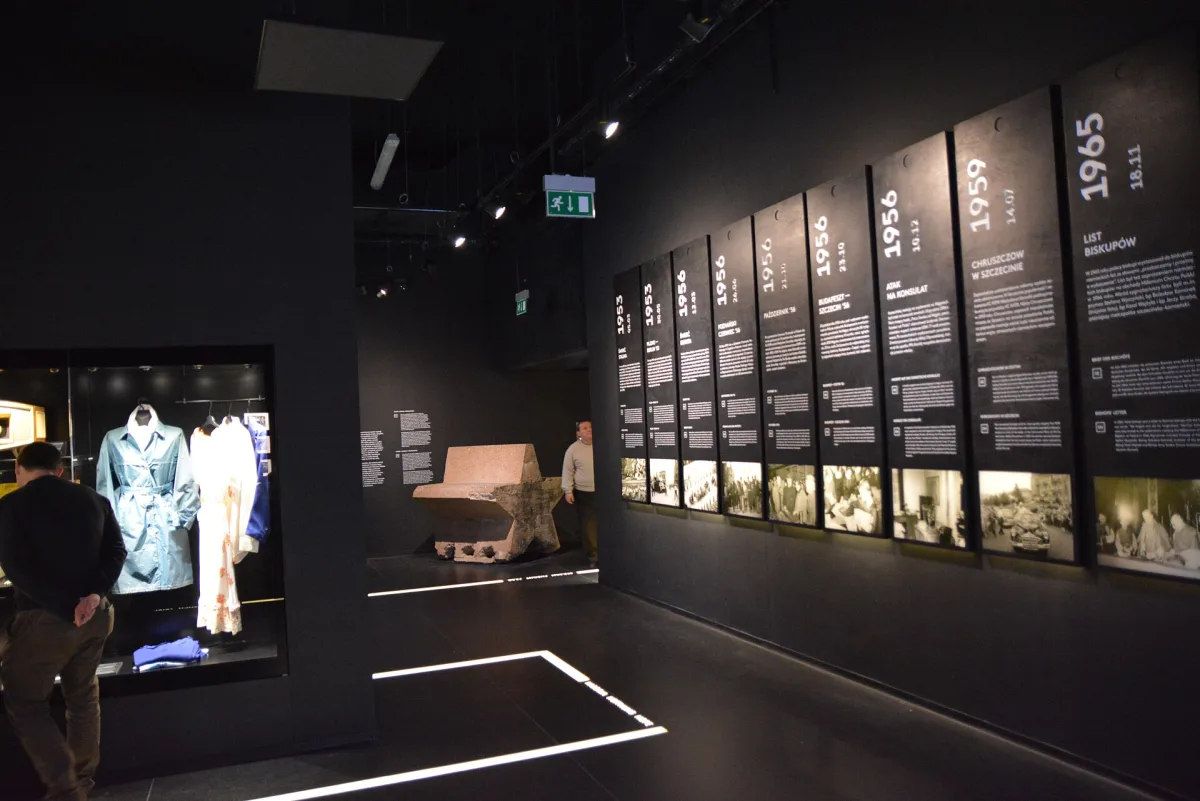
The history of those days, together with December 1970, August 1980, martial law and 1989, is covered, according to the premises described in Wikipedia, by the exhibition of the Przełomy Dialogue Centre, a branch of the National Museum in Szczecin on Solidarity Square. The foundation act, according to Wikipedia, was set in the wall on 30 August 2013, on the thirty-third anniversary of the August Agreements. The museum provides its visiting rules.
Be the first! Add a comment.
You need to log in to add a comment.
Log in