
Before Barnim III's stone house stood on Castle Hill, the hill above the Oder was for many centuries a stronghold, a place of worship and the seat of a ducal court. Written sources from those times are scant, so the picture is put together from the three lives of Otto of Bamberg, a few chronicle accounts and the findings of archaeologists. Where the dates and figures in the studies diverge, we point this out in the text.
The stronghold and the settlement below the hill
According to the Wikipedia entry on the history of Szczecin, the town was founded by the Wkrzanie tribe at the turn of the 7th and 8th centuries on today's Castle Hill. At first it was a settlement of farmers and herders, then, with the growth of trade and crafts, it was rebuilt as a stronghold. The entry on the city itself states that the hill has been inhabited continuously since about 700, and that in the 9th century Slavic dukes built a stronghold surrounded by a moat, at whose foot a trading and fishing settlement developed. Elsewhere the same entry on the history indicates that the oldest traces of early medieval settlement date from the end of the 9th and the beginning of the 10th century. The beginnings of the hill as a settlement and as a fortified stronghold are thus dated in different ways.
Wikipedia describes the stronghold as consisting of three parts: the stronghold proper, the outer bailey and the trading and fishing port. It extended over the marshy ground of the left bank of the Oder and over the island of Łasztownia and had an oval shape, narrowed in the middle. In the 10th century Szczecin was described by Ibrahim ibn Yaqub, who wrote the name of the place as Sadżin.
Three hills and the temple of Triglav
What is known of the beliefs of the inhabitants comes from the hagiography of Otto of Bamberg. According to Wikipedia, the information on Triglav comes from three sources: the life from the Prüfening abbey, written by 1146, Ebbo's life of 1151 and Herbord's dialogue of about 1158-1159. Ebbo wrote that Szczecin contained three hills, and the middle and highest was dedicated to Triglav. The statue had three heads, and the eyes and mouth were covered by a golden cloth. The priests explained that the god has three heads because he rules heaven, earth and the underworld.
The number of temples varies by author. The Anonymous of Prüfening mentioned two richly decorated shrines (contini) located not far from each other, and according to Herbord, as Wikipedia states, there were four in Szczecin. The entry on the history of the city adds, after Herbord, that one of them was the most important and covered with paintings of people and animals, that beside it grew a large thorny oak with a spring welling up beneath it, and that a black horse consecrated to the god and used in divination was kept in the stronghold. On Otto's orders the temples were destroyed, and the wooden statue of Triglav was said to have been smashed by the bishop himself. According to Wikipedia he took only three silvered heads and sent them to the pope as proof of the baptism of the inhabitants. The cult is attested from 1124, and according to the same entry it officially ended in 1127.
Wikipedia, citing a study by Paweł Szczepanik from 2020, indicates that the hill with the temple of Triglav is most probably identical with Castle Hill. On its summit there was said to have stood a circle surrounded by a ditch, originally sacred, used from the 8th century and later replaced by the temple of Triglav and finally by a Christian one. This is a hypothesis of archaeologists, not a fact confirmed by a record in the sources.
Wartislaw's court and the church from Otto's mission
Pomeranica, that is the Encyclopedia of West Pomerania, states that a ducal seat already existed in Szczecin at the time of Otto's mission in 1124-1128. The court of Duke Wartislaw was placed on Triglav Hill, next to the pagan temple, within the ramparts, and archaeologists identify this place with the north-western part of the present Castle Hill. Otto's hagiographies do not describe the appearance or size of this building, so the encyclopedia only cautions that it was most probably not a very large structure.
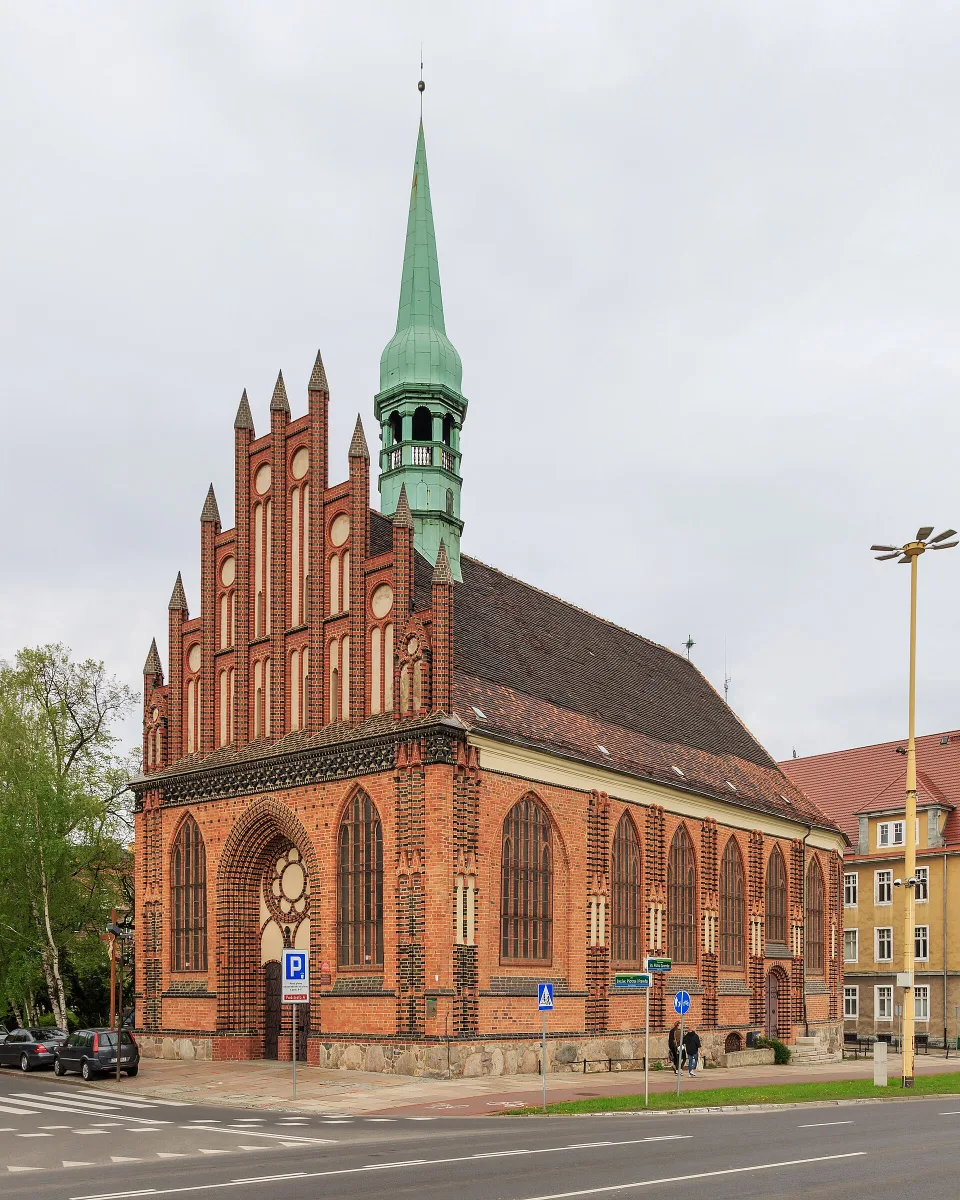
On the site where the Church of St Peter and St Paul stands today, the first wooden church was built, according to Wikipedia, in 1124, when Otto of Bamberg came to Szczecin, and it was probably the town's oldest sacred building. It burned down in 1189 during a Danish raid, and in 1223-1237 a brick church was built in its place. The Collegiate Church of St Otto, which stood on the hill, has a different history in the same Wikipedia: it was built in 1346 at the foundation of the burghers of Szczecin, so it is not a successor of the church from the mission.
The charter of 1243 and the dispute over the stronghold
According to Wikipedia, in 1243 Duke Barnim I granted Szczecin Magdeburg town rights. In the entry on the castle the Polish Wikipedia states that in 1235 Barnim I moved the capital of the duchy from Uznam to Szczecin, and according to Pomeranica the duke made Szczecin his main seat around 1237. Pomeranica adds that the decision met with resistance from the burghers, who, in defence of the rights guaranteed by Magdeburg law, in 1249 forced the ruler to destroy the stronghold that existed in the area of today's Mariacki Square. The encyclopedia notes at the same time that the few written sources from the time of Barnim I do not specify the location of his court, and that archaeological research has confirmed that the ducal seat of Barnim I arose on the basis of a rebuilt older court.
Pomeranica thus indicates the area of Mariacki Square, not Castle Hill itself, and we record the place that way, without deciding whether it is the same stronghold.
The beginning of the castle
Wikipedia states that the beginnings of today's Castle of the Pomeranian Dukes go back to 1346, when Barnim III, breaking the privileges of the Szczecin patriciate, began to build on the hill the so-called stone house. With this stone house begins the layer of the hill's history that is visible today in the walls of the castle.

Be the first! Add a comment.
You need to log in to add a comment.
Log in