
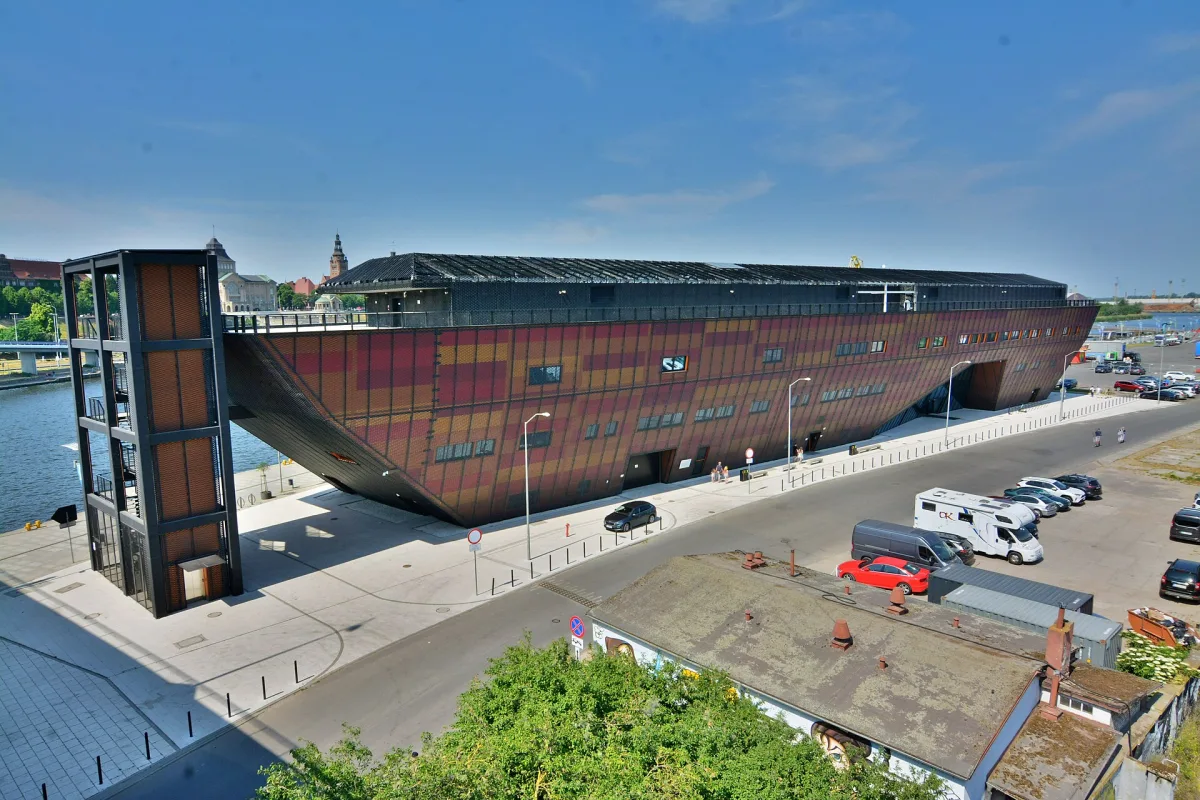
Łasztownia is an island and part of Szczecin lying opposite the Old Town, beyond the West Oder. Until 1945 it was called Lastadie in German. From the Middle Ages it was a place for transhipping goods, for warehouses and for shipbuilding, and today it combines historic monuments, port cranes and a modern science centre.
Origin of the name Łasztownia
According to Wikipedia, a łasztownia, from the German Lastadie, from the Latin lastadium, is in port towns a place where goods are unloaded and loaded onto ships or where ships discard ballast. Warehouses, called granaries, usually stood there. Later such areas also served for the repair and building of ships. The general entry lists łasztownie in many towns on the Baltic and the North Sea, and Szczecin appears there with the year 1315, alongside Königsberg (1339), Amsterdam (1342) and Gdańsk (1361).
A separate entry on the Szczecin island explains this somewhat differently. The medieval words lastagium, lestagium and lastadium, in Polish łaszt, denote the weight of a cargo. In the 14th century it was a unit of ship's cargo and a measure of bulk goods, with which the displacement of ships was also calculated. In time the whole island was called by this name. The name of Łasztowa Street derives from the same records.
An island bought by the town
According to Wikipedia, the early medieval island was much smaller: a small islet opposite today's Długi Bridge (Long Bridge), separated from the main current of the Oder by a narrow arm. The oldest route from the eastern to the western bank of the river ran this way, across the marshy valley of the Międzyodrze (the Oder floodplain). In 1283 Szczecin acquired the island and began to use it for port purposes: warehouses and granaries were put up there, and in time wooden loading platforms and quays.
The dates of the bridge differ between the sources. The entry on Łasztownia writes that a permanent wooden bridge called the Long Bridge was built in 1299. The entry on the Long Bridge states that a wooden bridge with a passage for ships was built in 1283, in place of a ferry crossing. Both dates appear in Wikipedia, without settling which moment is meant.
The road towards Dąbie was reinforced with an embankment of stones, hence its German name Gross Stein Damm, that is, the Great Stone Causeway. Today it is Gdańska Street. Already in the 14th century the whole area as far as the Parnica was called Łasztownia. Two terms arose: Wielka Łasztownia (Great Łasztownia) for the oldest part and Mała Łasztownia (Little Łasztownia) for the areas along the Oder as far as the Duńczyca. At the Duńczyca there was a shipyard, and according to Wikipedia also a municipal slaughterhouse, right by the Kłodny Bridge.
In 1308 St Gertrude's Church was built for the inhabitants. The people living here were mainly porters and port workers, shipyard workers and fishermen. Wikipedia also describes here a transhipment crane by the Long Bridge: its existence was confirmed only in 1570, although indirect sources from the 15th century mention fees for its use. The turn of the 16th and 17th centuries brought the filling in of the south-eastern arm of the Oder, and the northern one was filled in during the second half of the 17th century. According to Wikipedia, Łasztownia ceased to be an island in its original shape.
Ramparts, tenement houses and destruction
In the mid 17th century the settlement was surrounded by earth ramparts along today's Gdański Boulevard and Władysława IV Street. In 1727 the Parnica Gate was built in the fortifications, and by the shipyard the Goat Gate. After Szczecin was incorporated into Prussia in 1721, public and residential buildings were put up, and the present street layout dates, according to Wikipedia, from the time of Frederick William I. In the mid 19th century the ramparts were dismantled and replaced with streets.
At the turn of the 19th and 20th centuries the old houses were replaced with Art Nouveau tenement houses for workers, between factories and production buildings. Among the largest was the sugar refinery on Władysława IV Street. The opening of the free port in 1898, as Wikipedia notes, took place outside the area of historic Łasztownia. The island suffered in Allied air raids in 1942-1944 and according to Wikipedia was almost completely ruined. The free port lies on the eastern edge of the island and is part of the Port of Szczecin.
Reconstruction and the Castle Route
The former Grosse Lastadie Street, the main street of the island, was the quickest to be cleared of rubble after the war. Reconstruction work began in the 1960s, when Wielka and Gdańska Streets were widened, as well as Energetyków Street, the former Grosse Lastadie. It was given two carriageways with a tram track in the middle. A new, higher Port Bridge over the Parnica was also built. In the mid 1970s Energetyków Street was incorporated into the system of the Castle Route (Trasa Zamkowa) then being built, into its eastern interchange. According to Wikipedia, in the 1960s a design was also drawn up for several modern buildings for Polska Żegluga Morska, but it was not carried out.
St Gertrude's Church was secured at the end of the 1950s, and after renovation it received the dedication of the Holy Trinity. Today it is the Church of the Holy Trinity: a neo-Gothic building of dark brick. The present church was built in 1894-1896 on the foundations of an older Gothic church, and the heritage register gives the years 1896-1897. Since 1959 it has belonged to the Evangelical-Augsburg parish, and on 16 October 1960 it was given the dedication of the Holy Trinity.
The Dźwigozaury and the Maritime Science Centre
Three port cranes from the 1930s, most likely made by Friedrich Krupp AG, bear the name Dźwigozaury, from the words dźwig (crane) and dinozaur (dinosaur). According to Wikipedia, they were used to unload general cargo from ships until the first years of the 21st century, in 2009 they were handed over to the National Museum in Szczecin, and they were restored between 2016 and February 2017 together with their original colours. Since 2018 they have been illuminated. The entry calls them one of the symbols of Szczecin.
The island is also home to the Maritime Science Centre on Nad Duńczycą Street, in a building whose shape recalls a ship's hull. It is 14 metres high and 122 metres long, with three exhibition levels, a planetarium and a viewing terrace on the roof. According to Wikipedia it is a cultural institution of the West Pomeranian Voivodeship, established by a resolution of the regional assembly in September 2017.
In the following years Łasztownia continued to change. According to Wikipedia, in September 2022 the quay hitherto called the Russian Quay was renamed the Ukrainian Quay, and in 2022 construction began on an estate of apartment buildings on Celna Street. In 2024 the Szczecin Łasztownia railway stop was opened on Kępa Parnicka.
Be the first! Add a comment.
You need to log in to add a comment.
Log in