
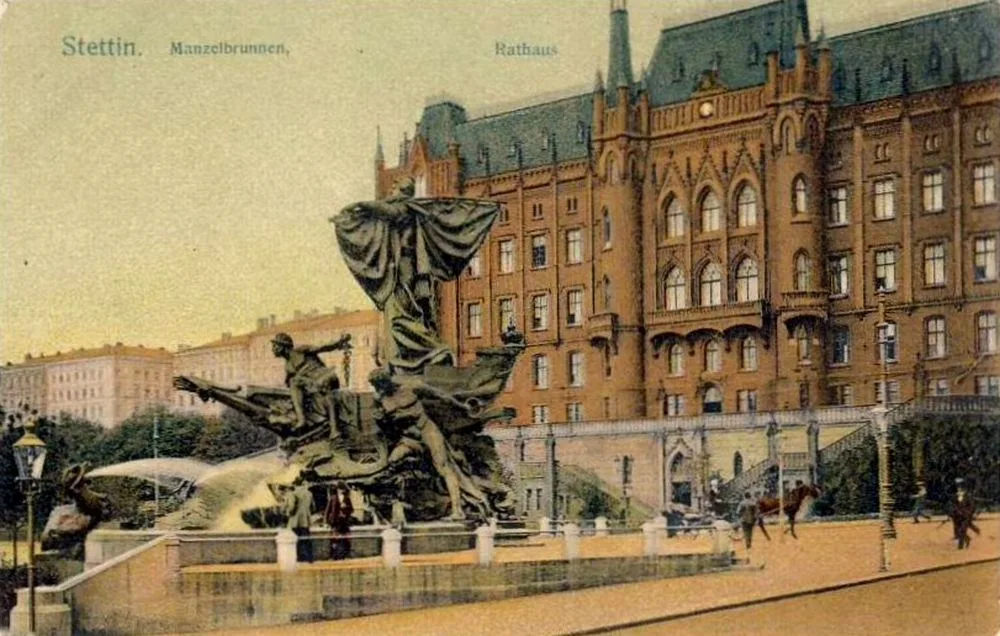
Sedina is a female figure who was invented in the late 19th century as the personification of Szczecin: a city of trade, shipping and its port. According to Wikipedia she was depicted as a woman in a boat, accompanied by Mercury, the god of trade, nymphs and sea creatures. Her best-known image was the fountain unveiled in 1898, and today a monument with an anchor stands on the site.
A fountain with a copper group of figures
According to Wikipedia the fountain was jointly funded by the Board of the Prussian Art Fund and the Szczecin City Board. It was unveiled on 23 September 1898 in the presence of Emperor Wilhelm II, together with the ceremony marking the opening of the Eastern Basin in the free port on Łasztownia. It stood at the northern corner of today's Tobruk Square, which was then called Marktplatz, at the junction of today's Dworcowa and Nowa streets.
The whole consisted of two parts. The basin of the fountain was designed by Otto Rieth, and the figural composition was made by Professor Ludwig Manzel, after whom the monument was named in German Manzelbrunnen, that is, the Manzel Fountain. The figures were made of copper using the repoussé technique and placed on a plinth of red sandstone. The group stood on a rock, below which was the basin.
Wikipedia describes the composition thus: a woman leaning on an anchor holds on her arm a yard with an unfurled sail, and beside her can be seen Mercury, people sailing in a boat, and sea deities. The whole was meant to symbolise Szczecin as a Hanseatic city of trade, shipping and industry. According to the same encyclopaedia the figure was turned towards the port-to-be, the free port.
From Stettina to Sedina
According to Wikipedia the figure was originally named Stettina, after the German name of the city, Stettin. However, a Latinised name was soon popularised, one that referred to one of the oldest names of Szczecin. The inhabitants began to say Sedina shortly after the fountain was unveiled. Wikipedia writes that the figure was meant to become a symbol of the continued prosperity of the city, which was then developing very fast, and was also meant to attract tourists.
The name has its own history, and here the interpretation is contested. Professor Tadeusz Białecki, one of the creators of the Encyclopedia of Szczecin, claimed according to Wikipedia that Sedina was invented by a group of Berlin students originally from Szczecin, at a time of rising German nationalism. Her name was supposed to come from the Germanic tribe of the Sidini, mentioned by Claudius Ptolemy, and to whom the 16th-century chronicler Thomas Kantzow attributed the founding of the city. The Germans identified Ptolemy's Sedini with Germanic tribes and ascribed to them a goddess Sedina.
Wikipedia also gives a contrast: for some, Sedina is a beautiful symbol of port Szczecin, while others are bothered by the fact that she recalls the German past of the city.
1942: removal from the plinth and the anchor
According to Wikipedia the sculpture was dismantled on 29 July 1942, during the Second World War, and melted down for war purposes. The original of the main figural composition has not survived. An anchor was placed in its stead, which is why the place is now called the Anchor Monument. Wikipedia does not say in which year the anchor was put up, and mentions only that it happened after the sculpture disappeared.
Sedina also had a private dimension: according to Wikipedia, the house of August Lentz in Szczecin contained the Sedina Chapel until the 1940s. Part of the furnishings survive, and on the top of the sideboard to the left of the chapel there is a likeness of Sedina. The main altar was lost in the 1940s. Wikipedia also mentions the Stoewer Sedina car, produced in 1937-1940 at the Stettiner Eisenwerk works in Szczecin.
The dispute over rebuilding
According to Wikipedia, plans to reconstruct the fountain have existed since the 1990s, and since then there has also been a dispute over the role of Sedina in shaping the identity of the city. In 2004 a civic committee was formed that wanted to recreate the figural composition from voluntary donations. In 2008, commissioned by the association “Merchants for Szczecin”, a model of the sculpture more than two metres high was made at the Centre of Polish Sculpture in Orońsko and shown during the annual Days of the Sea.
Opponents of rebuilding believe that the group with Sedina was inspired by the pan-Germanic views of 19th-century students and is a propaganda symbol of Germanic domination. Among the voices of opposition Wikipedia names Professor Białecki and Professor Władysław Filipowiak, as well as an open letter from the Szczecin branch of the “Niklot” Association. The historian Jan M. Piskorski recalled in Gazeta Wyborcza the opinion of the German historian Peter Hahn: Sedina contains no direct militaristic references, but the sheer size of the figure expresses the might of power and a sense of superiority, so it belongs to its time.
Wikipedia thus describes the dispute without resolving it: the fountain has not been rebuilt so far, and both sides appeal to the same history.
Sedina in Police
After the war a fountain with Sedina was built in Police, on Bolesław Chrobry Square in the Old Town, to a design by Mieczysław Glib. Its model was the prewar fountain from Szczecin. According to Wikipedia it was originally meant to depict the goddess Amphitrite.
Be the first! Add a comment.
You need to log in to add a comment.
Log in