
The Swedish governor and the Prussian garrison
After the House of Griffin died out in 1637, the Ducal Castle (the Castle of the Pomeranian Dukes) ceased to be a ducal seat. According to Polish Wikipedia, a Swedish governor lived in it from 1637, and a Prussian garrison was stationed there from 1720. German Wikipedia adds that the Swedish governors ruled Pomerania from here until 1720, and that during the siege of the city in the Swedish-Brandenburg war the castle was heavily damaged by the cannon of the besieging Brandenburg troops. According to the same entry, in 1709-1711 the exiled King of Poland Stanisław Leszczyński lived there with his wife Katarzyna Opalińska.
After Szczecin came under Prussian rule, according to German Wikipedia the castle was home to the garrison commander Christian August of Anhalt-Zerbst, father of the later Empress Catherine II. King Frederick William I ordered the building to be rebuilt so that it could house the provincial authorities, the courts, the Pomeranian War and Domains Chamber, an arsenal and rooms for the king.
Frederick II's mint
In 1752 Frederick II the Great established, according to Polish Wikipedia, a mint in the museum wing of the castle. German Wikipedia speaks of an order to set up a minting works in the same year. This wing was added at the beginning of the 17th century as the first building in the region intended for a museum, and the Encyclopedia of West Pomerania now calls it the Mint Wing.
Destruction: the 19th century and 1944
According to Wikipedia, the greatest devastation was done by the Prussian garrison in the 19th century: the vaults in the east wing were demolished, the south wing was completely rebuilt, the cloisters were pulled down, and staircases and corridors were built into the interiors. The garrison left the castle in 1902. Renovation work was undertaken in 1925 but abandoned a year later.
The castle suffered during Allied bombing. The entry on the castle gives the year 1944 and says that the building was then seriously destroyed. The entry on the bombing of Szczecin lists the castle among the targets of the raid of 17-18 August 1942, and the caption of a photograph of the ruins speaks of bombing in 1942-1944. The exact day of the destruction therefore depends on which raid is taken as the decisive one, and the cited entries do not settle this.
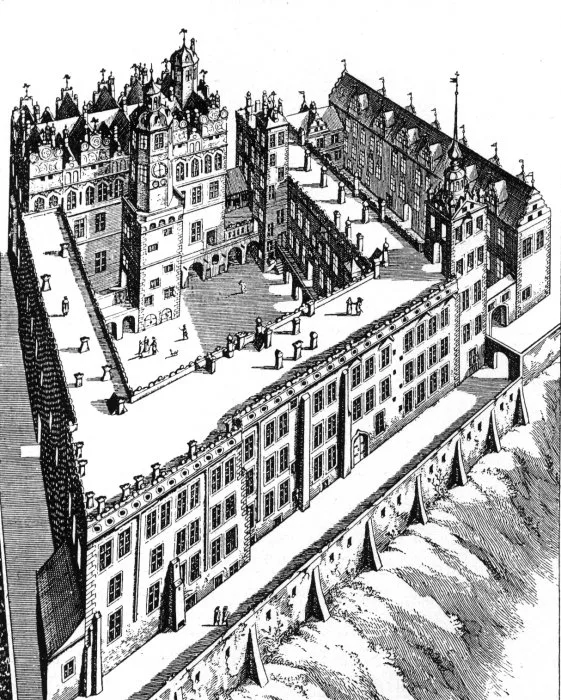
Rebuilding from Merian's engraving
The ruins were secured from 1946. The work was led by the office of the Regional Directorate of Spatial Planning, in which Helena Kurcyusz served as chief urban planner of the Szczecin voivodeship. Under her direction a crypt with the sarcophagi of the dukes was discovered, and from 1948 archaeological work was carried out in the courtyard.
The castle was rebuilt in 1958-1980. According to Wikipedia, the conservation and renovation designs in 1958-1970 were prepared by Professor Stanisław Latour of the Szczecin University of Technology, who in 1958 began the reconstruction together with his team. The entry on him calls the rebuilding of the castle, alongside his part in the rebuilding of Szczecin Cathedral, his life's work. The castle was given back its 16th-century Renaissance appearance, with the form reconstructed from the engraving by Matthäus Merian of 1652, and the interiors of the north wing were also recreated. Wikipedia gives 1652 as the date of the engraving, while the file on Wikimedia Commons has the year 1653 in its description. What was reconstructed was therefore the appearance from the time of the Griffins, not from the time when the castle was a Prussian garrison.
The extent of this reconstruction is not uniform. The Encyclopedia of West Pomerania says that the Renaissance appearance was recreated most fully in the north wing, only partially in the east and west wings, and that the facades of the south wing refer to the 16th century, although some solutions were dictated by the modern function. The entry on the castle church, in turn, states that the north wing was rebuilt in 1948-1956, which differs from the 1958-1980 frame in the entry on the castle.
What the castle houses
According to Wikipedia, the castle belongs to the voivodeship authority. It houses a cultural centre with exhibition rooms, a cinema, the Krypta Theatre and the cabaret Piwnica Przy Krypcie, as well as the Opera at the Castle, which according to its entry has its stage in the south wing and has been located here since 1978. The surviving part of the original furnishings consists of Gothic vaults and frescoes in the clock tower. The bones of the dukes were placed in St James' Cathedral, and the ducal clothing and jewels went to the National Museum in Szczecin for the exhibition “The Golden Age of Pomerania”.
The castle's website points to the Bell Tower as the tallest of the towers and a viewing point with a panorama of the city. The castle's clock tower is one of the subjects of the photographs in the Wikipedia entry on the castle. In 2017 the ceiling collapsed in the north wing, which had been closed earlier after cracks were detected, and according to Wikipedia the wing was reopened on 25 October 2025.
Be the first! Add a comment.
You need to log in to add a comment.
Log in