
Szczecin's free port has a date that can be pinned to the calendar: 1898. According to Wikipedia, that was when this part of the port was opened, with the East Basin put into use first and the West Basin following in 1910. Construction began in 1894. To understand why the city needed such an investment, we have to go back a dozen or so years.
The road to the free port
For centuries the development of Szczecin's port was limited to the banks of the Oder between Długi Bridge and Kłodny Bridge. Only in the last decades of the 19th century did the city begin to enlarge the port area. First, quays were built on the Duńczyca, in 1880 the Piast Canal was opened, which shortened the waterway to Świnoujście, and a year after construction of the free port began the Wrocław Canal was opened, linking the Duńczyca and the Parnica. This is what Wikipedia's entry on the Port of Szczecin says. The same entry marks the 1894 date as lacking a citation, so the year construction began should be treated as information from a single source.
According to Wikipedia, the free customs area in Szczecin's port today allows goods from outside the European Union to be stored without customs duty or import charges, and imported goods to be processed and finished. The principle is similar to that of 1898, but the sources do not describe the regulations of the former zone.
The opening on 23 September 1898
In its entry on the port, Wikipedia gives only the year 1898. A more precise date comes from the entry on the Manzel Fountain. According to it, the fountain was unveiled on 23 September 1898 in the presence of Emperor Wilhelm II, together with the ceremony marking the opening of the East Basin in the free port on Łasztownia. That is the date the fountain was unveiled, and the East Basin is mentioned as part of the same ceremony.
The fountain stood not by the basin itself but on Tobruk Square in the Old Town, at the junction of today's Dworcowa and Nowa streets. The fountain's basin was designed by Otto Rieth, and the copper figure group was made by Ludwig Manzel. It showed a woman leaning on an anchor, Mercury, the god of trade, and sea deities. Residents soon named the female figure Sedina, and according to Wikipedia she symbolised Szczecin as a Hanseatic city of trade, shipping and industry. The sculpture was dismantled on 29 July 1942 and melted down, and the Anchor Monument took its place. Manzel's work can still be seen elsewhere: his stone sculpture of a man fighting a centaur stands on the central terrace of the Chrobry Embankment.
Size and expansion up to 1945
According to Wikipedia, after the opening of the West Basin the free zone covered 60 ha, including 22 ha of water area. In 1911 construction of an industrial port on the lower Parnica began, and in 1917 the Upper Silesian Basin was opened. In 1923 the municipal and state ports were merged into one company, the Stettiner Hafen Betriebsgesellschaft. In the 1920s brick warehouses began to be built and wooden piles were replaced with concrete ones. In 1931 the port area was extended to include Ostrów Grabowski island.
The cargo turnover table in the same entry gives a turnover of 6,246 thousand tonnes in 1930 and 3,338 thousand tonnes in 1932. In 1945 bombing put the port out of action, and after the war an inventory showed, according to Wikipedia, 80 per cent destruction. All 152 cranes were destroyed.
What remains on Łasztownia
The Wikipedia entries give different accounts of the location. The entry on the port says that the free port was built on Łasztownia, while the entry on Łasztownia itself notes that the opening of the port in 1898 was the biggest event in the area, but that the port area lies outside the historic Łasztownia. Both versions agree that it concerns the eastern part of the island by the Oder, the Duńczyca and the Wrocław Canal.
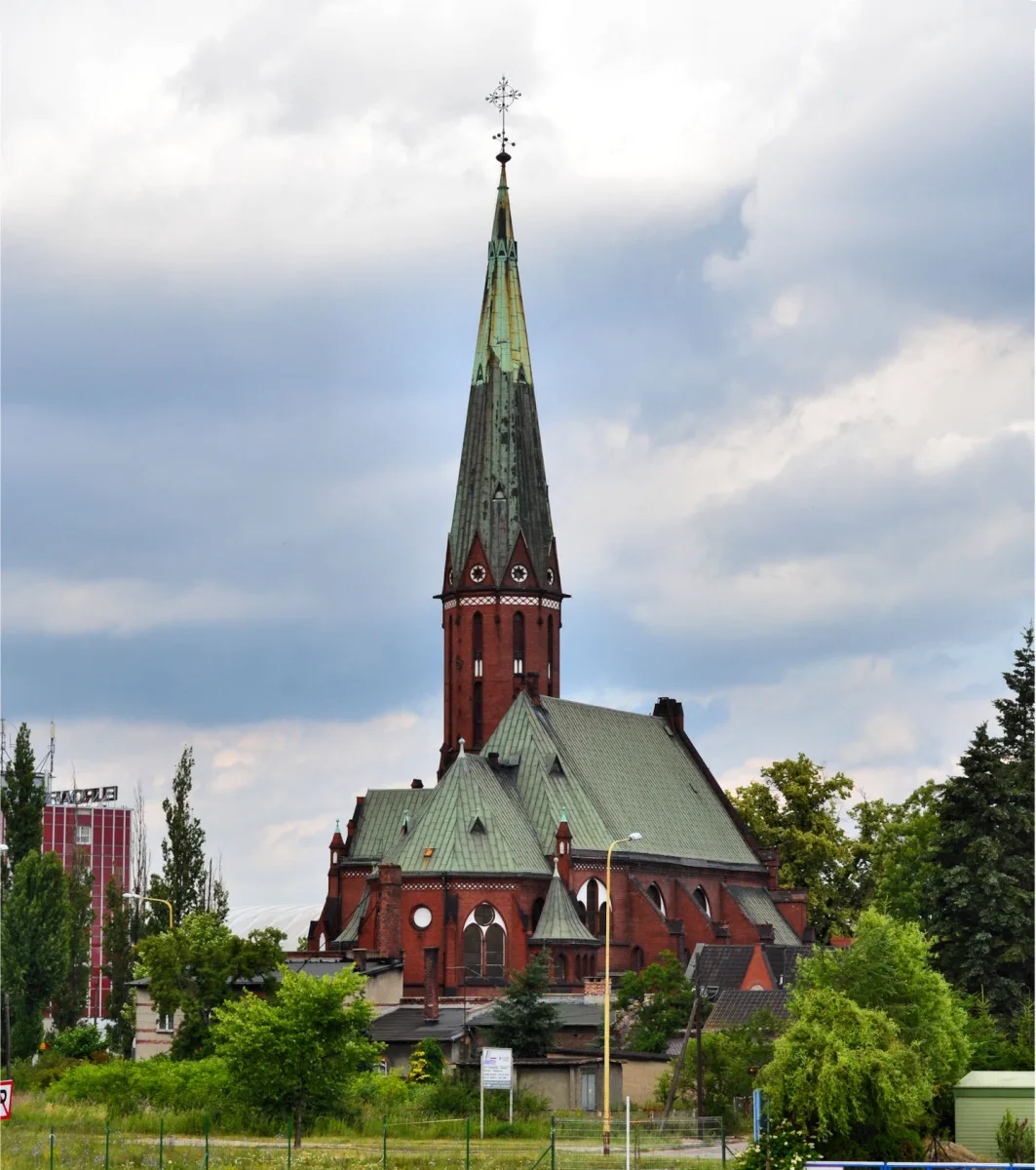
The Neo-Gothic administration building of the free-zone port from the late 19th century has survived. Also surviving are the reinforced-concrete warehouse number 7 from 1929 and other warehouse buildings of the former port. Łasztownia is also home to the Neo-Gothic Church of the Holy Trinity, built in 1894-1896, at the same time as the port. It is not, however, a church of the free port but the former St Gertrude's church from the island.
The former municipal slaughterhouse dates from the same period. The surviving Old Slaughterhouse building was built in 1888-1898 to a design by Conrad Kruhl and Carl Schmidt, and today houses the Euroregion Culture Centre. From a later period three port cranes remain, known as the Dźwigozaury. According to Wikipedia they were built in the 1930s, worked until the first years of the 21st century, were handed over to the National Museum in Szczecin in 2009, and after renovation in 2016-2017 have been illuminated every night since 2018.
The free customs area today
The port still has a free customs area, established, according to Wikipedia, in 1989. Operations began on 1 July 1995 on 4.49 ha, in 2000 the area was enlarged to 19.39 ha, and in 2005 to 19.66 ha. In another passage of the same entry, however, the free customs area is given as 11.47 ha in the eastern part of Łasztownia, so the size depends on the date of the description. The entry lists five quays there with a total length of 1,377 m, among them the former Russian Quay, which according to the entry on Łasztownia was renamed the Ukrainian Quay in September 2022.
Be the first! Add a comment.
You need to log in to add a comment.
Log in