
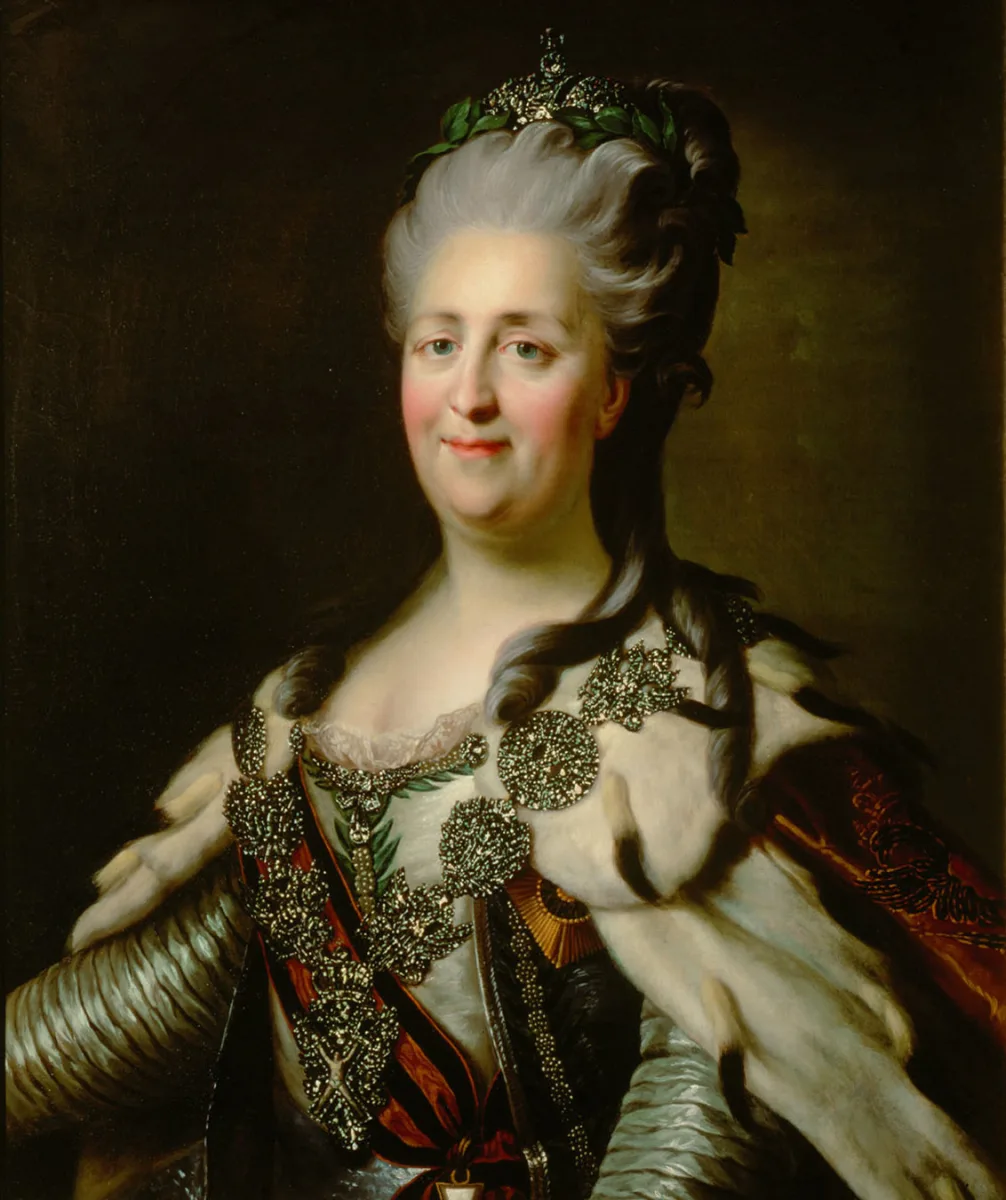
Two rulers of Russia were born in Szczecin, thirty years apart. Sophie Friederike Auguste of Anhalt-Zerbst became Catherine II and reigned in the years 1762-1796. Sophie Dorothea of Württemberg, as Maria Feodorovna, was the wife of Tsar Paul I. They were linked not only by their city of birth but also by family: according to the Encyclopaedia of West Pomerania, it was Catherine who decided on the marriage of her successor to the younger woman from Szczecin.
Catherine II: the house on the corner of Farna and Plac Mariacki
According to Wikipedia, Catherine II was born on 2 May 1729 in Szczecin as the daughter of Prince Christian August of Anhalt-Zerbst and Johanna Elisabeth of the House of Holstein. The place of birth is indicated at Farna 1, on the corner with Plac Mariacki. According to Wikipedia, the owner of the house, the chairman of the Chamber of Commerce, leased it to Prince Christian August, later commandant of the Szczecin fortress. German Wikipedia states that he became commandant of Szczecin on 22 January 1729, and governor of the city in 1741.
The future empress lived in this house for several years. The family then moved, according to Polish Wikipedia, to the western wing of the Castle of the Pomeranian Dukes. German Wikipedia writes that after taking over the rule of Anhalt-Zerbst in November 1742 the prince settled with his family in the castle in Zerbst. In 1745 in St Petersburg, Sophie converted to Orthodoxy, took the name Catherine and married Peter Ulrich, later Emperor Peter III.
What remains of the house at Farna 1
According to Wikipedia, the house at Farna 1 is the only surviving pre-war building of the former development of this street. It was originally five storeys high, with Neoclassical detail, a rusticated ground floor and a balcony on the square side. After post-war reconstruction it lost its facade decoration, and after renovation in 1994-1995 it gained a postmodern facade with details referring to its original appearance. In the 1920s it housed the district office of Randow County, and today it houses a branch of an insurer.
A commemorative plaque in Russian and German was unveiled on the building in 1889. The bombing of 6 January 1944 destroyed most of the buildings around Plac Mariacki, and on the site of tenement houses nos. 1-3 a school playground was created, which reduced the size of the square.
Maria Feodorovna: the Grumbkow Palace on Plac Orła Białego
Sophie Dorothea of Württemberg was born on 25 October 1759 in Szczecin. According to Wikipedia and the Encyclopaedia of West Pomerania, this happened in the Grumbkow Palace, today the Palace Under the Globe. The encyclopaedia states that she was the fourth child and eldest daughter of the commandant of the Szczecin fortress, Friedrich Eugen of Württemberg, and Friederike Dorothea Sophia of Brandenburg-Schwedt, a cousin of King Frederick II of Prussia. Wikipedia calls her mother a niece of Frederick II, so the sources describe the kinship differently.
The building in which she was born has not survived in that form. According to Wikipedia, the Baroque residence of Grumbkow was built in 1724-1725, and according to the study of the building on the portal in 1723-1725. Today's neo-Baroque building with a globe on top dates from 1891, after the palace was bought in 1890 by the National Insurance Company.
In 1769, according to the encyclopaedia, ten-year-old Sophie Dorothea left with her family for the family castle in Montbéliard. Before her wedding in October 1776 she converted to Orthodoxy and took the name Maria Feodorovna. Wikipedia states that the marriage was arranged by Frederick II and Empress Catherine. The encyclopaedia adds that in this way an engagement to Louis of Hesse was broken off. With Paul I she had ten children, among them the future tsars Alexander I and Nicholas I. Together with her husband she built, according to Wikipedia, the palace in Pavlovsk, the summer residence of the tsars, where she died on 5 November 1828.
Women of Szczecin at the imperial court
The first two sons of Maria Feodorovna, Alexander, born in 1777, and Konstantin, born two years later, were brought up, according to the encyclopaedia, by their grandmother, Empress Catherine. Their parents could visit them once a week. Only Alexandra Pavlovna, born after 1781, was the first child that Maria could raise herself. After her husband's death in 1801 Maria Feodorovna devoted herself, as the encyclopaedia writes, to founding institutes for the education of girls and to caring for orphans, invalids and veterans.
Be the first! Add a comment.
You need to log in to add a comment.
Log in