
Amber: a raw material known since prehistory
Baltic amber is, according to Wikipedia, a variety of amber called succinite, a fossil resin formed in the Eocene, that is, about 49 million years ago, when amber-bearing forests covered the lands around the then North Sea. The entry notes that the species of the parent tree has not been established with certainty. Amber is light, and its density, from 0.96 to 1.096 g/cm3, is comparable to that of sea water. It is easy to work, which explains why people made ornaments from it from the earliest times.
Wikipedia writes that it was traded throughout ancient Europe, and expeditions for amber were organised from the 5th century BC along the so-called Amber Road, from the Adriatic to the shores of the Baltic. Wolin appears on this map only in the 9th to 12th centuries, when the raw material reached the workshops on the Dziwna.
Wolin: amber as a commodity and as a product
According to the Wikipedia entry on the history of the town of Wolin, the settlement on the Dziwna became in the 9th century an important centre of craft production. Objects made of amber, pottery and antler combs were produced here on a large scale, and the products found buyers locally and on European markets. The same entry mentions that vessels analogous to those of Wolin were discovered in Denmark, Sweden and southern Norway. Wikipedia, citing an older work by the historian Malkewitz from 1904, also lists the goods in which the people of Wolin traded: local and northern furs, dried and salted fish, honey, amber, linen and slaves. The list thus comes from a study more than a century old, repeated in the encyclopedia, and not from excavations.
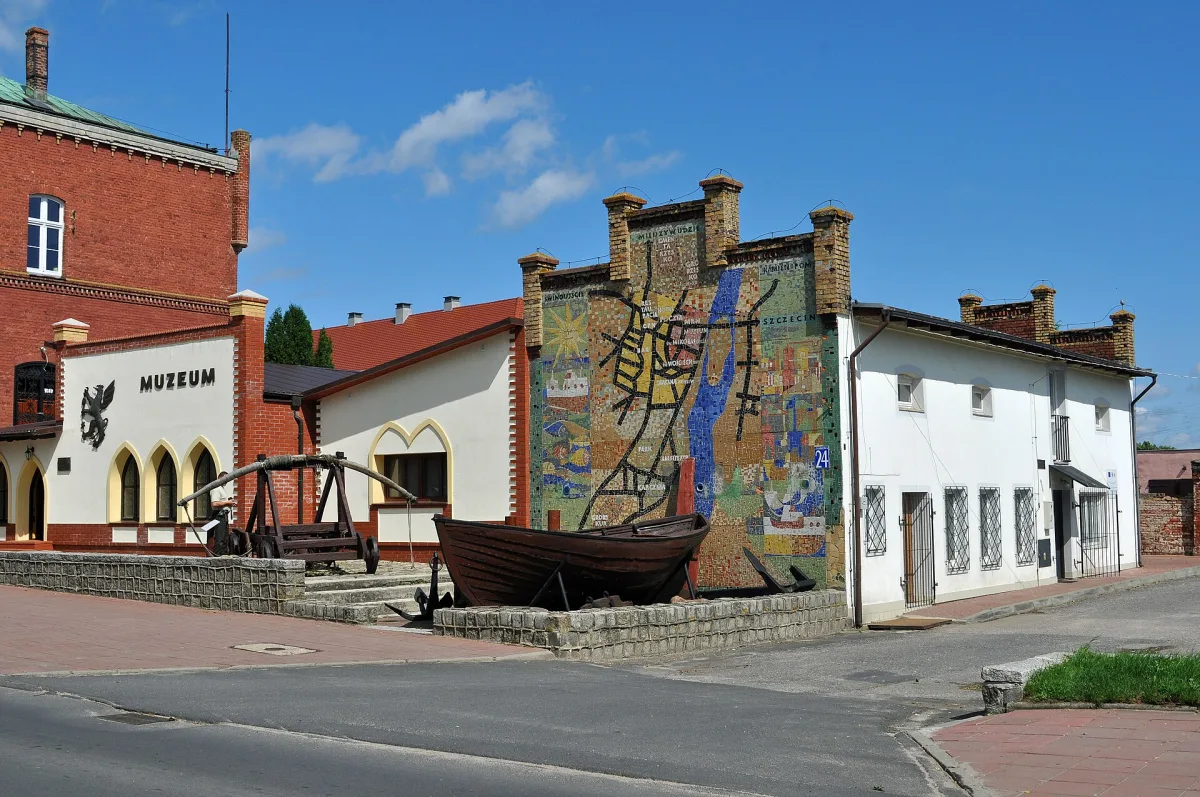
The working of amber is also shown by the Regional Museum in Wolin. According to the tourist website of the West Pomeranian Voivodeship, one of the rooms presents the crafts of the inhabitants: smelting and blacksmithing, the working of non-ferrous metals, glassmaking, developed amber working and shoemaking. The museum, according to its own website, holds hundreds of thousands of artefacts from the early Middle Ages. How many of them are made of amber is not stated in the published descriptions, so the numbers of workshops and products are best treated as an open question, not an established statistic. A reconstruction of the old buildings, in which a hut of an amber worker was planned among others, is shown by the Open-Air Museum in Wolin.
Silver and dirhams: the currency of the north
Amber was bought with silver, and silver arrived from the Orient. The Wikipedia entry on the history of Wolin states that the town's former wealth is attested by numerous silver hoards discovered, especially on Srebrne Wzgórze (Silver Hill), north of the old town. Among the finds are Arab coins, dirhams, which according to this entry formed the basis of the economy of northern Europe in the early Middle Ages and played a role similar to that of today's dollar or euro. The Encyclopedia of West Pomerania says that silver hoards and Arab coins, among others on Srebrne Wzgórze, were found as early as the 17th and 18th centuries, before the first scientific research.
Wikipedia mentions that the dirhams found in Wolin were struck mainly in the 10th century. It adds that Rudolf Virchow, who began the first research in 1871, was initially pessimistic about it, and his attitude was changed by discoveries of hoards on Srebrne Wzgórze, on Wzgórze Wisielców (Gallows Hill) and in the market square. The name of the hill itself is, according to Wikipedia, linked to a found hoard of silver coins. The German name Silber Berg was replaced in 1950 by the official name Bielica, although Srebrna Góra and Srebrne Wzgórze remain in use.
Silver hoards are not a speciality of Wolin alone. The Encyclopedia of West Pomerania, describing the sites in Bardy and Świelubie, about 15 km south-east of Kołobrzeg, lists Arab coins among the materials dating the settlement and dates its beginnings to the end of the 8th or the beginning of the 9th century. In the graves there, ornaments of gold, silver and bronze were found, similar to Swedish ones from Gotland. The numbers of coins in individual hoards of West Pomerania are not given by the sources we reached, so there is no value to quote here.
Imports from afar and the routes
The finds from Wolin show the reach of former contacts. According to Wikipedia, archaeologists discovered vessels of Norwegian steatite, glass beads from the Middle East, cowrie shells from the Indian Ocean, silks from Byzantium, painted eggs from Kievan Rus, rings decorated with beads from Central Asia, and even Scottish tartan fabrics. Traces of contacts with Scandinavia also include a tablet with a runic inscription and a wooden handle from the 11th century with an ornament in the Borre style.
The Encyclopedia of West Pomerania writes that in the 10th century Wolin was one of the most impressive craft and trading centres on the Baltic and the largest centre of the north-western Slavic lands, and routes from south to north and from east to west crossed here. The Wikipedia entry lists merchants from Frisia, Scandinavia, Byzantium, Central Asia, Rus and Slavic towns. The Dziwna gave the town direct access to the sea, and the extensive port made it possible to transship goods.
Trade had a second pole on the coast. Wikipedia derives the name of Kołobrzeg from the Latin form salsae Cholbergiensis in the chronicle of Thietmar of Merseburg, which under the year 1000 speaks of the bishop of the local church. The word salsa indicates, according to the entry, that it was originally a settlement of salt boilers. Today amber in Kołobrzeg is the subject of the Amber Museum in Kołobrzeg, which according to its own website runs workshops showing live the old and modern techniques of working it.
The end of the golden age
Wikipedia states that in 1043 (Wikipedia also cites the year 1042 after Malkewitz) the Danish king Magnus the Good invaded Wolin and the town was captured and partly destroyed. According to the same entry, in the second half of the 12th century the role of long-distance trade collapsed, and the most Danish attacks fell in the years 1170-1184. Wikipedia, following Stanisławski and Filipowiak, regards the invasion of the mid-11th century as a turning point in the history of the town. The Encyclopedia of West Pomerania sets the end of the golden age only with the invasions at the end of the 12th century, so Wikipedia and the Encyclopedia indicate the moment of the turning point differently.
Amber today
Amber from the southern Baltic is still in circulation. Wikipedia, citing geological data from 2010, states that outside documented deposits, 4 to 6 tonnes of amber obtained, according to official data, from Baltic beaches is bought up in Poland every year. The largest known lump of Baltic amber, weighing 9.75 kg, was found, according to the same source, in 1860 near Kamień Pomorski, and it is held by the Natural History Museum of the Humboldt University in Berlin.
Collections where lumps and inclusions can be seen are also by the sea. The Amber Museum in Jarosławiec shows, according to its own website, an amber forest, a reconstruction of an underground mine and an inclusion room. Its collection includes a lump weighing 2,906 grams, the second largest in Poland according to the museum's description, and rare inclusions, for example a grasshopper and a pine cone.
Be the first! Add a comment.
You need to log in to add a comment.
Log in