
From the Darłowo castle to three thrones
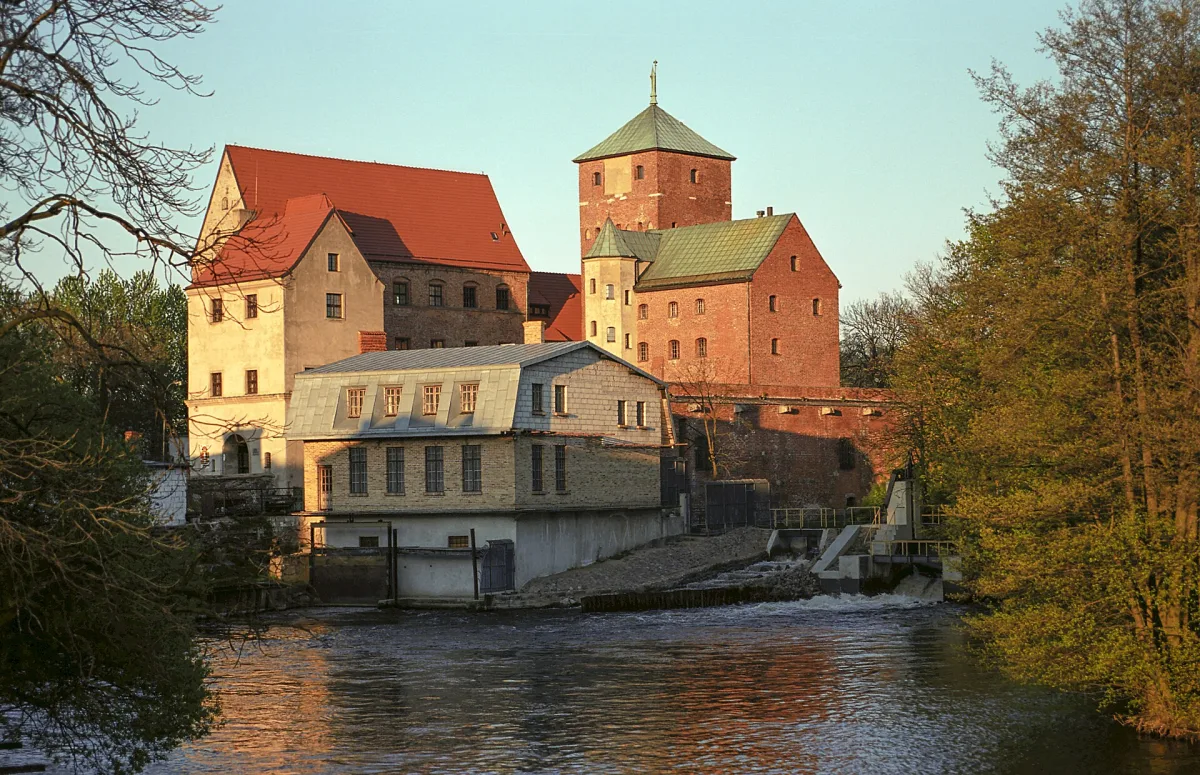
Eric of Pomerania was born in Darłowo, according to Wikipedia at Darłowo Castle, in the first half of 1382 (certainly before 11 June). At baptism he was given the name Bogusław, popular in the House of Griffin. He was the son of Duke Warcisław VII of Słupsk. The castle in which he was born stands to this day: the Castle of the Pomeranian Dukes in Darłowo is a brick Gothic fortress on an artificial island, since 1930 the seat of a museum.
According to Wikipedia, in 1389 Queen Margaret I adopted the young duke, and he then officially changed his name to Eric. He was recognised as king of Norway, and in 1396 Margaret brought about his election as king of Denmark and Sweden. Wikipedia gives the years of his reign: in Norway 1389-1442 (as Eric III), in Denmark 1396-1439 (as Eric VII), in Sweden 1396-1439 (as Eric XIII), with a break from 1434 to 1435. In this way three kingdoms of the Kalmar Union came under one sceptre.
Wars, tolls and deposition
After taking up independent rule in 1412, Eric, as Wikipedia describes, tried to win back for the Danish crown the Duchy of Schleswig, which was held as a fief by the counts of Holstein. The fighting lasted until 1423 and ended with Eric's withdrawal. Wikipedia also mentions his alliance with the Crown of the Kingdom of Poland of July 1419, concluded as a counterweight to the Hanseatic cities and the Teutonic Order, and a pilgrimage to the Holy Land in the years 1423-1425.
The war with Holstein and the Hanseatic League, resumed after his return to Denmark in 1426, exhausted the countries of the union. According to Wikipedia, in 1429 Eric imposed tolls on ships passing through the Danish straits, and later raised taxes, which together with the Hanseatic naval blockade worsened the economic situation. The entry describes him as a hot-tempered man, rough in manner, with autocratic tendencies. In Sweden an uprising broke out led by Engelbrekt Engelbrektsson, and the councils of the three kingdoms decided on Eric's deposition: in Denmark on 23 June 1439, in Sweden in September of the same year, in Norway in 1442.
Gotland and the privateering raids
The deposed Eric settled, according to Wikipedia, on Gotland, where he set up his seat in Visby. From there he carried out plundering raids, attacking merchant ships, most often belonging to the Hanseatic League. The entry writes that he was offered Gotland for life, but he stepped up privateering operations in the Baltic. He tried to sell the island to the Teutonic Order, Denmark or Sweden, and after a successful counterattack by Swedish forces he left Gotland in 1449. The term “pirate king” is therefore a shorthand, but its basis is described in the source: Wikipedia speaks directly of plundering and privateering expeditions. Details, such as the number of ships attacked, the entry does not give.
Return to Darłowo after 1449
In 1449 Eric took power in the Duchy of Słupsk after Bogusław IX, his cousin, who had died in 1446, and established his residence in Darłowo. According to Wikipedia, he looked after the affairs of the duchy, eased disputes between the bishop of Kamień and the towns, especially Kołobrzeg, and mediated in the dispute over rafting on the Rega River between Gryfice and Trzebiatów. He also brought about the marriage of Sophia, daughter of Bogusław IX, to Duke Eric II of Wolgast, whom he designated as his successor in the Duchy of Słupsk.
The castle was his seat. According to Wikipedia, in the years 1449-1459 Eric rebuilt the fortress, strengthened its defences and added a western wing, modelled on his earlier seat, Kronborg Castle. Linked with the town of his time is also the High Gate in Darłowo, the only surviving one of the four gates of the old town walls; the heritage register dates it to the 14th-15th century.
Death in 1459 and the sarcophagus
Eric died in Darłowo before 16 June 1459, according to Wikipedia probably on 3 May. The entry states that before his death he passed to Sophia and Eric II a treasure made up of valuables brought from Denmark and gained during the privateering expeditions. Later Danish kings tried to recover it, considering it their property. Wikipedia notes that what happened to the treasure is not known to this day.
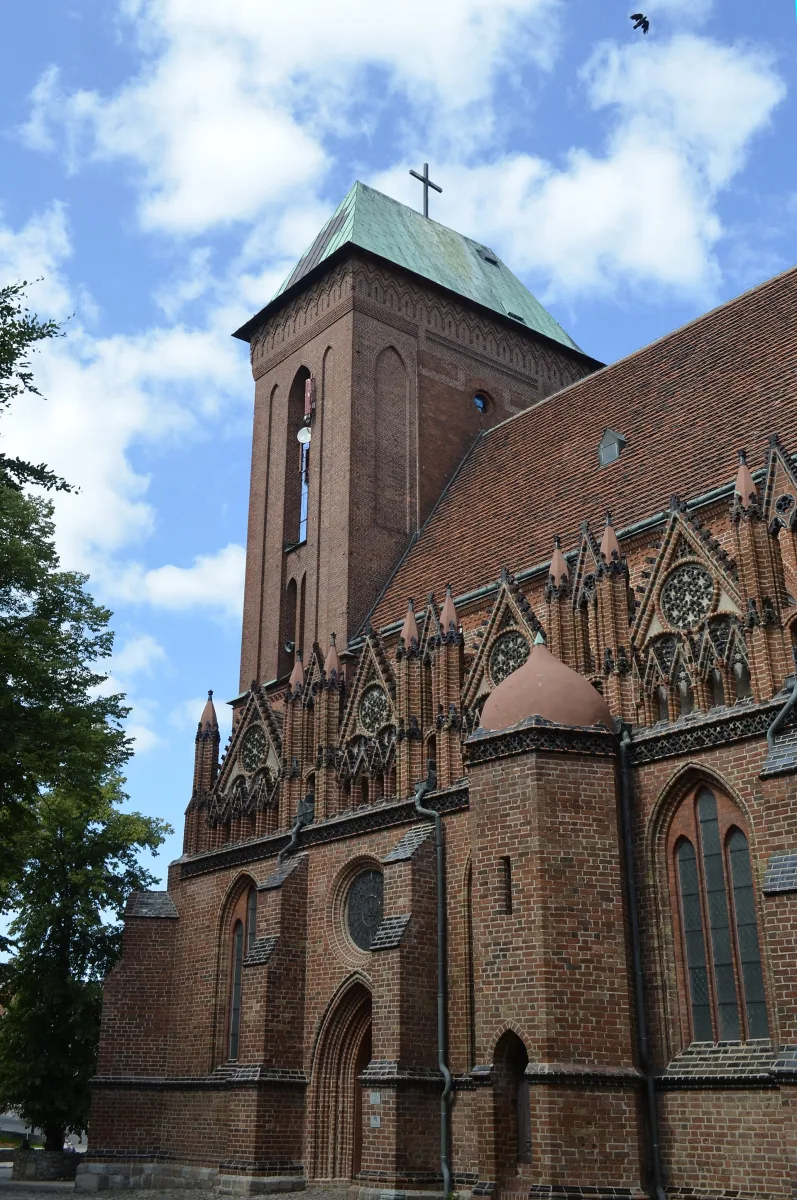
The king is buried in St Mary's Church in Darłowo, today the parish of Our Lady of Częstochowa. According to Wikipedia, his tomb was erected in 1882, and the coats of arms of Denmark, Sweden and Norway were placed on the sarcophagus. Among the sarcophagi of the Pomeranian dukes in this church are also those of Elisabeth, wife of the last duke Bogusław XIV, and Hedwig, wife of Ulrich, brother of Bogusław XIV.
A trace of the pilgrimage in Darłowo
Linked with Eric's pilgrimage to the Holy Land is a Darłowo building standing in a cemetery: St Gertrude's Church in Darłowo, a former cemetery chapel on a hexagonal plan with a twelve-sided ambulatory. According to Wikipedia, the chapel's documents were destroyed by the fire of Darłowo in 1722, so it is not known who founded it and when it was built. Many researchers attributed its construction to Eric, linking it with his pilgrimage, but modern historians do not agree on this. Franz Kugler dated the church to 1450-1460, Ludwik Böttger to the second half of the 14th century, and Karl Rosenow to the second half of the 15th century. It is an example of how hard it is, after six centuries, to separate fact from tradition, even for such a well-known ruler.
Be the first! Add a comment.
You need to log in to add a comment.
Log in