
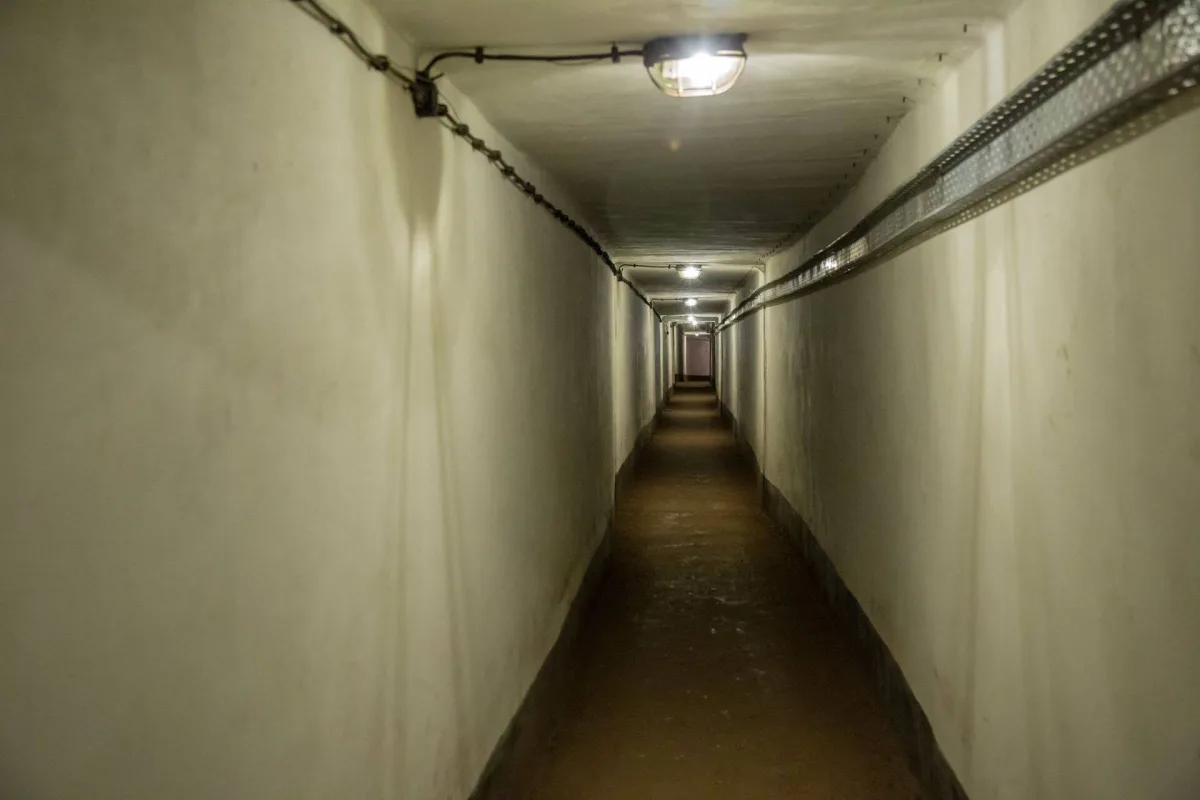
A Kriegsmarine battery on a dune in Przytór
Underground City on Wolin Island is a former coastal artillery battery complex in Świnoujście, in the Przytór area, entered according to Wikipedia in the heritage register in 2016. The German Kriegsmarine command built it to protect the naval base. Wikipedia states that it was built in 1936-1938, and begins the history of the battery in 1935, with the decision to strengthen the defence of the naval port. The museum's website writes that construction began in 1936 and that the first trial firing took place in 1939. The first soldiers took up their positions in 1939, according to both sources.
The complex consists of seven reinforced concrete bunkers. Four of them are barracks-and-combat bunkers, named in Wikipedia Anton, Cäsar, Dora and Emil. Each had a barracks section and a combat section with a barbette for a 15 cm SK C/28 gun. According to the museum the range of the guns was about 20 km, and each armoured gun weighed nearly 8 tonnes. The fifth bunker, on two levels, was the fire control post of the whole battery. According to Wikipedia it had two periscopes, a rangefinder and a steel armoured cupola weighing more than 60 tonnes, which has survived to this day. The two auxiliary bunkers are a machine room with power generators and a well, and an ammunition store.
According to Wikipedia the name “Vineta” comes from the legendary city of Vineta. The museum's website describes it less definitively. It writes that around 1940 the original guns were dismantled and taken to the Netherlands, where a new Vineta Battery was built, while older guns with similar parameters were installed in the Świnoujście bunkers, after which it also calls the Świnoujście battery the Vineta Battery. During the war, according to the museum, the complex received a FuMo 214 Würzburg-Riese fire-control radar, and from 1941 it was used to train Kriegsmarine coastal gunners.
1945 and the handover to the Polish army
According to the museum, in March 1945 the battery supported with fire the German units that were defending the Dziwnów-Dziwnówek isthmus. In April 1945 the facilities were abandoned after the breech blocks of the guns had been blown up. The complex was taken by Soviet units on 5 May 1945, the same day on which, according to Wikipedia, the Red Army captured Świnoujście. The equipment was dismantled until December 1945, and in January 1946 the site was handed over to the Polish army. Wikipedia writes only that after a few months the battery passed to the Polish Army.
A reserve command post
For the first years there was no idea how to use the bunkers. According to the museum, in the 1950s it was decided to convert the battery into a reserve command post for the highest military authorities, and the first major modernisation was carried out around 1955. Wikipedia dates the change to the early 1960s and in its infobox gives conversions of 1961-1963. The discrepancy also concerns the second stage: the museum's website gives the year 1965, in which the bunkers were linked by a kilometre of underground corridors, while Wikipedia speaks of five bunkers linked by corridors with a total length of 1492 metres.
According to Wikipedia the bunkers then had new roles: bunker A was a radio transmitting post, B a command post, C an anti-chemical defence post with a clinic, D a radio receiving post, and E housed the canteen and officers' mess. The machine room was fitted with two generators with a total output of 180 kW. The museum's website lists a telephone exchange, the Radio Receiving Centre, a mess and an anti-chemical defence facility, and a division of the area into five security zones. Wikipedia gives the military unit number: JW 8646.
The descriptions also differ on whose command was to operate here. According to the museum the complex was a reserve command post of the Commander of the Maritime Front, while Wikipedia writes of the Forward Command Post of the Commander of the Northern Front. The museum writes that in the 1980s the site served the Commander of the Navy, and later the Commander of the 8th Coastal Defence Flotilla; Wikipedia places the Navy in the 1980s and the flotilla in the 1990s. The flotilla was formed in May 1965, and in 1994 it was named after Vice Admiral Kazimierz Porębski, according to Wikipedia. The last exercises involving the complex were, according to the museum, the “Pirania” manoeuvres of 1995, and according to Wikipedia “Anakonda 95”.
Takeover by the museum and visiting
According to Wikipedia, in 2007 the military took the decision to dispose of the site because of its obsolete bunkers and maintenance costs. The options were demilitarisation by blowing it up or handing it over to a public benefit institution. The Coastal Defence Museum in Świnoujście, which has its seat in Gerhard Fort, applied for the site for more than four years. Wikipedia states that the unit was struck off the list of military facilities on 31 January 2013, and according to the museum the museum became the site's host on 31 December 2013. Visits began, according to a photo caption in Wikipedia, on 1 May 2014, and Wikipedia also writes that museum staff opened the site within five months, which with the dates given (from 31 December 2013 to 1 May 2014) is an approximate figure. The museum is private and, as Wikipedia writes, unsubsidised. The rules for visiting are given by the museum.
The Prussian forts of the Świnoujście Fortress, including the Western Fort, were built in the 19th century, and according to Wikipedia the complex was built to defend the port. The battery of the 1930s, also described as the Vineta coastal artillery battery complex, is a separate work of a later era, with a different construction: reinforced concrete bunkers instead of brick forts.
Be the first! Add a comment.
You need to log in to add a comment.
Log in