
In Szczecin, unlike in Gdańsk and Gdynia, calm prevailed until 17 December 1970, although according to the IPN, Security Service reports noted a tense situation in the workplaces. The immediate cause of the protests was the rise in the prices of basic foodstuffs, announced on 12 December and introduced on Sunday 13 December. This text describes the course of 17 and 18 December in Szczecin on the basis of publications of the Institute of National Remembrance (IPN).
Morning at the Warski Shipyard
According to the publication of the Szczecin branch of the IPN, at about 10.00 a rally took place at the Adolf Warski Shipyard. The workers demanded the withdrawal of the price rise and a conversation with the First Secretary of the Provincial Committee of the PZPR, Antoni Walaszek. The conversation did not take place. At 10.30 more than six hundred shipyard workers left the shipyard. The march began to grow with workers from nearby plants and set off towards the seat of the Provincial Committee of the PZPR.
The account in the IPN's 2016 announcement is arranged somewhat differently: the morning rally in front of the management building turned into a march, which was dispersed by militia forces, and around noon a second, much larger march set out from the shipyard. Attempts by the militia to stop it on Dubois Street failed. Both versions come from the IPN and agree on the direction: the demonstrators were heading for the city centre.
The Provincial Committee building and the provincial militia headquarters
In front of the Provincial Committee of the PZPR building, according to the IPN, a crowd of about 20,000 gathered. People threw stones and petrol bottles, which caused a fire that engulfed the whole building. Walaszek decided to evacuate the building, and the crowd did not allow the fire brigade to reach it. Military reinforcements were brought into the city, including units that had earlier taken part in the pacification of Gdańsk and Gdynia.
The attack also covered the nearby Provincial Headquarters of the Citizens' Militia on Małopolska Street and the remand prison, where, according to rumours, detained demonstrators and representatives of the shipyard strike committee were being held. The headquarters building was set on fire. According to Michał Paziewski, quoted in the IPN publication, the first shots from the windows of the headquarters were fired at about 15.30. The assault was repulsed by militia and army units. Here the IPN gives different figures: the 2016 announcement says that eleven people were killed at that time, and the 2020 publication that a few hours later twelve people were killed in front of the headquarters.
A curfew was introduced from 18.00 to 6.00. Towards evening the fighting moved to the area of Kaszubska Street, where the remand prison, the prosecutor's office building and a nearby military unit were attacked. Late in the evening the crowd headed for the City National Council building, and in several places in the city, among others at the Provincial Prosecutor's Office and the Presidium of the Provincial National Council, further clashes took place. According to the IPN announcement, the events lasted until 22.00 and ended with a toll of fourteen dead and many wounded.
18 December: the strike and the toll
The next day people gathered from the morning in Polish Soldier Square. According to the IPN publication, the crowd attacked armoured vehicles there with stones and petrol bottles, and the army responded with fire. In other parts of the city, where workers tried to form marches and attack buildings of state institutions, firearms were also used. On that day more than 200 people were detained, most of them young.
A strike was declared in several plants: at the Parnica Shipyard, in the port, at the Warski Shipyard and at the Gryfia Repair Shipyard. The largest strike committee was formed at the Warski Shipyard, and its chairman was Mieczysław Dopierała. Outside the shipyard, surrounded by a cordon of army and militia, more people were wounded, two of whom died in hospital. During the night the City-Wide Strike Committee was formed, to which, according to the IPN, more than a hundred enterprises submitted. The strikers presented 21 demands, among others a demand for independent trade unions and for those responsible for the killings to be held to account. An agreement with the authorities was signed on 20 December, and the strike was formally ended on 22 December.
According to the IPN, sixteen residents were killed in Szczecin, and across the country forty-five people were killed and more than a thousand wounded. The figure of sixteen is also given by the National Museum in Szczecin in its description of the exhibition at the Przełomy Dialogue Centre. The Szczecin branch of the IPN stresses that to this day little is known about the Szczecin victims, because families kept silent for a long time for fear for their own safety.
Traces in the city
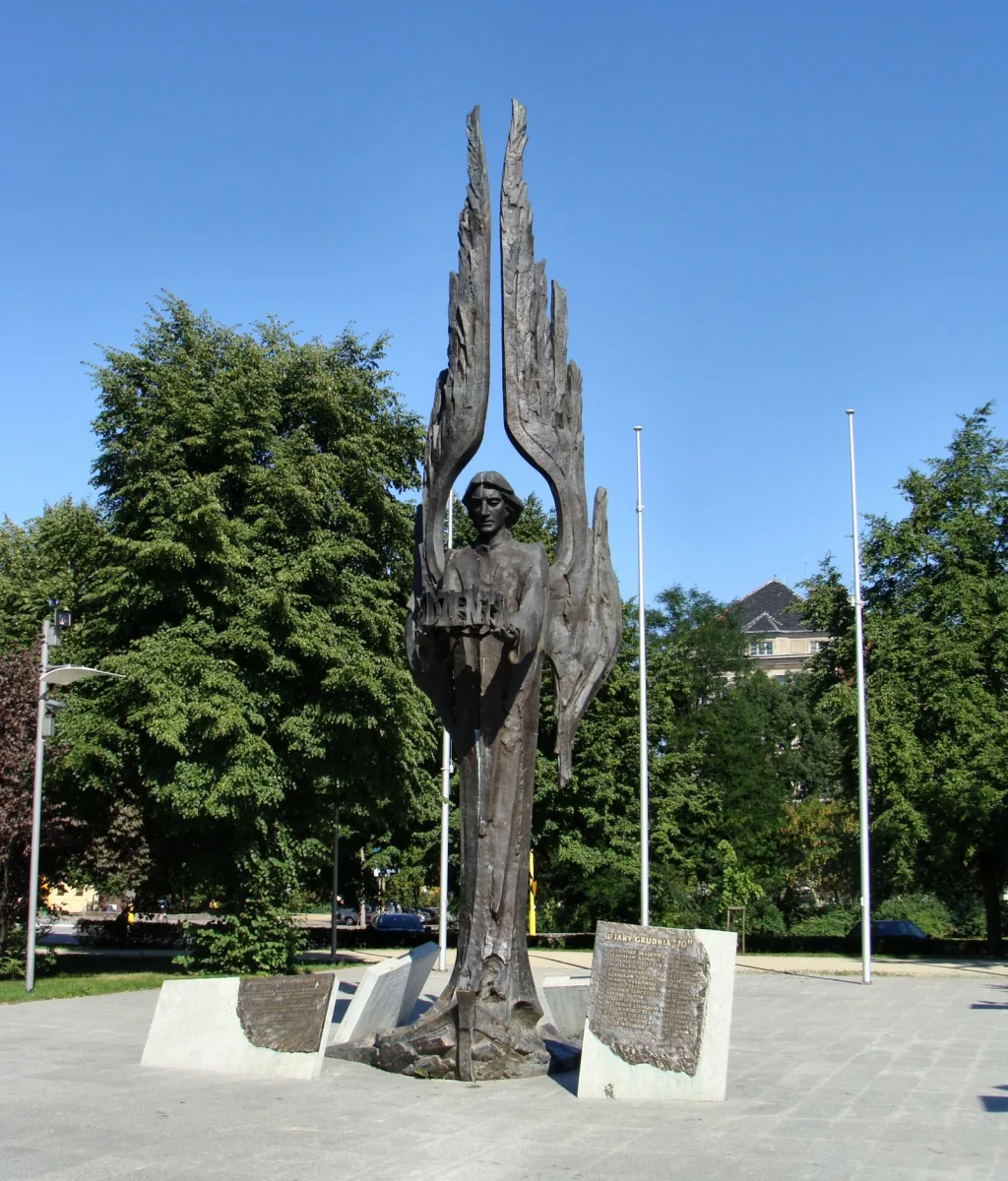
The Monument to the Victims of December 1970, known as the Angel of Freedom, was unveiled on 28 August 2005. According to the IPN it stands on the site of the bloodiest episode of the Szczecin December, in front of the former provincial militia headquarters. Solidarity Square is today a place for anniversary ceremonies, and beneath it is the Przełomy Dialogue Centre, a branch of the National Museum in Szczecin, with part of the exhibition devoted to the events of December 1970. Visiting rules are given by the museum.
Be the first! Add a comment.
You need to log in to add a comment.
Log in