
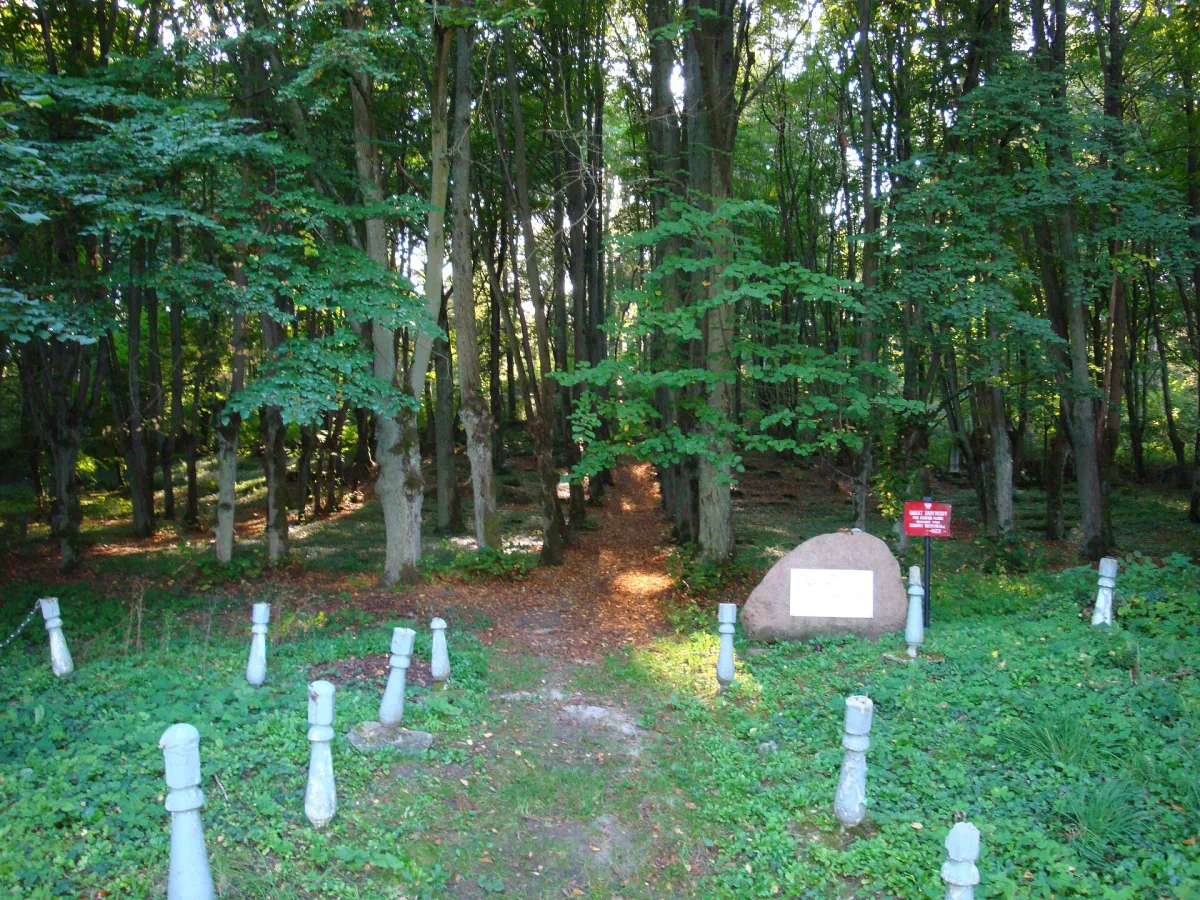
Before the war, Jewish communities were active in the towns of West Pomerania, and what remains of them are cemeteries and the sites of synagogues. On the night of 9 to 10 November 1938 many of these places were destroyed, and after 1945 more were liquidated or demolished. Today the state of preservation varies greatly: in some towns matzevot (gravestones) still stand, in others there is only a stone, a plaque or a lapidarium. Below is a summary based on the sources, from places with a monument to those where gravestones survive.
Places commemorated with a monument, a stone or a lapidarium
In Kołobrzeg the old Jewish cemetery was established, according to Wikipedia, in 1812 at the junction of Zdrojowa and Mickiewicza streets. It was destroyed in 1938 by German Nazis. In 2000 a lapidarium was set up there: the matzevot that had been found were arranged on the plan of a Star of David, and a monument in honour of the victims of the Holocaust was unveiled. The matzevot therefore do not stand in the original burial places.
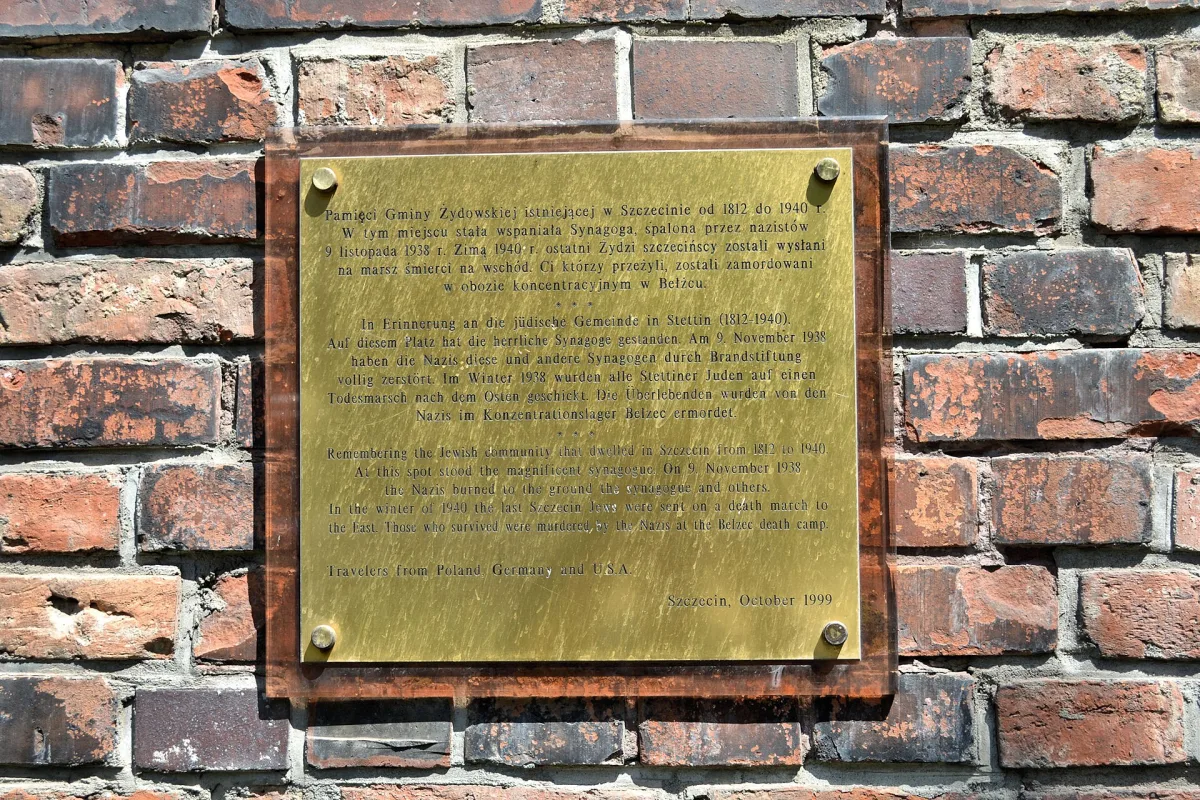
Koszalin had two cemeteries. According to Wikipedia, the old one, established in 1750 on Orla Street, was closed in 1900 and completely devastated in November 1938. A memorial stone stands there with the only surviving matzevah, bearing the name of David Baruch, which was found in the river in 2000 by the photographer Zdzisław Pacholski. The new cemetery on Racławicka Street was liquidated after 1945, and university buildings were erected on its site. In May 2006 a monument in the form of a slab stylised as a matzevah was unveiled there. Both places are described in the entry on the Jewish cemeteries in Koszalin. Nothing remains of the synagogue: according to Wikipedia it was burned on the night of 9 to 10 November 1938, and on the site of the synagogue in the Park of the Pomeranian Dukes a boulder with a plaque in Polish, German and English was unveiled in October 1999.
In Kamień Pomorski the Jewish cemetery at the junction of Rejtana and Chrobrego streets was established in the 19th century. According to Wikipedia it was destroyed during the Nazi period and liquidated in 1968. On 3 April 2008 a boulder with an inscription commemorating the town's pre-war Jewish community was unveiled there.
In Sławno the cemetery from the middle of the 19th century was destroyed in 1939, and in the 1960s the gravestones were used to build roads. In 1999 a plaque commemorating the Jewish community was unveiled on the chapel wall, and in 2016-2017, on the initiative of the town, the surviving gravestones were gathered in a lapidarium on the former cemetery.
Places with individual matzevot
In Szczecinek the cemetery was established at the beginning of the 18th century. It covers about 0.2 ha and is entered in the heritage register. The pre-burial house survives, rebuilt as an Evangelical-Augsburg chapel, and of the gravestones one matzevah from 1756, kept in the Regional Museum in Szczecinek. According to the heritage register, the land belongs to the municipality.
In Stargard the cemetery on Kalkenberg hill has different datings. Wikipedia gives the second half of the 18th century, the heritage register the end of the 17th century. It covered about half a hectare and was destroyed on Kristallnacht in 1938, like the synagogue by the Granary (Spichlerz). Individual surviving matzevot are in the Old Municipal Cemetery and in the Archaeological and Historical Museum in Stargard. In 2005 the authorities of the town and of the Jewish community signed a letter of intent on commemorating the Jews of Stargard.
In Pyrzyce the cemetery on Basenowa Street was established around 1735 and liquidated after 1969. According to Wikipedia there is no arranged place of remembrance there, and fragments of gravestones can be found in the undergrowth.
Cemeteries with surviving gravestones
In Moryń the cemetery was established around 1856, according to Wikipedia, although a plaque from 2006 speaks of the beginning of the 19th century. Eight gravestones survive, along with the pre-burial house, today a residential building. The site, covering half a hectare, is enclosed by a stone wall, and on 31 May 2006 a plaque in three languages was unveiled and the matzevot were restored.
In Chojna the cemetery, established around 1850, covers 0.3 ha and is enclosed by a stone wall. About ten gravestones of granite, sandstone and limestone survive, with inscriptions in German and Hebrew. In 1958-1960 the site was tidied by the local authorities.
In Człopa the cemetery on Poznańska Street, established in the 17th century, covers about 0.7 ha. About ten sandstone gravestones survive. In Mirosławiec the cemetery on Cmentarna Street covers 1.6 ha and has about 200 gravestones, the oldest from 1752. Wikipedia dates its founding to the 17th century, the heritage register to the early 18th century.
In Świdwin the cemetery on Dobra Rycerskie Street is described in the entry on zabytek.pl, prepared by the POLIN Museum of the History of Polish Jews, as the best preserved Jewish necropolis in West Pomerania. About seventy gravestones survive, and the heritage register of 1989 recorded 72 gravestones and 29 graves. Since 2001 it has been looked after by members of the local Pentecostal Church, and since 2009 the site has been owned by the Foundation for the Preservation of Jewish Heritage.
The rules of entry to the individual cemeteries are given by their administrators, most often town and municipal offices.
Be the first! Add a comment.
You need to log in to add a comment.
Log in