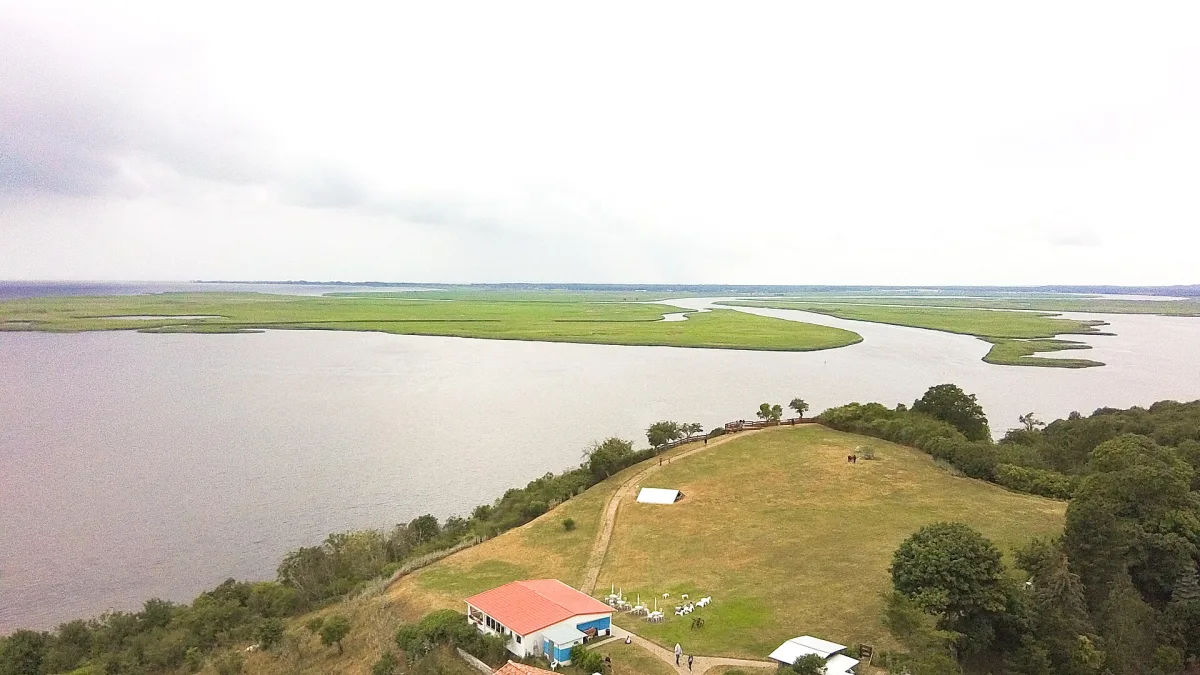
Early medieval hillfort on the cliff of the Szczecin Lagoon with the foundations of a tower and a viewpoint.
The hillfort in Lubin is the remains of an early medieval Slavic stronghold on Wolin Island, about 8 km from Międzyzdroje. It lies on the highest cliff of the shore of the Szczecin Lagoon, at 43-52 m above sea level, and is at the same time a viewpoint over the lagoon, the Świna delta and Lake Wicko Wielkie.
The oldest traces of settlement date from the 9th or the first half of the 10th century, and the defensive rampart was probably built at the end of the 11th century. In 1124 Otto of Bamberg came to Lubin and, as the chronicler Herbord records, consecrated an altar here. In 1173 the stronghold was taken by the forces of King Valdemar I of Denmark. It was last mentioned in a document of 1186 or 1187, in which it was granted to the Kamień chapter. A church of St Nicholas stood on the site.
Excavations in 2008-2011, carried out by a team from the University of Szczecin and the Institute of Archaeology and Ethnology of the Polish Academy of Sciences, uncovered the remains of the church of St Nicholas and a cemetery in which the remains of 71 people were found, as well as two ramparts and the foundations of a residential tower. Under a protective roof the foundations of this tower from the 15th or 16th century can be seen, which was the residence of the provost of the Kamień chapter. Apart from them no other remains of the stronghold can be seen. Among the finds is a dirham from the 10th century, minted most probably in Samarkand.
From the viewing place extends a panorama of the Szczecin Lagoon, the Świna delta and Lake Wicko Wielkie. In favourable conditions the chimneys of the plants in Police and the lights of Nowe Warpno can be seen, and on the other side Świnoujście and the Baltic. The site's own page encourages viewing the panorama of the 44 islands of the lagoon and the wild birds, including the white-tailed eagle.

Be the first! Add a comment.
You need to log in to add a comment.
Log in