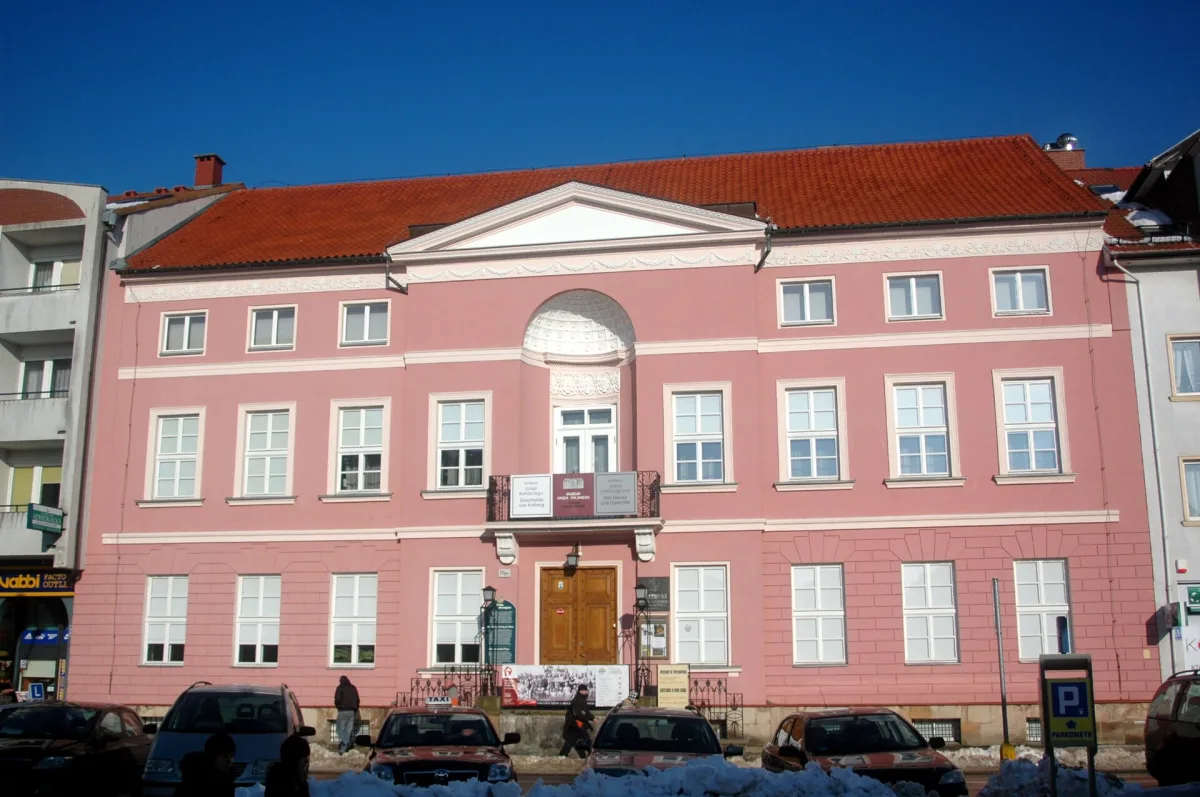
An Empire-style merchant palace from the early 19th century in the centre of Kołobrzeg, today the City History Branch of the Museum of Polish Arms with the exhibition “Dzieje Kołobrzegu”.
The Brunswick Palace, also called the Braunschweig Palace, is a building in the Empire style in the centre of Kołobrzeg. Today it houses the City History Branch, that is the Kołobrzeg Town Museum, which belongs to the Museum of Polish Arms, and the management offices of that museum.
The palace was built in the first two decades of the 19th century by the Kołobrzeg merchant C. F. H. Plüddemann as a dowry for his daughter Alma, who married Heinrich Braunschweig, a member of one of the oldest patrician families of Kołobrzeg. The family appears in documents from 1282 and was connected with salt boiling. Despite changes of owner the building was always called the Brunswick Palace.
Just before the Second World War the palace was bought by the town with a museum in mind, but the outbreak of the war interrupted the renovation. In March 1945 the building suffered no major damage. After the war it housed the Public Security Office, and then a court and prosecutor's office. After a major renovation in the 1970s, since February 1977 it has been the seat of the Museum of Polish Arms.
The palace was built on a rectangular plan, has three storeys and richly finished halls. The best known is the banqueting hall on the first floor with its original plafond, a large ceiling painting on paper, probably made in 1816-1818. At the centre is Flora, the Roman goddess of spring vegetation, in an oval frame of flower garlands. On the pink walls hang oil paintings of Polish historical figures. In the niches stands a 16th-century suit of armour with a shield and a lance, and opposite it a marble bust of Athena. The hall is used for conferences, concerts and museum lessons.
In the permanent exhibition “Dzieje Kołobrzegu” (The History of Kołobrzeg) you see a chronological account of the more than thousand-year history of the town, from the early Middle Ages to the middle of the 20th century. The palace also has a temporary exhibition room, a library and workshops. Formerly a small turret stood on the ridge, from which the entry of ships into the port was watched.

Be the first! Add a comment.
You need to log in to add a comment.
Log in