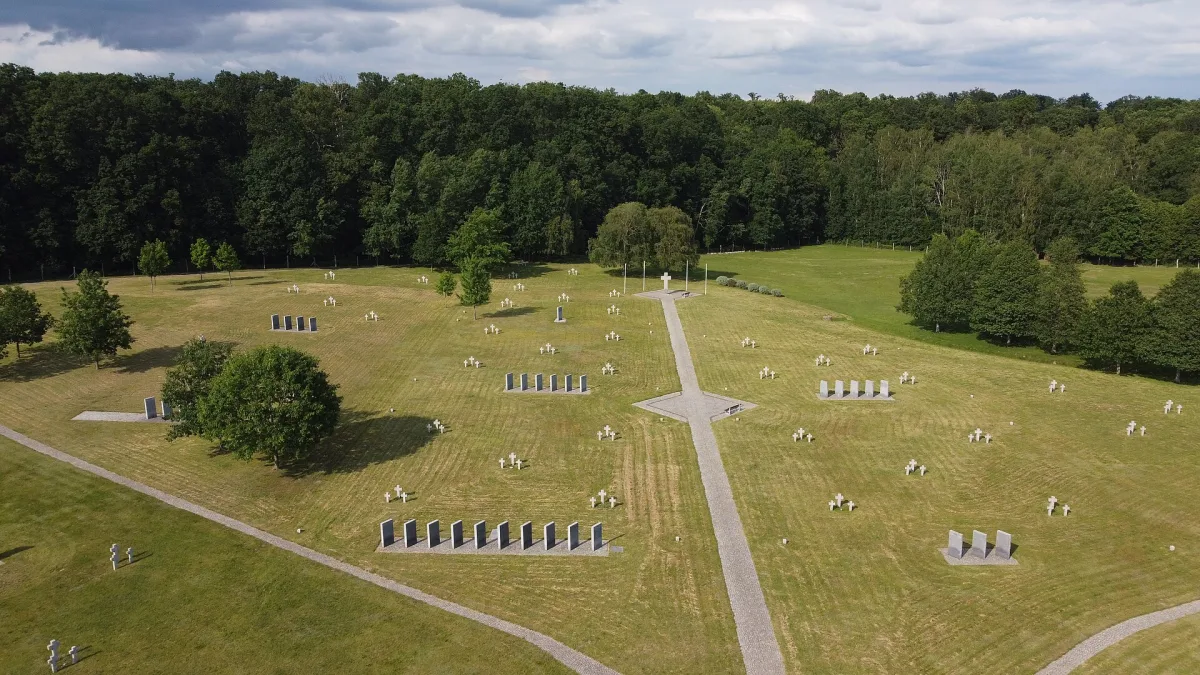
Collective war cemetery of German soldiers and civilian victims of the Second World War, run by the Volksbund.
The German War Cemetery in Glinna lies in Stare Czarnowo municipality, on the edge of the Beech Forest. It is a collective cemetery of secondary burials of German victims of the Second World War, above all soldiers killed or deceased on Polish territory. It was established by the Volksbund Deutsche Kriegsgräberfürsorge, and according to its records 30,076 people rest here. It is one of 13 war cemeteries created by this organisation in Poland since 1991.
The cemetery occupies a gently rising site of about 3.5 ha, provided free of charge by Stare Czarnowo municipality. At the entrance stands an information building with an exhibition and books containing the names of German war victims. The main avenue leads to a large wooden cross, which is the central element of the layout. On both sides of the paths lie sections of mass graves, marked with groups of three crosses and stone plates with names and dates of birth and death in alphabetical order, without military ranks or unit names. Space is provided for about 32,500 people.
In autumn 2000 Polish and German soldiers fenced the site and together put up a wooden cross. In the same year the first remains exhumed from the Central Cemetery in Szczecin were moved here. The main works took place in 2001-2003, and the ceremonial opening was held on 15 July 2006. Burials continue: in April 2019 a further 1,183 dead were buried.
In 2008 a mass grave was discovered in Malbork. Research by the Institute of National Remembrance (IPN) showed that about 2,120 people lay in it, mostly women and children, most probably German civilians who died or were killed in February and March 1945. On 14 August 2009 the remains of 2,116 people were buried in a distinct plot in Glinna. After this burial the name “German Soldiers' Cemetery” was changed to “German War Cemetery”.

Be the first! Add a comment.
You need to log in to add a comment.
Log in